

Greece Farmer Roadblocks Ease on Highways
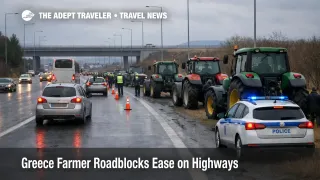
Greek farmers are beginning to ease the pressure on mainland mobility, with tractors being pulled off many motorways and several border checkpoint approaches across Greece. On January 21, 2026, reporting in Greek media described most major routes reopening after a long run of rolling closures and traffic throttling. Self drive travelers, tour buses, and anyone positioning to airports or borders should still treat road timing as unstable and build buffer, because some groups are keeping tractors staged roadside and may reimpose short closures in pockets.
The practical change is that a drive that was previously at risk of becoming a forced detour day is now more likely to be passable, but not fully predictable. Even when lanes reopen, the reopening can come with traffic management, localized congestion where machinery remains parked, and uneven conditions by region as local assemblies decide whether to stand down or keep pressure on.
Who Is Affected
Road trippers doing classic mainland loops are the most exposed, especially travelers driving north from Athens, Greece toward Delphi, Greece and Meteora, Greece, or onward to Thessaloniki, Greece on the main national corridors. Travelers heading into Epirus, Greece for Ioannina, Greece, or using the western approaches for ferry ports can also see outsized delay if a single interchange or port approach becomes the bottleneck. Cross border itineraries are still fragile because a single customs point slowdown can turn a short hop into a missed hotel check in and a last minute reroute.
Airport bound travelers remain a high risk group even if flights are operating normally. Athens International Airport Eleftherios Venizelos (ATH) is the most sensitive when the inbound transfer is a long, single segment drive from Central Greece or the Peloponnese. Thessaloniki Airport Makedonia (SKG) is most exposed for travelers arriving from Halkidiki, Greece, Thessaly, Greece, or the northern motorway network, where detours can stack quickly once traffic is diverted off the mainline.
Tours and private drivers also take a hit when the network is uneven. When a coach leaves earlier to protect arrival windows, the day can compress, and that often shows up as shorter site time at stops like Delphi and Meteora, plus knock on changes to restaurant reservations, timed entries, and evening returns to Athens or Thessaloniki.
What Travelers Should Do
Build resilience into any day that has a hard handoff. If you are driving to a flight, a ferry, a border crossing, or a timed tour meet point, treat normal navigation app ETAs as an optimistic guess until conditions are stable for several days in a row. On long drive days, the cleanest hedge is to stage overnight near the departure asset, for example in Athens ahead of an ATH departure, or in Thessaloniki ahead of a northern onward move.
Use a decision threshold instead of waiting for clarity on the road. If your route depends on a known protest node, if your ETA slips past airline bag drop cutoffs, or if a border crossing plan is time boxed by lodging, treat that as the trigger to reroute immediately, or rebook to a different day. In practice, arriving early and waiting is cheaper than arriving late and buying last minute alternatives, especially in winter when limited daylight and weather can compound detour fatigue.
Over the next 24 to 72 hours, monitor whether tractors remain parked at the roadside near key toll areas and interchanges, and whether local groups announce rally days that temporarily restore closures. If you are traveling north, keep an eye on the corridors that have repeatedly seen stoppages on the Athens to Thessaloniki axis, plus border approaches where freight restrictions can spill into general queues. For background on how these disruption patterns behaved during the escalation phase, see Highway Blockades In Greece Disrupt Road Transfers and the earlier overlap with airport access pressure in Greece Taxi Strike And Roadblocks Disrupt Airport Access.
Background
The Greece farmer roadblocks pattern matters because it creates a network effect, not a single closure. First order impacts are direct, drivers hit a choke point at a toll plaza, tunnel, interchange, or customs station, traffic police divert vehicles onto secondary roads, and the detour absorbs capacity quickly. Even when blockades ease, tractors staged on shoulders and intermittent local actions can still trigger sudden slowdowns, which is why a day can look normal at breakfast and become a time sink by mid afternoon.
Second order ripples spread across at least two other layers of the travel system. Airport operations may remain stable, but surface access becomes the critical dependency, which raises misconnect risk for travelers trying to reach ATH or SKG from outside the metro area, and forces airlines, hotels, and travelers into last minute changes when a drive consumes check in time. Tour and coach operations then reoptimize around uncertainty, pushing departures earlier, rerouting around known nodes, and compressing stops, which can degrade the value of prepaid excursions even when the traveler technically still makes the itinerary. Cross border movement adds another layer, because a freight restriction or a short full stop at a major checkpoint can back up vehicles for miles, cascade into missed arrivals, and reduce availability of same day alternatives once travelers are displaced into the same gateway towns.
Sources
- Highways open to traffic after most farmers rule to end protests | eKathimerini.com
- Road blockades ease nationwide | eKathimerini.com
- Farmers ease roadblocks ahead of meeting with Prime Minister: which roads are reopening | ProtoThema English
- Greece offers farmers cheaper fuel, damage cover in bid to end blockades | Reuters
- Farmers block highways across Greece in protest over rising costs and EU trade deal | AP News