

Milan Trenord Strike Hit Airport Trains February 2
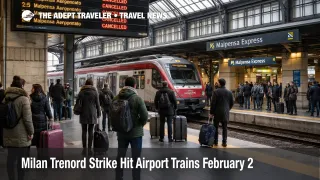
A regional labor action disrupted Trenord rail service across Lombardy, Italy, including the airport connected trains many flyers use to reach Milan Malpensa Airport (MXP). The strike window ran from 300 a.m. on February 2, 2026, to 200 a.m. on February 3, 2026, and it could affect regional, suburban, and airport routes. Travelers were most exposed outside the published guaranteed service windows, when cancellations and long gaps can turn a flight plan into a last mile ground transport failure.
The Milan Trenord strike airport trains disruption matters because it reduces the reliability of the transfer segment that has the least slack, getting from Milan rail hubs to the terminal on time. If your trip depends on an airport train at a specific time, the practical approach is to plan around the guaranteed windows, build a road backup, and leave earlier than you normally would.
Who Is Affected
Air travelers headed to Milan Malpensa are the highest risk group, especially anyone relying on Malpensa Express style airport rail links from the city. Even if some airport trains operate, many itineraries still fail upstream, a canceled commuter or regional feeder can prevent you from reaching the origin station in time to catch any operating airport departure.
Travelers connecting through Milan's main rail nodes face a second layer of risk. On a strike day, demand compresses onto fewer departures, platforms crowd, and the time cost of switching plans rises fast. That dynamic makes tight chains fragile, hotel to station, station to airport, airport to check in, and it can also create longer lines for ticketing, customer help, and replacement buses.
Road users are affected too, even if they never planned to ride the train. When airport rail capacity drops, more passengers shift to taxis, rideshares, and private transfers at the same time, which can push congestion and pricing pressure into the peak hours that already carry heavy traffic.
What Travelers Should Do
If you can still choose your departure time, anchor your airport move to the guaranteed windows, then add extra margin beyond what you would normally consider sufficient. For Milan Malpensa, that means treating the train as one option, not the plan, and having a priced, ready road backup before you leave your hotel.
Rebook or switch modes early if a miss triggers a hard penalty, such as an international flight that closes bag drop, a separate ticket connection, a cruise embarkation, or an event check in window you cannot move. Waiting can be rational only when you can absorb a multi hour slip and you already know the exact point where you will abandon the rail plan and move to a car or bus.
Over the next 24 to 72 hours after a strike window, monitor three operational signals that predict whether knock on disruption persists. First, watch whether late evening service resumes smoothly as the action ends, because uneven restarts can still strand early morning travelers. Second, check for bunching patterns at key Milan hubs, because crowding and rolling cancellations can delay recovery. Third, watch airport ground transport notices, because replacement buses, curbside congestion, and taxi availability often become the real constraint after rail capacity drops.
How It Works
Regional rail strikes in Italy often create an uneven service day rather than a complete shutdown. In this case, the public notice referenced two guaranteed service bands, 600 a.m. to 900 a.m., and 600 p.m. to 900 p.m., which are designed to preserve limited mobility during the heaviest commuter periods. In practice, those windows can become islands of relative reliability surrounded by long gaps, and the gaps drive passengers to converge on fewer departures.
Airport rail links amplify the traveler impact because the lateness penalty is higher. A missed airport train is not just an inconvenience, it can become a missed flight, and many travelers then pivot to roads at the same time. That shift turns rail cancellation into road time uncertainty, with spillover into highway congestion, longer curbside dwell times, and fare spikes when demand overwhelms supply.
The disruption also propagates across layers of the travel system beyond the rail platform. When travelers miss flights, airlines see more same day rebooking pressure, which can raise misconnect exposure and force overnight stays when remaining seats disappear. Hotels near the airport and near major stations can tighten as stranded travelers add an unplanned night, while tours, meetings, and timed venue arrivals downstream are missed because the first link in the day failed. The result is a system problem, not a single train problem, because one weak segment forces simultaneous rerouting behavior across many travelers.