

NJ Transit Manhattan Service Cuts Through March 15
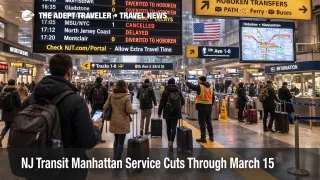
NJ TRANSIT riders heading into Manhattan are facing reduced rail capacity as the Portal Bridge cutover work shifts traffic off the aging bridge and onto the new Portal North Bridge over the Hackensack River. The weekday impact is sharpest from Tuesday, February 17, 2026, through about Sunday, March 15, 2026, with modified schedules, fewer trains into New York Penn Station, and some trains rerouted to Hoboken. Travelers with fixed time plans, including Broadway nights, meetings, cruise departures, and airport transfers, should treat the rail corridor as capacity constrained, and build a larger buffer than they would on a normal weekday.
The NJ Transit Manhattan service cuts change how reliably travelers can reach Midtown, because fewer trains can operate through the constrained segment, and recovery options are thinner when one delay starts to cascade.
Who Is Affected
The most directly affected riders are those using lines that normally funnel into New York Penn Station during weekday peaks, especially anyone who relies on Midtown Direct service. NJ TRANSIT says there is no weekday Midtown Direct service into Penn Station New York on the Morristown Line, Gladstone Branch, and the Montclair Boonton Line during the cutover, and those trains are diverted to Hoboken starting Tuesday, February 17. During the same window, the Northeast Corridor Line and the North Jersey Coast Line also run fewer weekday trains into Manhattan because trains are limited to a single track between Newark and Secaucus during parts of the work.
Travelers who are not daily commuters can still get hit hard. Day trippers coming from suburbs or New Jersey hotels can arrive later than planned, and late night returns can become more crowded as travelers bunch onto fewer departures. Anyone connecting between NJ TRANSIT and Amtrak at New York Penn Station should also assume less schedule slack, because Amtrak is running an adjusted plan during the cutover period, and the shared Northeast Corridor can propagate delays across both operators.
Airport bound travelers should be especially conservative. Newark Liberty International Airport (EWR) can be reached by rail, but a capacity constrained corridor raises the odds that a small disruption becomes a missed flight check in or bag drop cutoff. Travelers who pivot to flying out of LaGuardia Airport (LGA) or John F. Kennedy International Airport (JFK) should still plan for surface travel uncertainty inside the region, especially during peak hours, and they should not assume that ride hail will be plentiful when large volumes of riders are shifted off trains.
What Travelers Should Do
Start with immediate actions and buffers. If your trip begins in New Jersey and ends in Manhattan, lock your exact train plan to the special schedules, then add a deliberate second leg if you are being routed to Hoboken. Treat Hoboken Terminal as a transfer station during this period, not as a minor detour, and plan for platform crowding, queueing for PATH, ferry, or bus options, and longer walk times inside terminals.
Use decision thresholds for rebooking versus waiting that match your stakes. If you have a fixed arrival time, for example a Broadway curtain, an Amtrak departure, a cruise terminal boarding window, or an airport check in deadline, the threshold should be early. Move to an earlier departure as soon as you see sustained service alerts, because the corridor has less spare capacity to absorb a disruption later. If you have flexibility and multiple later trains still work, waiting can be rational, but only while you still have at least one backup departure that preserves your plan.
Over the next 24 to 72 hours, monitor the signals that predict cascade days. Watch for NJ TRANSIT alerts that mention train consolidations, cancellations, or changed stopping patterns, because those are the moments when platform crowding spikes and transfer times become less predictable. Also monitor region wide friction that can compound rail issues, including airport delay risk if you are pairing rail with a flight, and construction driven capacity constraints in the New York area. For additional New York area delay context on the air side, see LaGuardia Runway Closures Raise Delay Risk This Week and Flight Delays and Airport Impacts: February 17, 2026.
How It Works
The Portal Bridge corridor is a critical choke point on the Northeast Corridor, shared by NJ TRANSIT and Amtrak. During the Portal North Bridge track cutover, Amtrak and NJ TRANSIT need defined work windows to deactivate legacy infrastructure, activate new track alignments, integrate signaling and power systems, and complete testing. NJ TRANSIT says that during this work trains can be limited to a single track between Newark and Secaucus, which is why fewer trains can reach New York Penn Station on weekdays and why some services are shifted to Hoboken as a pressure relief valve.
The first order effect is straightforward, fewer trains into Manhattan means longer average waits, more crowding, and less tolerance for late running equipment. The second order ripple is where travelers lose time and money. When the rail spine is capacity constrained, missed connections become more common, including missed Amtrak departures at New York Penn Station, missed PATH or ferry transfers at Hoboken, and missed flight check ins when rail delays push a traveler into road congestion at the end of the journey. The ripple also hits hotels and venues. Late arrivals can push check in past desk staffing hours, and late returns can compress the evening departure bank, increasing the chance that travelers are forced into pricier last minute rideshare or an unplanned overnight.
This is why agencies are urging advance planning and, where possible, remote work during the cutover window. The system is being managed for a long term reliability gain, but in the short term it behaves like a corridor with a narrowed lane, it still moves, but it does not recover quickly when something goes wrong.
Sources
- Portal Bridge Cutover: What It Means For You (NJ TRANSIT)
- PORTAL NORTH BRIDGE ENTERS FINAL PHASE OF CONSTRUCTION AS WORK BEGINS TO PUT FIRST TRACK INTO SERVICE (NJ TRANSIT)
- Portal North Bridge Track Cutover Work (Amtrak PDF)
- Gateway Program (Amtrak New Era)
- Some NJ Transit trains rerouted to Hoboken due to Portal Bridge cutover project (ABC7 New York)