

Flight Delays and Airport Impacts: Feb 19, 2026
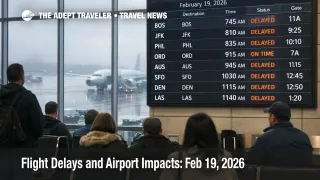
Low clouds and reduced visibility are the main constraint shaping US flight delays February 19, 2026, with the FAA flagging potential impacts that begin this morning across the Northeast and extend into Austin and ski country. Wind is the second headline risk, with San Francisco and Las Vegas called out as airports where winds could slow arrival and departure rates during key banks. The practical traveler takeaway is that this is a capacity day, not necessarily a headline incident day, where flow programs can escalate quickly once approach spacing increases and arrival rates are cut. That pattern matters because once the network loses slack, even modest delays tend to persist into evening departures.
The FAA's daily outlook specifically highlights low clouds and visibility for Boston, the New York terminal area airports, Philadelphia, Austin, and ski country, and it adds wind as a delay risk for San Francisco and Las Vegas. This combination is a classic setup where the Northeast drives the first wave of delay, and then the West Coast winds can limit late day recovery options if aircraft and crews arrive out of position. Travelers should plan around the idea that the worst disruption often shows up after midday, when banks are fuller and there is less open gate space to absorb late arrivals. This forecast is consistent with the FAA's daily air traffic report for Thursday, February 19, 2026.
Who Is Affected
Travelers transiting Boston Logan International Airport (BOS) and the New York region airports, John F. Kennedy International Airport (JFK), LaGuardia Airport (LGA), and Newark Liberty International Airport (EWR), carry the highest compounding risk because multiple airports can be constrained by the same low ceiling regime at the same time. Even if your origin has clear weather, flights into constrained terminal airspace are often held at the gate to prevent airborne holding from stacking up, which pushes delays back into the departure side of the network. Philadelphia International Airport (PHL) is part of the same corridor pattern, so itineraries that rely on short Northeast connections, especially late afternoon and evening banks, are more likely to break.
Travelers connecting through ski country should treat today as higher risk for downstream disruption even if their specific flights look fine early. When mountain region airports and airspace get constrained, aircraft rotations drift, crews time out, and later legs across the country can lose their assigned equipment, which is where cancellations tend to emerge. The FAA planning view also points to low ceilings and low visibility risk in Austin, which can become meaningful during peak arrival windows because spacing increases tend to ripple into longer taxi times and gate conflicts. If you are flying into or out of San Francisco or Las Vegas, wind is the variable that can turn a routine day into a metered day, particularly when runway configuration changes or crosswinds reduce usable arrival rates.
One nuance for Las Vegas is that some FAA pages may show a separate airport closure notice that applies to non scheduled transient general aviation operations, which is not the same thing as an airline closure. Commercial passengers should focus on airline operational status and flow initiatives, and use the FAA airport status pages to gauge whether delays are shifting from minor averages into formal programs.
What Travelers Should Do
Start with immediate actions and buffers that protect your connection and reaccommodation options. If your itinerary touches Boston, JFK, LaGuardia, Newark, or Philadelphia, pull up your inbound aircraft and watch whether it is being held at its origin, because that is often the earliest sign that your flight will not recover later. If you have a tight connection, assume taxi and gate time will run longer than usual under low ceilings, and avoid stacking separate ticket legs where one miss forces you to buy a new last minute ticket.
Use clear decision thresholds for rebooking versus waiting. If your connection is under 90 minutes through the Northeast corridor today, or you are on separate tickets, your best move is usually to switch to an earlier departure or reroute before delay programs become active and seat maps thin out. Waiting is most rational when you are protected on a single ticket and you still have multiple later same day options, but your cutoff should be the moment you are down to the last viable same day flight that still meets your real world needs without an overnight.
Over the next 24 to 72 hours, monitor whether the FAA planning risks translate into active flow initiatives during the afternoon and evening banks. Watch for wind driven slowdowns at San Francisco and Las Vegas that can compound late day recovery, and watch ski country constraints for signs of aircraft positioning drift that can affect flights far from the mountains. For continuity with the current weather pattern and system sensitivity, compare against US Flight Delays February 18, 2026 FAA Outlook, and for New York operational context that can amplify small disruptions, see LaGuardia Runway Closures Raise Delay Risk This Week.
How It Works
The FAA Air Traffic Control System Command Center manages national flow by matching demand to reduced capacity using tools like arrival rate reductions, ground delay programs, and ground stops. When low ceilings reduce how quickly aircraft can land and safely sequence on approach, traffic managers often meter arrivals by holding flights at their departure airports, which shows up to travelers as gate holds, delayed pushbacks, and missed connection windows even when the origin weather looks fine. When wind is added to the mix at large airports like San Francisco or Las Vegas, runway configuration and spacing can further cut throughput, and that matters because those airports handle dense banks where minutes quickly turn into hours once gates fill.
The propagation is where the traveler cost compounds. First order effects begin at the constrained airports, slower arrivals, longer taxi times, and gate conflicts that keep arriving flights waiting for parking. Second order effects ripple outward into connecting hubs, where misconnects surge, standby lists grow, and airlines run out of same day aircraft and crew legality to operate the full schedule. A third layer often appears by evening, when aircraft and crews are out of position, and even unconstrained airports start seeing cancellations because the inbound flight that would operate their departure never arrives. For broader system reliability context on why these "capacity days" can feel more brittle than they used to, see U.S. Air Traffic Control Privatization: Reality Check.
Sources
- FAA Daily Air Traffic Report (February 19, 2026)
- Previous Operations Plan Advisory, ATCSCC ADVZY 027 DCC 02/19/2026
- General Edward Lawrence Logan International Airport (BOS) Real time Status (FAA)
- John F. Kennedy International Airport (JFK) Real time Status (FAA)
- LaGuardia Airport (LGA) Real time Status (FAA)
- Newark Liberty International Airport (EWR) Real time Status (FAA)
- Philadelphia International Airport (PHL) Real time Status (FAA)
- San Francisco International Airport (SFO) Real time Status (FAA)
- Harry Reid International Airport (LAS) Real time Status (FAA)