

Northeast Bomb Cyclone Flight Cancellations Feb 23
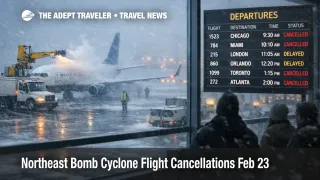
A rapidly intensifying Northeast winter storm, widely described as a bomb cyclone, is forcing airlines to cut schedules hard across the U.S. Northeast on February 23, 2026. The heaviest disruption is concentrated at John F. Kennedy International Airport (JFK), LaGuardia Airport (LGA), Newark Liberty International Airport (EWR), Boston Logan International Airport (BOS), and Philadelphia International Airport (PHL), where blizzard conditions, high winds, and low visibility are reducing arrival rates and making ground handling, deicing, and snow removal the binding constraints. If your itinerary touches any of these hubs, the practical move is to assume cancellations first, then treat any remaining flights as fragile until the system regains reliable arrival capacity.
The Northeast bomb cyclone flight cancellations problem is that multiple major hubs sit inside the same weather regime and the same tightly coupled airspace, so you do not get the usual escape hatch of a nearby alternate airport. When the New York complex and the Philadelphia corridor degrade together, airlines protect what they can by pre canceling large blocks of flights, then try to restart with smaller recovery banks once runway conditions and visibility stabilize.
Who Is Affected
Travelers beginning trips in New York, New York, Newark, New Jersey, Boston, Massachusetts, and Philadelphia, Pennsylvania are affected first, because the storm reduces the number of departures that can physically operate and because airport access can be constrained by local road restrictions. If you are planning to drive to an airport, assume longer travel times, limited curbside operations, and the risk that ground transportation availability collapses when conditions are declared unsafe.
Connecting passengers are the second group that gets hit harder than they expect. JFK, LaGuardia, and Newark share airspace constraints and traffic management programs, so a delay or cancellation at one airport often spills into the others, and that can break tight connections to Florida, the Caribbean, and transatlantic flights. BOS and PHL feed into the same broader Northeast flow picture, so misconnect risk rises even when your origin weather looks acceptable, because the aircraft and crew you need may never arrive from a disrupted prior leg.
The third group is travelers with time bound onward plans. Cruise embarkation windows, last train departures, and prepaid tours do not wait for airline recovery. If you are trying to reach a ship, a wedding, a conference, or a one night hotel stay that cannot slide, this is not a "wait and see" day. This is a "move the trip, or change the routing" day.
What Travelers Should Do
Start with immediate actions that preserve options. Open your airline app, check your flight status, then check the inbound aircraft and its prior legs, because the earliest warning is often that your plane never leaves its previous station. If you are not yet at the airport and you see a cancellation wave building at JFK, LaGuardia, Newark, Boston Logan, or Philadelphia, do not commute into the problem, rebook first, then decide whether to travel.
Use a clean decision threshold for rebooking versus waiting. Rebook if your itinerary includes a connection under about two hours through the New York complex or Philadelphia, if you are on separate tickets, or if you are on a last flight of the day that has no realistic same day backup. Waiting only makes sense when you are protected on one ticket and you can see multiple later options that still meet your real constraint, including hotel check in cutoffs, cruise boarding deadlines, or last onward ground departures.
Over the next 24 to 72 hours, monitor the signals that actually move outcomes, not social media noise. Watch FAA NAS status and command center advisories for ground stop or delay program language at BOS, the New York airports, and PHL, because that is the closest public view into how quickly arrival rates can recover. Watch your carrier's waiver terms and inventory, because waivers are only useful while seats exist. Watch whether cancellations persist into the next schedule day, because that is how you spot aircraft and crew mispositioning that can extend disruption well beyond the storm peak. For closely related context on how this type of event propagated before the Monday peak, see Northeast Blizzard Grounds NYC, Philly Flights Feb 22 and Flight Delays and Airport Impacts: Feb 22. For structural context on why the region is brittle under stress even before weather arrives, see U.S. Air Traffic Control Privatization: Reality Check.
How It Works
A bomb cyclone label is media shorthand for a rapidly intensifying low pressure system, but the travel mechanism is simple. As winds rise and visibility drops, aircraft must be spaced farther apart on arrival and departure, which reduces how many flights per hour can safely operate. At the same time, snow removal and deicing cycles consume runway and taxiway availability and slow turn times at gates, so the airport's practical capacity falls from both the airside and the ground side.
Once capacity drops, the network cascade begins. The first order effect is airlines canceling flights to match a reduced arrival rate, which protects some of the remaining schedule but strands travelers and compresses the flights that still operate. The second order effect is mispositioning, aircraft end up at the wrong airport, crews time out, and a storm day becomes a recovery week problem because the system is trying to rebuild a coherent rotation pattern with fewer available planes and crews. The third layer is traveler substitution, passengers shift to rail, buses, or rental cars to bypass airports, which tightens hotel inventory near hubs and increases the odds of missed onward departures when rail operators also adjust service for safety.
Sources
- FAA Daily Air Traffic Report
- National Airspace System Status (FAA)
- Current Operations Plan Advisory (FAA ATCSCC)
- East Coast Winter Weather, Bulletin 1 (Delta Pro)
- Travel alerts, Severe weather, Northeast U.S. (American Airlines)
- Powerful winter storm shuts schools, disrupts travel across US Northeast (Reuters)
- February 22-23 Winter Storm, Briefing #8 (NWS Philadelphia, Mount Holly)
- Northeast rail operations prepare for blizzard (Trains.com)