

Northeast Rail Recovery: Near Normal, Misconnect Risk
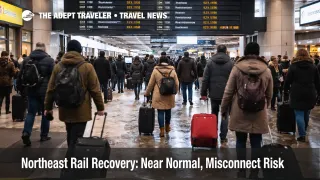
Amtrak and several major Northeast transit systems are largely back to normal operations as of Wednesday, February 25, 2026, after blizzard driven disruption earlier in the week. The traveler decision shift today is that most corridor itineraries are viable again, but "near normal" still carries risk, because equipment rotations, residual infrastructure impacts, and consolidated loads can create late departures, tight connections, and crowded platforms. The practical move for travelers is to treat rail and airport access as operational again, but not fully predictable, and to add buffer time anywhere a missed train breaks the day.
What is new versus the last 48 hours is that the region is transitioning from broad suspensions into a restart phase where most lines run, yet some segments still operate on modified schedules or with localized cancellations. That restart phase is where misconnects tend to spike, because yesterday's cancellations compress into today's demand, and because the fleet and crew positioning that makes an on paper timetable work can take an extra day to normalize.
Northeast Corridor Rail Recovery: What Changed for Feb 25
For most travelers, "near normal" means you can plan to ride, but you should still expect variability by corridor segment, time of day, and operator. NJ TRANSIT, for example, is running its Northeast Corridor Line on a Portal cutover weekday schedule on February 25, which is not a storm schedule, but it is also not the standard pattern for all riders, and it can change transfer behavior into New York Penn Station.
In the Philadelphia region, SEPTA reported that the majority of service returned to normal operations by the morning of February 24, with riders directed to line level alerts for remaining exceptions, which is the right read for February 25 as well: treat the system as operating, but confirm your specific line before you commit to tight timing.
In New York, the Metropolitan Transportation Authority's storm guidance makes clear that some services may still see local running in place of express patterns, plus knock on effects for bus frequency and reliability. That matters for airport bound travelers who use local transit as the first leg of a rail to air chain, because the trip can be "running" while still taking meaningfully longer than normal.
In New England, Boston area rail is broadly resuming, but not necessarily uniformly, and at least one commuter rail segment is operating on a modified weekday schedule, which is a reminder that "weekday service" can still mean "not your usual train." In Connecticut, CTrail Shore Line East and the Hartford Line both published restart notices that resumed service mid morning on February 24 due to residual impacts and cleanup, which is exactly the kind of lag that can linger into the next day for travelers trying to stitch together timed connections.
Which Travelers Still Face the Highest Misconnect Risk
The highest risk itineraries today are not the simple A to B trips. They are the trips where one late train cascades into a missed flight, a missed cruise embarkation window, or a hard start event where late arrival is effectively failure.
Air travelers are the obvious exposure set. If your rail plan is how you reach Boston Logan International Airport (BOS), John F. Kennedy International Airport (JFK), LaGuardia Airport (LGA), Newark Liberty International Airport (EWR), or Philadelphia International Airport (PHL), the key risk is not just train delay, it is transfer variability at the last mile. When regional transit is restarting unevenly, the airport connector leg can be the weakest link even if the airport itself is operating. This was visible earlier in the storm window when transit, not the runway, became the failure point for reaching terminals, and that logic still applies during the restart.
Travelers who pivoted from air to rail earlier in the week should also assume higher load factors today, because demand does not disappear, it stacks. When cancellations compress ridership into fewer trainsets, operators can consolidate equipment, and stations can feel crowded even if the timetable looks normal. That crowding increases dwell times at platforms and gates, and it increases the odds that a small operational slip becomes a missed connection.
If you are traveling for a cruise, a wedding, a major convention session, or a ticketed event, the risk profile is simple: you have a hard deadline, and you do not want your plan to depend on a single on time performance assumption. Those travelers should behave like the system is in recovery mode even if the apps show green.
What Travelers Should Do Now, Buffers and Decision Thresholds
If your trip is rail only, the main decision is whether you can tolerate a late arrival. If you can, confirm your operator status, pick an earlier departure than you normally would, and move on. If you cannot, because you are catching a flight, a ship, or a timed event, the correct play is to buy time, not optimism, by adding buffer at every transfer.
For same day flights, the decision threshold is whether you can preserve at least a two hour cushion between your scheduled rail arrival and your non negotiable airport deadline, like bag drop, security, or boarding. If you cannot, rebook the flight, shift the rail departure earlier, or add an overnight near the airport, because the restart phase is when small delays are most likely to stack into missed check in windows.
For cruises, do not plan to arrive day of sailing if your only viable routing depends on multiple rail legs or a late afternoon arrival. If you are already committed, shift to the earliest feasible trains, book a backup ground transfer option, and assume the last mile will be slower than normal. For events, treat "doors time" as a hard stop, not "show time," and pad accordingly.
What to monitor over the next 24 to 72 hours is not the storm headline, it is operational normalization signals. Watch for operators explicitly removing modified schedules, watch for fewer line specific cancellations driven by equipment availability, and watch for recovery phase congestion at hubs like New York Penn Station and Boston South Station that can slow platform moves even when trains are running.
Why "Near Normal" Still Breaks Some Itineraries
The mechanism is straightforward. A blizzard disrupts equipment cycles, crew positioning, and infrastructure readiness. Even after track clearance and power checks, operators still have to rotate trainsets back into their planned assignments, restore peak level frequency, and unwind the demand spike created by prior cancellations. That mismatch is why you can see a system described as essentially normal while still seeing localized cancellations, modified patterns, and crowding.
The second order effect matters for travelers who are mixing modes. During a major storm, many travelers shift from air to rail or postpone travel entirely. During recovery, those choices come home to roost, because airlines are rebuilding schedules, travelers are rebooking into narrower windows, and ground access systems are trying to absorb a surge at the same time. That is how a rail restart can indirectly stress airport rail links and terminal access, even as airlines try to rebuild. It is also why the restart phase can create the perception that everything is open again, while the true constraint is throughput, not existence.
For travelers making today's decisions, the takeaway is not that rail is unsafe or unreliable, it is that restart days are different days. Most trips will work. The trips most likely to fail are the tight ones, the multi transfer ones, and the ones with hard deadlines. Plan accordingly, and you will mostly avoid becoming the person stuck waiting for the next viable connection.
Sources
- Northeast rail operations almost completely restored after storm
- Travel Alerts and Advisories, NJ TRANSIT
- Winter Storm Updates, SEPTA
- Winter storm service changes: February 22 to 25, 2026, MTA
- Winter Storm Update: Shore Line East Service Resumes Mid Morning Tuesday, February 24
- Winter Storm Update: Hartford Line Service Resumes Mid Morning Tuesday, February 24
- Paralyzing blizzard hits US Northeast, closing roads and canceling flights
- Northeast Storm Recovery Keeps Feb 24 Cancellations
- NYC Transit Shutdown Blocks JFK, LGA, EWR Access