

Middle East Airspace Closures Snarl Gulf Hub Flights
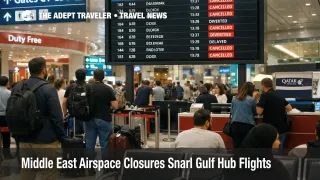
Middle East airspace closures hit global itineraries on February 28, 2026, after U.S. and Israeli strikes on Iran, and Iranian retaliation, triggered a rapid tightening of civilian aviation routes across Iran, Iraq, Israel, and parts of the Gulf. For travelers, the immediate consequence is that routings built around Gulf connections stopped behaving like a reliable shortcut between Europe, Asia, and Africa, and started behaving like an irregular operations day where the safest path is often the simplest path.
Multiple states imposed closures or restrictions that caused wide swaths of traffic to vacate the region's normal corridors, and several airlines suspended services rather than accept uncertain overflight and diversion risk. Reports and live aviation tracking indicated closures affecting Iran and Israel, with knock on impacts as nearby airspaces, including Iraq, and several Gulf states, tightened or closed, and airports in key hub cities saw cancellations and operational pauses.
This is a system wide connectivity shock, not a single route disruption. If a traveler's itinerary depends on connecting in Dubai, United Arab Emirates, or Doha, Qatar, the decision problem becomes: is the operating carrier still flying, and if not, how quickly can the ticket be reissued onto a viable corridor that avoids closed airspace.
Which Itineraries Are Most at Risk
The highest risk group is travelers mid journey who are already inside a Gulf hub connection bank, especially those arriving on one long haul segment and counting on a short onward leg to clear the same calendar day. When airspace restrictions force cancellations and diversions, the rebooking queue quickly becomes a capacity problem, and the traveler who misses a single bank can be pushed into an overnight, or longer, depending on how widely carriers have paused flying.
Travelers on separate tickets are the most fragile case. If the long haul into the Gulf was ticketed separately from the onward leg, a cancellation can break the chain without automatic protection, even if both flights were marketed by the same brand family via codeshare. This is the scenario where a traveler can end up paying twice, once for the original segment that operated, and again for a last minute replacement onward flight that the original carrier will not cover.
Europe to Asia itineraries are particularly exposed because many routings normally cross, or sit adjacent to, the airspaces now constrained, and detours add time, fuel, and sometimes a technical stop. That combination raises the odds of missed onward connections at the far end, even when the first flight still operates. It also increases the chance that a flight that would normally be legal under crew duty rules becomes illegal after a long detour, which can force an unplanned intermediate stop and a crew swap that is hard to execute during a fast moving security event.
Cruise and tour itineraries across the region are an under discussed exposure. If a guest is flying into a cruise embarkation, a liveaboard dive departure, or a timed tour start, a single overnight misconnect can cascade into missed sailings, forfeited excursions, and hotel churn at the destination, particularly when the trip was built around a tight arrival window.
What Travelers Should Do Now
Start by separating your problem into two questions: whether your operating carrier is still flying your route, and whether the ticket issuer can change the ticket quickly. Check the operating carrier, not only the marketing carrier, because codeshares can hide the reality that the aircraft and crew are controlled by a different airline with different suspension decisions. If you booked through an online travel agency, assume reissue speed may be slower than dealing directly with the airline, and move earlier rather than later if your connection chain is already broken.
Use a simple decision threshold. Rebook now if you are already canceled, if you have a hard arrival deadline in the next 48 hours, if you are on separate tickets, or if your itinerary depends on a single Gulf hub connection with no same day backup. Wait only if your flight is still operating, you can tolerate an overnight, and you have enough flexibility that a longer reroute, or a date shift, will not break the purpose of the trip. In fast moving airspace events, waiting for perfect clarity often costs seat availability.
If you are stranded in transit, treat hotels and entry formalities as part of the plan, not an afterthought. Ask the airline what it will provide for overnight accommodation when disruptions are security driven, then make your own backup reservation if inventory is tightening around the hub. Separately, verify whether you can legally enter the country you are transiting, because some travelers cannot clear immigration without a visa, even if they can normally transit airside. If your reroute shifts you to an unexpected overnight in Amman, Jordan, use the verified guide Jordan Entry Requirements For Tourists In 2026 as a starting point for document planning, then confirm against your government's current advisory for your passport.
Finally, keep your plan tight for the next 24 to 72 hours. Monitor your reservation at three checkpoints: before leaving for the airport, at online check in, and again at the gate, because airspace openings and closures can cause rolling cancellations, and because long detours can propagate delays into the following day. If you have Middle East segments in early March, this is also the moment to proactively revisit corridor risk, including routes already flagged as fragile in the region, such as Qatar Cuts Iran Flights, Limited Tehran Service to June 30 and KLM Suspends Amsterdam Tel Aviv Flights From March 2026.
Why Gulf Hub Disruption Cascades Globally
This disruption spreads because the Gulf hubs are not just endpoints, they are routing machines that compress long haul travel into banked connections. When a large airspace block appears, airlines either cancel, or they detour around the closed region, and that detour pushes flight times beyond what the banked connection system was built to absorb. The first order effect is straightforward, cancellations, diversions, and missed connections at hubs.
The second order effect is global network displacement. Aircraft and crews end up in the wrong place, at the wrong time, and sometimes in an airport that was never planned as a recovery base for that carrier. That mismatch then forces knock on cancellations tomorrow, even for flights that never go near the Middle East, because a long haul widebody that was meant to fly a Europe to Asia segment might be stuck on an unexpected detour, or parked away from its planned maintenance and crew rotation.
A separate mechanism is capacity squeeze. When multiple carriers avoid the same corridors, the remaining viable routes become crowded, and the airline that is still operating may have fewer available slots, fewer alternates, and less flexibility to add recovery sections. That is why travelers see sudden overnight misconnects and poor reaccommodation outcomes, even when the initial cancellation looks like a single flight problem. In this type of event, the winning traveler behavior is to choose routings with slack, reduce the number of connections, and avoid relying on a single hub bank to make the whole trip work.
Sources
- Airlines suspend Middle East flights after US, Israel strikes on Iran
- Attack on Iran disrupts flights across the Middle East and beyond
- Israel launches "pre-emptive" strikes on Iran, airspace closures going into place
- UK urges citizens in Gulf states to shelter after missile attacks
- Russia suspends flights to Iran and Israel