

UAE Airport Recovery Delays Dubai, Abu Dhabi March 1
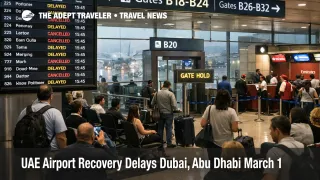
UAE airport recovery delays became the practical story on March 1, 2026, because restarting flights does not immediately restore hub throughput at Dubai International Airport (DXB) and Zayed International Airport (AUH). Even where carriers begin limited service, recovery constraints, including aircraft and crew displacement, gate availability, and terminal processing, can turn "operational" into stop start schedules that do not resemble the timetable you booked. Emirates, for example, posted that it suspended operations to and from Dubai until 3:00 p.m. local time on March 2, 2026, and warned of short notice changes.
UAE Airport Recovery Delays: What Changed for March 1
The shift since the initial shutdown phase is that disruption is now driven by recovery limits as much as by the airspace picture. Dubai and Abu Dhabi have both reported damage linked to intercepted drones and debris, which adds an infrastructure and safety overlay on top of flight planning. Meanwhile, airlines are publishing rolling suspensions and restart windows that can change within hours, which means a flight showing as "scheduled" in an app can still be vulnerable to late cancellations, gate holds, or an aircraft swap that breaks tight connections.
Which Trips Are Most Likely to Break First
The highest risk group is connecting passengers whose itineraries depend on same day onward banks through Dubai or Abu Dhabi, especially when the next leg is on a separate ticket, or on a different operating carrier. In a recovery phase, hubs often prioritize clearing parked aircraft, reuniting crews with rotations, and rebuilding gate flow, and those priorities do not always align with preserving the shortest legal connection times for travelers. If your itinerary involves a short connection, checked bags, or a terminal change, your true risk is not only the inbound delay, it is the cascading effects of a missed bank when reaccommodation seats are scarce.
Travelers who were meant to connect onward to Europe and South Asia are particularly exposed because those networks rely on tightly timed wave schedules. When a hub pauses, even briefly, it mispositions widebody aircraft and pushes crews toward duty time limits, so cancellations can persist after partial reopening even if the airspace map looks improved.
What Travelers Should Do Now
Do not travel to the airport based only on the printed departure time. Treat "operational" as "operational with constraints" until you see your flight moving through check in and boarding steps, and you have a verified gate assignment that is holding. Emirates is explicitly flagging that changes may occur at short notice during the suspension window, which is a signal that re timings and cancellations can remain fluid even as service restarts.
Set a decision threshold before you are inside the churn. Rebook earlier if your trip cannot tolerate an overnight, or if missing the connection would cascade into a missed cruise embarkation, a protected tour start, or a hard business arrival. Wait only if you have flexibility to slide by a day or more and you can absorb a forced hotel night without turning a disruption into a budget problem. If you are holding an Etihad ticket, use the carrier's flight status tools and waiver guidance to decide whether to shift dates or request a refund, rather than guessing based on social media reports.
Over the next 24 to 72 hours, monitor three items that actually move outcomes. First, the airline's posted suspension or restart window for your specific flight number, not the airport's general status. Second, whether your inbound aircraft is physically arriving, because out of position aircraft are a common late stage failure point during recovery. Third, whether your connection is on one ticket with a single operating carrier, because that determines whether misconnect protection is automatic or becomes a self managed rebook.
What "Operational" Means During a Hub Recovery Phase
In a hub event, "operational" can mean the airport is accepting some movements while still operating below normal capacity, or with constrained parts of the system. Airspace restrictions and security measures can limit arrival banks, while on the ground, even minor infrastructure damage can reduce usable gates, force remote stands, or slow baggage and passenger flows. When that happens, airlines may choose to cancel late rather than accept a schedule that strands aircraft at a gate with no departure slot, or strands inbound passengers without a viable onward bank.
This is why recovery often looks like waves of delays, then bursts of cancellations, rather than a clean return to normal. The first order effect is visible at the airport as gate holds and missed connections. The second order effect is global, because widebody fleets and long haul crews rotate across continents, so a disruption in Dubai or Abu Dhabi can propagate into the next day's departures in Europe, South Asia, and Southeast Asia as aircraft arrive late or crews time out.
Sources
- Travel Updates, Emirates Help
- US Iran conflict disrupts thousands of flights as travel chaos deepens, Reuters
- Abu Dhabi complex housing embassies damaged as retaliatory strikes widen in Gulf, Reuters
- Check EY flight status online, Etihad Airways
- Israel Iran conflict, 19,000 flights delayed as Middle East aviation comes to a standstill, Euronews