

Middle East Airport Strikes Strand Gulf Hub Travelers
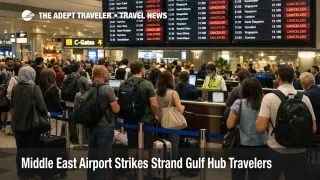
Iranian strikes aimed at major Gulf aviation nodes have pushed parts of the region into a stop, then uneven restart pattern, stranding large numbers of travelers and breaking connecting itineraries that normally flow through the Gulf's hub airports. In the last several days, the disruption has included attacks and intercept debris incidents affecting airport operations in the United Arab Emirates, Qatar, Kuwait, and Bahrain, alongside wider airspace restrictions across multiple Middle East states.
For travelers, the practical change is that the Gulf is no longer behaving like a reliable transfer bridge between Europe, Asia, and Africa, and the knock on effects now reach well beyond the Middle East. When a hub flight bank collapses, a traveler can be "on time" for their first flight and still lose the rest of the trip because their onward flight cancels, their aircraft never arrives, or their crew times out after reroutes.
The U.S. State Department has told Americans in more than a dozen countries to "DEPART NOW" using available commercial options, and has emphasized STEP enrollment and emergency contact channels rather than announcing a broad U.S. run evacuation flight program.
Which Travelers Face the Highest Risk Right Now
Connecting passengers are the most exposed group, especially anyone whose itinerary transits Dubai, United Arab Emirates, Abu Dhabi, United Arab Emirates, or Doha, Qatar, even if their origin and destination are in Europe, Asia, or Africa. The Associated Press estimated at least 90,000 people change flights daily through Dubai, Doha, or Abu Dhabi on Emirates, Qatar Airways, and Etihad alone, which is why even a partial shutdown can strand travelers at scale and overwhelm rebooking capacity quickly.
Travelers currently in, or transiting through, Dubai International Airport (DXB), Zayed International Airport (AUH), and Hamad International Airport (DOH) should expect limited, shifting schedules, and uneven "special flight" patterns designed to clear backlogs, rather than restore normal networks. On the edges of the hub system, Kuwait International Airport (KWI) and Bahrain International Airport (BAH) have also been tied to the disruption window, which matters because those airports have fewer alternative nonstop options for onward travel when banks collapse.
Non Middle East travelers can still get hit through aircraft and crew mispositioning. A widebody that was supposed to run Europe to Gulf to Asia can get stuck, diverted, or delayed, then a later Europe to North America segment cancels simply because the aircraft and legal crew are not where the schedule assumed they would be. That is why this event is producing cancellations and tight capacity in Europe and the Americas even on routes that never approach closed airspace.
What Travelers Should Do Now, Decision Thresholds That Matter
Travelers with Gulf hub connections in the next 72 hours should treat rerouting as the default resilience move, not a last resort. If the trip has a hard start, for example a cruise embarkation, a wedding, timed entry tickets, or a fixed work commitment, rebook now onto routings that avoid Gulf hubs entirely, even if elapsed travel time is longer, because reliability beats speed while schedules remain unstable.
Waiting can make sense only if three conditions are true at the same time. First, your operating carrier has confirmed your specific flight is operating, not just that the airport is "open." Second, you can absorb an overnight without breaking the trip's purpose. Third, you are on a protected single ticket, or you are willing to eat the cost of a misconnect on separate tickets. If any one of those is false, waiting tends to increase cost because rebooking inventory gets consumed by stranded passenger backlogs.
If you are already in the region and trying to leave, follow government channels that can actually message you directly. The U.S. Department of State is pushing travelers to enroll in the Smart Traveler Enrollment Program (STEP) for alerts, and it has published emergency contact numbers for consular support. UK travelers should monitor Foreign Office updates and airline communications closely, as Britain has been publicly discussing evacuation support, and has reported very large registration volumes from stranded nationals.
Why This Disruption Spreads Beyond the Middle East
Airline networks run on tight sequencing. Aircraft, crews, maintenance windows, and gate plans are scheduled as linked chains, and hub airports exist to concentrate those chains into "banks" of arrivals and departures that make connections possible in short windows. When airspace closes or airports stop functioning, airlines either cancel or reroute, which adds flight time, breaks connection windows, and pushes crews into duty time limits that cannot be waived safely. The first order effect is obvious, cancellations, diversions, and stranded passengers at the affected airports.
The second order effect is what travelers outside the region feel. Once aircraft and crews are out of position, the next day's schedule can unravel in places far away, because recovery flights are used to rebuild the network, not to serve normal demand, and because there are fewer spare aircraft and reserve crews available to "heal" the schedule overnight. That is why disruptions tied to Gulf hubs can show up as cancellations in Europe and the Americas, even while those airports remain fully safe and open.
Finally, government guidance is shaping traveler behavior in ways that intensify the rebooking surge. The U.S. "depart now" message pushes more people to try to move immediately, using whatever limited commercial capacity exists. The UK has similarly advised citizens to leave, while also discussing evacuation support for some travelers, and that combination tends to front load demand into a constrained operating window. As a result, even when limited flights restart, the system can stay congested because the backlog is larger than the daily seat supply available to clear it.
Sources
- State Department urges Americans in region to "DEPART NOW"
- Attack on Iran closes Middle East airports and strands travelers
- Iran Is Shooting at Some of the World's Busiest Airports
- Resources and Support for U.S. Citizens Overseas
- STEP, Smart Traveler Enrollment Program
- UK sending rapid teams to help citizens leave Middle East
- UK working with airlines to boost Oman evacuations