

Dubai Restart, Emirates Runs 100 Plus Flights March 5 6
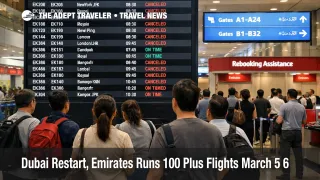
Dubai International Airport (DXB) is moving again, but the restart is still a controlled, limited operation rather than a normal schedule. Emirates says it will operate more than 100 flights to and from Dubai across March 5, 2026, and March 6, 2026, and it is reinforcing a hard rule that passengers should not travel to the airport without a confirmed booking, and that transit passengers will only be accepted if their onward connection is operating. The practical update versus earlier Dubai coverage is that Emirates has now published a destination list for the two day window, which turns "limited departures" into a checkable plan travelers can validate flight by flight.
The nut graf is simple. Emirates Dubai restart flights are real, and bookable, but they are still a partial network, so the main traveler risk is not just cancellation, it is showing up for a flight that is not operating, or building an itinerary that depends on a fragile connection bank that cannot recover if something slips.
Emirates Dubai Restart Flights: What Changed for March 5 and 6
Emirates' latest operational advisory says flights are running "until further notice" under reduced schedules, and it points travelers to a live destination list for services operating on March 5, 2026, and March 6, 2026. Emirates and state media both frame the same core point, over 100 flights will depart from Dubai and return over the two day window, moving passengers as well as time sensitive cargo such as perishables and pharmaceuticals.
The destination list matters because it clarifies what "restart" means in practice. For March 5 and 6, Emirates shows operating service to major European gateways including Paris (CDG), Amsterdam (AMS), London Heathrow (LHR), Frankfurt (FRA), Rome (FCO), and Zurich (ZRH), to North America including Chicago O'Hare International Airport (ORD), John F. Kennedy International Airport (JFK), Toronto Pearson International Airport (YYZ), and San Francisco International Airport (SFO), and to a broad set of Asia Pacific and South Asia markets including Sydney (SYD), Singapore (SIN), Bangkok (BKK), Delhi (DEL), Mumbai (BOM), and Colombo (CMB). Emirates also flags a few routing specifics inside the list, including Newark (EWR) operating via Athens (ATH), and Christchurch (CHC) operating via Sydney.
Which Itineraries Are Most Likely to Break in Dubai
This restart favors travelers whose entire trip is on a single confirmed Emirates booking to one of the operating destinations, or who can accept a longer wait in Dubai for the next operating flight. The risk climbs fast for anyone relying on a tight connection in Dubai, anyone mixing tickets across airlines, and anyone whose itinerary depends on same day reaccommodation options if their planned flight does not operate.
Emirates is being explicit about two gatekeeping rules that shape who actually gets moved. First, "do not go to the airport unless you hold a confirmed booking" for an operating flight, which is a warning against self deploying into DXB hoping to sort it out at the counter. Second, transit customers are only accepted if the connecting flight is operating, which means even travelers who can physically get to Dubai may not be allowed to start travel if the onward segment is not running.
Second order effects are where the restart still bites. Partial schedules concentrate demand into fewer departures, which increases missed connection odds, increases mishandled baggage risk during irregular transfers, and pushes more travelers into unscheduled hotel nights in Dubai, or into repositioning attempts via other hubs, if they are trying to escape a stranded situation.
What Travelers Should Do Now if They Are Routed Through Dubai
Start with verification, not hope. Use Emirates' flight status tools and the airline's published destination list for March 5 and 6, 2026, then confirm your booking is ticketed and active before you move toward the airport. If you are transiting Dubai, treat your itinerary as valid only if both your inbound and onward flight numbers show as operating, because the airline is warning that transit acceptance depends on the onward sector actually running.
Choose between waiting and repositioning based on a simple threshold: if your trip has a hard deadline in the next 24 to 48 hours, and your destination is not on the operating list, repositioning to another departure point becomes rational, even if it costs more. If you can tolerate a delay of several days, and your destination is on the published list, waiting for a confirmed seat on a single ticket is usually safer than self building a multi ticket escape plan that can strand you again mid route.
For the next decision window, monitor two signals. First, whether Emirates expands the destination list beyond March 6, 2026, because that is the clearest indicator of schedule normalization for bookable commercial travel. Second, watch for signs that overall Dubai movement rates are rising, because even when departures resume, the system can stay fragile if airspace availability and safe corridor capacity remain constrained.
Why the Restart Still Feels Constrained
The mechanism is constraint stacking. Even when an airport resumes movements, the surrounding airspace, routing corridors, and airline operational requirements still determine how many flights can safely operate, and which city pairs make sense. That is why the restart shows up as a published short window schedule rather than a full timetable, and why Emirates is emphasizing gradual rebuild language tied to airspace availability and operational requirements.
External reporting underscores the same operational picture. Reuters describes Dubai as restarting but still far below normal levels, and notes that Emirates and Etihad are operating limited services through safe air corridors rather than full network operations. In other words, the restart is best understood as a controlled clearing operation, it moves real passengers, but it does not restore normal flexibility, which is why misconnect risk and recovery options remain unusually poor even when you see flights operating.
Sources
- Travel Updates, Limited Operations Due to Airspace Closures, Emirates
- Flights Operated to and from Dubai on March 5 and 6, 2026, Emirates PDF
- Emirates to Operate 100 Flights to Depart From, Return to Dubai on March 5 6, Emirates News Agency
- Oil Spike Hits Airlines as Iran Conflict Disrupts Flights and Forces Re Routing, Reuters
- Dubai Airport Limited Departures Resume March 5, 2026, Adept Traveler