

UAE Shelter In Place Rules Reshape Exit Planning
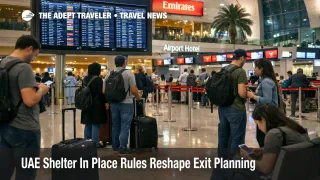
The UAE is no longer just a generic caution story. The U.K. Foreign, Commonwealth & Development Office, or FCDO, updated its United Arab Emirates advice on March 6, 2026, to add explicit shelter in place language, limit movement to essential journeys, tell travelers to prefer daylight movement when unavoidable, avoid crowded venues, and consider departure through limited air options in the UAE or from Oman if their presence is not essential. That changes the traveler problem inside the country itself, because the question is no longer only how to leave, but whether moving around Dubai, Abu Dhabi, or another emirate is worth the risk before you even start the exit attempt. This is a meaningful shift from Adept's earlier UAE border fallback coverage because the new advisory is behavior shaping, not just route shaping. The FCDO also says travel within or out of the UAE is at your own risk, warns that travel insurance could be invalidated if you travel against advice, and tells travelers to keep departure plans and onward visas under review. For people already in the country, the main decision is now whether to shelter in place, move only for a confirmed departure chain, or reposition toward Oman only if the full border, hotel, and onward ticket plan is already secured.
## UAE Shelter In Place Rules: What Changed What changed on March 6 is precision. The FCDO page, still current on March 7, says the latest update added sheltering in place information, and the live text now tells travelers to seek the nearest safe building if an attack occurs or an official UAE warning is issued, with added advice to use an interior stairwell or room with as few external walls or windows as possible. It also tells travelers to stay away from security and military facilities, which matters in cities where ordinary visitor movement can otherwise drift close to high value sites without much thought. The practical result is that movement inside the UAE now needs a harder threshold. A speculative airport run, a casual hotel change, or a wait and see transfer across town makes less sense when the advisory itself says to limit movement to essential journeys only. That does not mean travelers should never move. It means the burden of proof has changed, and the move should usually be tied to a confirmed flight, a protected transfer, or a clearly better staging point with less same day uncertainty. ## Which Travelers Face the Hardest Choice Travelers already holding confirmed departures from Dubai or Abu Dhabi are in the strongest position, but even they should treat airport movement as a controlled operation, not a hopeful gamble. Emirates said on March 7 that it had resumed operations, but only passengers with confirmed bookings for that afternoon should proceed to the airport, including transit passengers whose onward flight is also confirmed. Etihad's position is similarly restrictive, saying passengers should not travel to the airport unless they were contacted directly or hold a confirmed booking on one of the new flights in its limited schedule. The harder choice falls on three groups. First are travelers without a confirmed seat, because the new advisory makes speculative movement less defensible while scarce inventory remains unstable. Second are travelers on split tickets, where one segment may be back on sale but the onward leg, hotel timing, or visa chain is still fragile. Third are travelers considering an Oman overland exit, because that route can still work, but it only improves the situation if border access, legal entry, and onward air inventory line up cleanly. Adept's earlier reporting on [UAE Oman Border Crossings Offer Overland Exit](https://adept.travel/news/2026-03-06-uae-oman-border-crossings-overland-exit) and [Etihad Abu Dhabi Flights Resume on Limited Routes](https://adept.travel/news/2026-03-06-etihad-abu-dhabi-flights-resume-limited-routes) remains useful here because the UAE rule change did not remove those exits, it raised the standard for when moving toward them is justified. ## What Travelers Should Do Now For most travelers already safely in a hotel or residence, the cleanest default is to stay put unless you have a confirmed, end to end reason to move. That means a confirmed same day or near term flight, a transfer organized around that booking, and enough buffer to absorb delays without getting stranded landside. It also means avoiding crowded venues and nonessential errands, because the FCDO guidance now frames those as avoidable exposures rather than normal travel behavior. Choose a UAE airport departure over an Oman reposition only when the airline chain is stronger than the road chain. Emirates is usable again for a subset of confirmed passengers, and Etihad has a broader but still limited published schedule through March 19, 2026. That makes a direct departure from Dubai or Abu Dhabi the better option when your booking is confirmed and protected on one reservation. Move toward Oman only when UAE inventory is absent or mismatched, and when you have already checked border status, entry requirements, onward flight availability, and your lodging fallback on the Oman side. Over the next 24 to 72 hours, watch three things. First, whether airlines keep narrowing airport access to confirmed passengers only. Second, whether the FCDO wording changes again from shelter guidance into a harder departure push or tighter movement language. Third, whether limited resumed flying in the UAE starts to absorb stranded demand or simply shifts congestion into airport hotels, private transfers, and border routes. The broader backdrop still matters here, and [Middle East Airspace Reopens, Closures Stay Fluid](https://adept.travel/news/2026-03-04-middle-east-airspace-reopens-closures-stay-fluid) is still the right reminder that partial airline resumptions are not the same thing as normal hub reliability. ## Why This Changes the UAE Decision Tree The mechanism is straightforward. When official advice shifts from general caution to shelter in place rules, essential only movement, and daylight only preferences, the risk is no longer limited to the flight inventory problem. It becomes a ground movement management problem too. First order, travelers have to decide whether to move at all. Second order, every unnecessary move competes for road space, transfer capacity, hotel rooms near airports, and scarce airline seats that carriers are already trying to manage under constrained operations. That is why this advisory matters even though it did not announce a full closure. It hardens the logic around confirmed travel, reduces the case for self dispatching to airports, and makes airport hotel staging or Oman repositioning more selective decisions rather than generic fallback ideas. In plain terms, the UAE is still usable for some departures, but the threshold for moving has risen. Travelers who can tie their movement to a real booking and a protected chain still have options. Travelers who cannot should treat sheltering in place as the operational baseline until the exit path is clearer. ## Sources * [United Arab Emirates Travel Advice, GOV.UK](https://www.gov.uk/foreign-travel-advice/united-arab-emirates) * [Travel Updates, Emirates](https://www.emirates.com/us/english/help/travel-updates/) * [Flight Status, Etihad Airways](https://www.etihad.com/en/manage/flight-status) * [UAE Oman Border Crossings Offer Overland Exit, Adept Traveler](https://adept.travel/news/2026-03-06-uae-oman-border-crossings-overland-exit) * [Etihad Abu Dhabi Flights Resume on Limited Routes, Adept Traveler](https://adept.travel/news/2026-03-06-etihad-abu-dhabi-flights-resume-limited-routes) * [Middle East Airspace Reopens, Closures Stay Fluid, Adept Traveler](https://adept.travel/news/2026-03-04-middle-east-airspace-reopens-closures-stay-fluid)