

Flight Delays and Airport Impacts: March 8
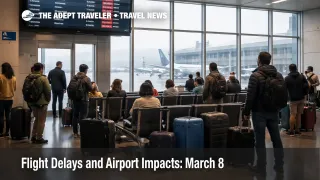
Flight delays March 8 are shaping up as a New York and Southeast flow management story, not a nationwide meltdown. The Federal Aviation Administration's March 8 operations plan flags low ceilings, wind, or visibility around Boston, the New York and Philadelphia airspace, Orlando, Tampa, and Seattle, while thunderstorms are the bigger late day risk around Atlanta, Charlotte, Houston, and the broader Southeast corridor. For travelers, the most immediate confirmed slowdown is at LaGuardia Airport (LGA), where departure delays had already stretched into the 31 to 45 minute range and were increasing by midafternoon UTC. The practical move is to protect connection time now, especially if your itinerary touches New York, Philadelphia, Atlanta, or Florida later on March 8.
The key change from Flight Delays and Airport Impacts: March 7 is that the clearest current pain point has shifted away from Texas and toward the Northeast flow complex, with the FAA also warning that Newark Liberty International Airport (EWR), Hartsfield-Jackson Atlanta International Airport (ATL), and Orlando International Airport (MCO) could move into stronger delay programs later in the day. That matters because March 8 looks more like a rolling network management problem than a single hub breakdown.
Flight Delays March 8: What Changed
The live picture on March 8 is mixed, but it is not random. LaGuardia was already under weather related traffic management initiatives, with gate hold and taxi delays running 31 to 45 minutes and increasing, while Boston Logan International Airport (BOS), Newark, John F. Kennedy International Airport (JFK), Philadelphia International Airport (PHL), Orlando, George Bush Intercontinental Airport (IAH), and Chicago O'Hare International Airport (ORD) were still generally reporting delays of 15 minutes or less at the time of their latest FAA status updates. In plain language, one airport in the New York system is already absorbing visible strain, while several other major airports are still in the vulnerable but not yet broken phase.
The FAA's operations plan explains why. It lists terminal constraints at BOS, the New York and Philadelphia airspace complex, MCO, Tampa, ATL, Charlotte, the I90 flow into Florida and the Caribbean, and Seattle. It also says Newark could face a ground stop or delay program after 600 p.m. UTC, Atlanta after 900 p.m. UTC, and Orlando after 10:00 p.m. UTC. LaGuardia also had Runway 04/22 closed until 1600Z, which reduces flexibility at the exact moment the airport is already dealing with weather metering.
Which Travelers Face the Most Disruption
The most exposed traveler on March 8 is not just the person starting in New York. It is the traveler trying to thread a tight connection through the New York, Philadelphia, Atlanta, or Florida system late in the day, especially on separate tickets or on the last usable bank to a smaller city. When LaGuardia is already slowing and Newark is still listed as a possible later program candidate, the whole region becomes less forgiving.
The second high risk group is leisure traffic heading south. The FAA says high snowbird volume is already part of the national airspace picture, and it specifically asked users bound for Florida to use west coast routing if feasible. That is a strong clue that the issue is not only airport weather, but also route crowding in the airspace feeding Florida and Caribbean demand. Travelers headed to cruises, spring beach trips, or same day resort check in windows are therefore more exposed than travelers on simple point to point business trips with multiple later departures.
Travelers with the least exposure are those on early nonstops, those with longer layovers, and those whose route does not depend on New York or Southeast banks. For structural context on why these problems spread so quickly once a dense corridor starts losing throughput, U.S. Air Traffic Control Privatization: Reality Check is still useful background, and Flight Delays and Airport Impacts: March 6 shows how these FAA warning zones often harden later than travelers expect.
What Travelers Should Do Now
For March 8 travel, the smartest move is to buy margin before the airport forces you to. If you still have a choice, take the earlier departure and the longer connection. If your trip runs through LaGuardia, Newark, Philadelphia, Atlanta, Orlando, or a Florida hub later on March 8, a sub 90 minute connection is now an avoidable gamble rather than a clever schedule play.
If your flight still shows on time, check the inbound aircraft and not just your own booking. A lot of March 8 damage will show up first as late equipment, late crews, and compressed gate turns, not dramatic early cancellations. That is especially true when one airport in a metro system is already slowing, while another nearby airport is only in the possible program stage.
The next decision point is late afternoon into evening on March 8. Watch whether Newark, Atlanta, or Orlando move from possible FAA action into an active ground stop or delay program. That is usually the point where same day reaccommodation gets thinner, hotel demand rises, and the cost of waiting becomes higher than the cost of rebooking. If your March 8 trip cannot tolerate a late arrival, flight delays March 8 are already serious enough to justify protecting time instead of price.
How the Disruption Spreads Through Travel
The mechanism on March 8 is a layered throughput problem. In the Northeast, low ceilings, wind, and visibility reduce how tightly aircraft can be sequenced into busy airports and shared metro airspace. In the Southeast, thunderstorms and route closures force detours, metering, and selective flow controls. The FAA also notes high snowbird volume and potential route closures around Atlantic and Florida bound flows, which means demand is colliding with weather and airspace limits at the same time.
That combination matters because the first order effect, modest airport delay, is often not the real traveler killer. The second order effects are missed onward flights, fewer later seats on the same route, longer ground waits, and a weaker recovery window once evening banks begin to collapse. LaGuardia's current delay range matters beyond LaGuardia because New York is a schedule dense system, and the FAA's own planning language suggests the pressure can spread into Newark, Philadelphia, Atlanta, Orlando, and Florida flows if conditions worsen.
March 8 does not look like a coast to coast shutdown. It looks like the kind of day where a few constrained nodes can still bend the national network. That is why travelers should read flight delays March 8 as a timing and connection risk story first, even when many airport status pages still look only mildly delayed.
Sources
- FAA Current Operations Plan Advisory, ATCSCC ADVZY 040 DCC 03/08/2026
- La Guardia Airport (LGA) Real-time Status, FAA
- Newark International Airport (EWR) Real-time Status, FAA
- General Edward Lawrence Logan International Airport (BOS) Real-time Status, FAA
- Philadelphia International Airport (PHL) Real-time Status, FAA
- John F Kennedy International Airport (JFK) Real-time Status, FAA
- Orlando International Airport (MCO) Real-time Status, FAA
- George Bush Intercontinental/Houston Airport (IAH) Real-time Status, FAA
- Chicago OHare International Airport (ORD) Real-time Status, FAA
- National Airspace System Status, FAA