

Italy March 18 Air Strike Hits Malpensa, easyJet
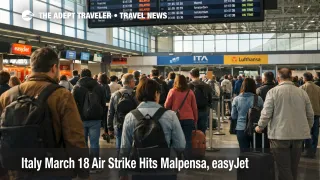
Italy's next dated aviation disruption window is now March 18, 2026, not just the strikes closing out this week. Italy's official transport strike calendar shows three separate air sector actions that day: a 24 hour walkout by ALHA staff at Milan Malpensa Airport (MXP), a national four hour stoppage by easyJet flying crew from 100 p.m. to 500 p.m. local time, and two 24 hour local actions at Brescia Montichiari Airport (VBS) involving GDA Handling and MH24 staff.
What changed since Adept's March 1 Malpensa handling piece is the exposure map. This is no longer just a Milan ground handling story. It is a split risk day, all day handling pressure at Malpensa, an afternoon carrier specific easyJet crew window nationwide, and a separate local handling problem at Brescia. For travelers, that means the danger is not assuming Europe's strike week ends on Friday, then building a tight Tuesday positioning trip through northern Italy.
The practical move is to treat March 18 as a buffer day if your trip depends on Milan, easyJet, or same day onward connections. Italy's aviation strike rules protect full flight operations in the 700 a.m. to 1000 a.m. and 600 p.m. to 900 p.m. local windows, and outside those bands airports must still authorize 20 percent of scheduled flights, but "protected" does not mean smooth when handling or crew availability is under pressure.
Italy March 18 Air Strike: What Changed
The official change is that March 18 now has three distinct aviation actions on the government strike calendar. The ALHA action at Malpensa runs from 1200 a.m. through 1159 p.m. and is listed as national in scope, even though the workplace named is Malpensa. easyJet's flying crew action runs from 100 p.m. to 500 p.m. nationwide. Brescia Montichiari has two separate 24 hour local actions, one covering GDA Handling staff and one covering MH24 staff, both from 1200 a.m. through 1159 p.m.
That matters because each action hits a different part of the operating chain. ALHA is a cargo and ramp handling operator at Malpensa's cargo complex, not a broad passenger terminal operator, which suggests the sharpest direct risk at MXP may fall on cargo flows, turnaround support, and aircraft handling tasks rather than every front of house passenger touchpoint. easyJet's action is different, because it directly affects flight crew availability and can produce targeted cancellations or retiming in the 100 p.m. to 500 p.m. band, especially from Milan Malpensa, which easyJet treats as a major base.
Brescia is the narrower case. Montichiari is primarily a cargo airport with limited passenger activity, so most leisure travelers will not feel that local strike directly unless they are using specialist, charter, cargo related, or private aviation services there. The bigger traveler consequence is that northern Italy's air system will have another labor pressure point on the same day, which can absorb operational slack and complicate ad hoc rerouting.
Which Travelers Face the Most Disruption
The highest exposure is travelers flying easyJet on March 18, especially on afternoon departures or inbound sectors that need to turn again later the same day. Because the crew action is scheduled from 100 p.m. to 500 p.m., the risk is not limited to flights departing exactly inside that window. Aircraft and crew rotations can slip into later banks, which means even early evening departures can inherit the problem if the day starts to unravel.
The next most exposed group is anyone using Milan Malpensa as a same day gateway for long haul travel, ski transfers, Lake Como positioning, or onward rail. A ground handling constraint does not always cancel flights outright, but it can slow the basic math that keeps a day on time, dispatch, loading, baggage, and stand turnaround. That raises the odds of missed self transfers and short connection failures even when the flight technically operates inside a protected service band. This is the same mechanism Adept outlined earlier in Milan Airport Ground Handling Walkout March 18, 2026.
Travelers with low exposure are those flying nonstop on non easyJet carriers in the protected morning or evening windows, with carry on only, and no same day connection or hard arrival deadline. Even then, lower exposure is not zero exposure. If your inbound aircraft or crew touched a disrupted station earlier in the day, delay can still propagate forward.
What Travelers Should Do Now
Rebook proactively if March 18 is a positioning day and missing it would break the larger trip. The clearest threshold is a self connection through Milan under about two hours, any checked baggage dependency, or any easyJet segment you cannot afford to lose in the afternoon. In those cases, shifting to Monday, March 17, or Wednesday, March 19, is usually the safer operational choice than waiting for day of disruption to force a more expensive fix.
Wait, but tighten monitoring, if you are on a nonstop in a protected window and your airline still shows normal operations 24 to 48 hours out. Watch for schedule trims, aircraft swaps, waiver language, and retimed departures from your operating carrier, then check whether your flight sits in the 700 a.m. to 1000 a.m. or 600 p.m. to 900 p.m. guaranteed bands. For easyJet travelers, the key decision point is whether your flight or inbound aircraft touches the 100 p.m. to 500 p.m. crew strike window.
Build more ground buffer than usual around Milan on March 18. The first order risk is delay or selective cancellation. The second order risk is what that does to hotel nights, onward rail, chauffeur pickups, tour joins, and long haul misconnects. That is the same reason Italy General Strike March 9 Could Disrupt City Services mattered earlier this month, labor actions in Italy often break the edges of a trip before they break the headline segment itself.
Why the Disruption Spreads Through Travel
Italy's minimum service rules reduce total shutdown risk, but they do not preserve normal throughput. ENAC says flights must be fully protected in the 700 a.m. to 1000 a.m. and 600 p.m. to 900 p.m. windows, and outside those hours airport authorities must still authorize 20 percent of scheduled flights. That framework keeps some service moving, but it also creates a misleading traveler assumption that protected flights will run normally.
The real mechanism is rotation and dependency. A crew strike hits the legal ability to operate certain flights. A handling strike hits the speed at which aircraft, bags, and equipment move through the airport. When both exist on the same day in northern Italy, even at different airports or in different time bands, the network loses spare capacity. As a result, the most common outcome may be not a dramatic shutdown, but a thinner, slower operating day with less margin for recovery.
That is why March 18 is a real misread risk for travelers. It arrives after the current week's disruption cycle, it is split across multiple labor groups instead of one obvious national stoppage, and part of it centers on Malpensa while another part centers on easyJet nationally. Travelers who only scan for blanket "airport closed" headlines can miss the more practical truth, a Tuesday that still works for some trips, but punishes tight, layered itineraries.
Sources
- Ministero delle Infrastrutture e dei Trasporti, Scioperi nei trasporti
- ENAC, Prestazioni minime garantite
- Milan Malpensa Cargo, Operators
- ALHA Group, Milan Malpensa
- easyJet, Milan Malpensa Airport Guide
- Aeroporto Brescia, Ground Handling Services
- Reuters, easyJet to boost presence at Italy's airports following ITA-Lufthansa deal