

U.S. Storm Flight Delays Stretch Into March 17
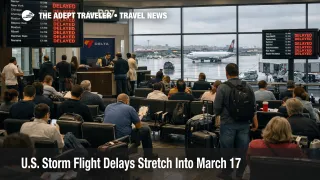
The U.S. storm flight delays story has shifted from same day weather failure into a March 17 recovery problem across the eastern half of the country. What changed since prior coverage is that Monday's disruption was larger than an ordinary bad weather day, with more than 4,800 U.S. cancellations and 12,800 delays on Monday, followed by another 1,000 plus cancellations and roughly 4,200 delays on Tuesday as hubs such as Hartsfield Jackson Atlanta International Airport (ATL), John F. Kennedy International Airport (JFK), LaGuardia Airport (LGA), and Chicago O'Hare International Airport (ORD) tried to reset. For travelers, that means the danger is no longer only the original storm cell. It is the broken aircraft, crew, and passenger sequencing left behind.
This matters most through Wednesday morning, March 18, because the weather risk has not fully cleared. The National Weather Service still had lake effect snow warnings in parts of New York and Ohio into Wednesday morning, while freeze warnings extended across parts of Florida, Georgia, and Alabama for the next overnight period. Travelers with flights still to take should treat this as a rolling recovery window, not a clean restart.
U.S. Storm Flight Delays: What Changed on March 17
The big number is not just how many flights were canceled, it is where the system stayed weak after the worst weather moved through. AP reported that Tuesday's disruptions were most severe at Atlanta, with more than 200 cancellations and about 450 delays, after Monday's storm cycle had already hammered Chicago O'Hare, Atlanta, and LaGuardia. Reuters also reported that about 57 percent of flights at both Atlanta and LaGuardia were canceled or delayed on Monday, with about 51 percent at Chicago O'Hare.
The Federal Aviation Administration also used traffic management tools aggressively as the system deteriorated. Reuters reported ground stops at Reagan National, Chicago O'Hare, Charlotte, Houston Bush, and Baltimore Washington on Monday, while local Atlanta reporting said certain Atlanta bound Delta flights were briefly grounded at the airline's request for operational reasons. That does not mean every affected airport remains in the same condition now, but it does confirm that the problem was network scale, not local inconvenience.
Which Travelers Face the Most Disruption
The most exposed travelers now are not only people starting in storm zones. They are anyone whose trip depends on a fragile chain, especially a hub connection, a same day cruise embarkation, a resort transfer, a prepaid event, or the last flight of the day. Atlanta remains the clearest example because it is both a huge origin airport and the country's most important connecting hub, so a bad day there spills outward fast. New York airports, Chicago O'Hare, and several Florida airports remain vulnerable because they absorb both local passengers and displaced connecting demand at the same time.
The second layer of exposure is checkpoint strain. Reuters reported that just over 10 percent of Transportation Security Administration officers did not show up for work on Sunday, versus a typical rate below 2 percent, and that absenteeism has been about 20 percent since February 14 at Atlanta, JFK, and Houston, with even worse spikes in some cities. That means some trips can still fail before boarding even if the flight itself operates. Readers who need that side of the picture should revisit U.S. Shutdown Hits TSA Lines at Spring Break Airports and TSA Shutdown Deepens as Storm Hits Spring Break Travel.
What Travelers Should Do Now
Travelers flying on March 17 or early on March 18 should stop using normal buffers. Check the inbound aircraft before leaving for the airport, not just your own flight status. If the inbound leg is badly delayed, your recovery odds are already worse. At origin airports under checkpoint strain, arrive earlier than you normally would, because a "still operating" flight can become irrelevant if security is the real choke point. That is especially true at large hubs and at spring break airports where backup seats vanish fast.
If you are ticketed on American, its current travel alerts show change fee waivers for affected March 16 to 17 travel, with flexibility to rebook into later dates within the published window. United's travel advisory page also shows an active East Coast thunderstorms waiver for March 16 to 17. The practical threshold is simple. Wait if you are nonstop, have schedule slack, and the inbound aircraft is still moving. Rebook early if you have one tight connection, a cruise or international departure, or a trip that gets materially worse if you arrive a day late.
Over the next 24 to 72 hours, watch three things. First, whether cancellation totals fall faster than delay totals, which would show the network is rebalancing instead of merely pushing the problem forward. Second, whether lake effect warnings and overnight freezes keep constraining crews, deicing, or early morning departures. Third, whether TSA absenteeism improves at major hubs. For structural context on why one storm day can keep damaging schedules after the weather map looks better, U.S. Air Traffic Control Privatization: Reality Check remains a useful companion read.
Why the Disruption Spread So Far Beyond the Storm
A day like this breaks the system in layers. First order, snow, wind, and storms cut runway acceptance rates, slow departures, and trigger ground stops or delay programs. Second order, aircraft miss their next assignment, crews time out, and passengers stack into later banks that were already full because of spring break demand. By the time the sky improves at one airport, the inbound aircraft may still be in the wrong city, the crew may be out of legal duty time, and the gate operation may still be jammed from the prior bank. That is why a March 17 traveler can inherit a March 16 problem.
The TSA staffing problem makes that recovery worse because it strips away one of the system's few remaining buffers. In a normal irregular operations day, some travelers salvage the trip by reaching the airport earlier, switching flights, or clearing security quickly enough to catch a later departure. When checkpoint staffing is thin, even that fallback gets weaker. The result is a travel day where the storm is only the trigger, not the whole mechanism.
Sources
- More Flight Cancellations, Delays Due to US Storms, AP News
- More Than 12,500 US Flights Delayed or Canceled Due to Major Storms, Reuters
- US Says 10% of Airport Security Officers Did Not Work Sunday Amid Shutdown, Reuters
- Travel Alerts, American Airlines
- Jetstream Travel Alerts, United Airlines
- WWA Summary for All, National Weather Service