

TSA Shutdown Deepens as Storm Hits Spring Break Travel
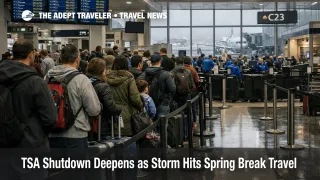
The TSA shutdown spring break travel problem is no longer just about slower checkpoints. It is now a stacked disruption day. More than 300 TSA officers have quit since the partial Department of Homeland Security shutdown began, unpaid staff are missing more work, and a major Midwest storm has already forced large flight cancellations at Minneapolis, Chicago O'Hare, and Chicago Midway as spring break volume builds. For travelers, that means airport plans can fail in two separate places, first at security, then again at the gate.
This is the meaningful change since earlier shutdown coverage. The March 15 airline CEO letter turned the issue from a staffing warning into a broader aviation pressure story, saying TSA officers had just received zero dollar paychecks and warning that travelers were already seeing two, three, and even four hour waits at some checkpoints. Airlines for America's letter also said U.S. airlines expect 171 million passengers this spring, a new record, which leaves less slack when staffing and weather hit at the same time.
TSA Shutdown Spring Break Travel: What Changed
What changed over the past several days is that three separate stress points are now overlapping. First, the shutdown that began in mid February remains unresolved, leaving about 50,000 TSA officers working without pay. Second, staffing pressure has become more visible, with more than 300 officers reportedly quitting since the lapse began and callouts running roughly double normal levels, according to reporting that cited agency statistics and TSA comments. Third, weather disruption across the Upper Midwest has already knocked out large blocks of flying, with Minneapolis, St. Paul International Airport (MSP) under a blizzard warning through Monday morning and airport operators warning that airlines had proactively canceled flights or issued waivers.
That matters because a spring break trip can break before the aircraft ever pushes back. A long screening line can wipe out the itinerary even if the flight itself still operates. Then, if weather removes the backup flight options later in the day, the traveler loses the easy recovery path that usually saves a family vacation or cruise connection. Adept Traveler's earlier U.S. Shutdown Hits TSA Lines at Spring Break Airports and Flight Delays and Airport Impacts: March 15 already showed those two risks separately. March 16 is the day they are colliding.
Which Travelers Face the Most Disruption
The most exposed travelers are families and leisure travelers on tight morning departures, especially anyone starting from or connecting through storm hit Midwest hubs or busy spring break airports. The risk is highest when the trip depends on one clean sequence, get to the airport, clear security, make the flight, connect once, and arrive same day for a cruise, resort transfer, event, or prepaid hotel night. If any one step slips, the whole chain gets more expensive fast.
Travelers with TSA PreCheck, flexible tickets, later departures, or nearby airport options are in a better position, but they are not insulated from the second order effects. When standard lanes back up, checkpoint staffing is rebalanced, airlines hold some flights for late passengers, and missed connections increase, crowding later banks. That can spread beyond the airports with the longest lines because crews, aircraft, and standby seats are all shared across the wider network.
The storm side sharpens that exposure. MSP publicly warned that some airlines had proactively canceled flights or offered waivers under a blizzard warning, while Reuters and AP reporting tied the shutdown strain to growing line problems at multiple U.S. airports. In plain language, this is not just a weather day and not just a shutdown day. It is a reduced recovery capacity day.
What Travelers Should Do Now
Travelers flying on March 16 or March 17 should leave materially more time for the airport than they would on a normal spring break trip, especially at major hubs and airports already reporting line strain. Three hours is the safer floor for many domestic trips in this setup, not because every checkpoint will fail, but because the penalty for being wrong is unusually high when staffing risk and weather cancellations overlap. If you are departing from MSP, Chicago O'Hare International Airport (ORD), Chicago Midway International Airport (MDW), or another airport in the storm footprint, check both your airline and airport before leaving for the terminal, not just once the night before.
Rebook early if your trip includes a cruise embarkation, wedding, tour departure, ski handoff, or any same day event that cannot absorb a missed connection. Waiting for the operation to degrade may preserve fare flexibility, but it can destroy itinerary flexibility once later flights fill. The better move is usually to protect the trip, not the original departure time, when your schedule has no slack.
Over the next 24 to 72 hours, watch three things. Watch whether DHS funding is restored, because that is the only clean way to ease the pay pressure on TSA staffing. Watch whether Midwest waivers expand, because that signals airlines expect recovery to take longer than one operating day. And watch whether your airport starts publishing earlier arrival guidance or checkpoint specific warnings, because that is often the clearest sign that staffing pain has become a traveler facing problem rather than an internal labor problem. For broader context, Government shutdown travel: What to expect if it drags on remains a useful baseline explainer.
Why the Disruption Spreads Through Travel
The mechanism is simple, but ugly. TSA officers are excepted workers, so security screening continues during a shutdown, but missing pay still creates financial stress, resignations, and unscheduled absences. OPM guidance confirms that employees affected by a lapse are entitled to retroactive pay once funding returns, yet that legal backstop does not solve the short term cash flow problem at the checkpoint today. That is why airports such as Denver International Airport (DEN) have been soliciting grocery and gas gift cards for federal workers, and why airline CEOs are pressing Congress to end the funding lapse and permanently shield aviation workers from future shutdowns.
Then weather amplifies everything. A storm that removes hundreds of flights from a hub does not just strand local passengers. It compresses later departures, reduces rebooking options, displaces crews and aircraft, and pushes more travelers into customer service lines after they finally clear security. That is the second order problem travelers often miss. Even if your own airport is clear and your own security line moves, your trip can still fail because the system has fewer spare seats, fewer spare aircraft, and fewer clean recovery paths once a shutdown strained checkpoint operation meets a storm strained flight network.
Sources
- An Open Letter to Congress from U.S. Airline CEOs
- US airline CEOs urge Congress to end standoff, pay airport security officers
- US Senate fails to end standoff over funding Homeland Security, airport screening
- Long airport lines highlight concerns about unpaid security officers in the shutdown
- CEOs of top airlines demand Congress restore funding to Homeland Security and pay airport workers
- A dad of 3 felt forced to quit his job at TSA as the partial shutdown drags on
- Denver International Airport Seeking Grocery Store and Gas Gift Card Donations for Federal Employees Working Without Pay
- MSP Flights and Airlines page, storm advisory banner
- OPM shutdown furlough guidance
- OPM 2025 lapse instructions on retroactive pay for excepted employees
- Annual Report on Transportation Security, TSA