

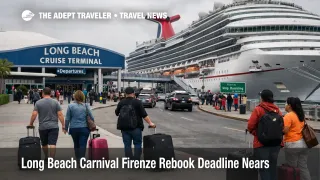
Long Beach Carnival Firenze Rebook Deadline Nears
Tijuana border blockades are no longer just a planning alert. They are an active three day disruption risk from Tuesday, March 18, through Thursday, March 20, with local Baja California reporting laying out a day by day protest map and day one already reaching the San Ysidro to Tijuana vehicular crossing at El Chaparral. For travelers, the practical issue is not an airport shutdown, it is ground access fragility on both sides of the border. Anyone crossing the line, timing a Tijuana International Airport (TIJ) run, heading south into Baja, or building a San Diego plus Tijuana itinerary should leave earlier, keep backup routing ready, and avoid same day plans with no buffer.
The new wrinkle versus our recent coverage is that this is a border and highway story with a published three day sequence, not a single city march or an airline schedule cut. Local organizer statements reported by El Sol de Tijuana said the action would start with intermittent San Ysidro blockades on March 18, shift to the Playas de Tijuana toll booths and the Tijuana to Tecate highway on March 19, and then move to the Transpeninsular Highway on March 20.
Tijuana Border Blockades: What Changed
What changed is that the first day is no longer hypothetical. El Sol de Tijuana reported that CNTE teachers marched from Glorieta Cuauhtémoc in Zona Río and reached the El Chaparral vehicular crossing into Tijuana on March 18, with local leaders saying the blockade began around 10:20 a.m. and would last about three hours. The same outlet had previously reported the broader March 18 to March 20 plan, including the later actions at the Playas toll booths, the Tijuana to Tecate corridor, and the Transpeninsular Highway.
The protest is part of a wider 72 hour CNTE mobilization. Reuters reported that thousands of teachers marched in Mexico City on March 18 and set up a 72 hour protest camp in the Zócalo, demanding salary increases and the repeal of education and pension reforms. In Baja California, local reporting tied the Tijuana actions specifically to opposition to the 2007 ISSSTE law and related pension demands.
Which Crossings And Baja Plans Face The Most Risk
The most exposed travelers are not only cross border commuters. They include spring break visitors driving from San Diego into Tijuana or Rosarito, medical travelers with clinic appointments tied to specific crossing times, passengers using TIJ or the Cross Border Xpress system, and anyone starting a longer Baja road trip on a tight clock. The day by day sequence matters because it spreads risk across different movement types: border entry on March 18, toll road and inland highway access on March 19, and longer southbound Baja movement on March 20.
March 19 looks especially awkward for travelers trying to choose between coastal and inland approaches. If protests affect both the Playas de Tijuana toll booths and the Tijuana to Tecate highway, some of the usual workarounds become weaker at the same time. March 20 then shifts the problem farther down the peninsula, which matters more for travelers heading beyond the immediate border zone. The tradeoff is simple: a crossing that remains technically open can still become a bad same day plan if the roads feeding it or extending beyond it are slowing, stacking, or being intermittently released.
What Travelers Should Do Now
Travelers crossing during this March 18 to March 20 window should front load time, not gamble on normal conditions. For March 19 and March 20 in particular, leave substantially earlier than usual for any scheduled transfer, clinic visit, tour, or flight. If your plan depends on arriving in Baja and continuing the same day to Rosarito, Tecate, Ensenada, or farther south, the safer move is to build in an overnight buffer or push the onward drive to a quieter window. CBP's Border Wait Times system is useful for checking lane conditions, but during protest days it should be treated as only one input because road blockages outside the booths can still break the trip.
There is also a decision threshold here. If you must cross for a fixed appointment or a flight, shift earlier and consider whether an alternate routing or a night before stay protects the itinerary better than hoping traffic clears. If your trip is discretionary, especially a leisure drive into Baja, waiting until the protest window closes may save hours of uncertainty, surge priced rides, and missed check in times. Travelers who still go should keep cash, extra phone battery, water, offline maps, and hotel or carrier contact details ready in case they need to rework the day mid trip.
The next decision point is late on Thursday, March 20. If the actions end on schedule and no new calls are issued, conditions should improve first at the most localized bottlenecks and only later across the wider transfer network. That lag matters because tours, private drivers, and hotel pickup patterns often need a few extra hours to normalize even after a protest line moves.
Why The Disruption Spreads Beyond The Border
This kind of protest spreads through travel because border movement is a chain, not a booth. A blockade at the crossing hits the obvious first order effect, delayed entry or exit. The second order effects then stack quickly: airport runs start earlier and still miss target times, hotel arrivals slide into late check ins, rideshare prices rise when vehicles are tied up, and tour operators lose precision because vans and guides cannot rely on predictable handoffs. That is why a land protest in Tijuana matters to travelers who are not even planning a long drive.
There is also a Baja specific mechanism. When disruption shifts from the port itself to toll booths and highways, it catches travelers who thought clearing the border was the hard part. Adept's previous reporting on Mexico Highway Blockades Disrupt Road Trips And Borders showed how "open" roads can still fail operationally when toll plazas, convoys, or protest points turn normal drive times into stop start slogs. For broader trip planning, Adept's guide to Baja, California - Travel News and Guides from The Adept Traveler remains useful, but for this week the immediate issue is narrower: Tijuana border blockades make rigid same day border to beach or border to airport plans far riskier than they look on a map.
Sources
aCarnival's fall cut to Carnival Firenze is no longer just a cancellation story, it is now a decision deadline story for West Coast cruisers. The line canceled 11 short sailings from Long Beach, California, scheduled between October 12, 2026, and November 16, 2026, and affected guests can either rebook a comparable sailing by March 25, 2026, with fare protection and onboard credit, or let the booking roll into a refund. That matters because these were easy three and four night Baja trips that many travelers use for quick fall breaks, and the closer travelers get to that deadline, the more likely nearby replacement inventory tightens.
The new angle here is not the existence of the cancellations alone. Adept already covered the original pullback in Long Beach Carnival Firenze Cruises Canceled for Fall. What changed is that the practical traveler question is now immediate, rebook under Carnival's protected terms, or take the refund and rebuild the trip from scratch before Southern California fall cruise pricing shifts further.
Carnival Firenze Rebook Deadline, What Changed
Carnival says the affected Firenze sailings fall in one blackout window, from October 12, 2026, through November 16, 2026. Trade reporting and Carnival's guest communication describe the canceled departures as 11 three and four night Baja Mexico sailings from Long Beach. Carnival's stated public explanation remains narrow, changes to itinerary plans, and it still has not publicly published a replacement Firenze program for that removed block.
The compensation terms are clearer than the reason. Guests who move to a comparable sailing by March 25, 2026, keep their original cruise fare, provided the replacement is comparable and in similar accommodations, and they receive $50.00 (USD) per person in onboard credit, capped at $100.00 (USD) per stateroom. Guests who do not rebook receive a full refund of the cruise fare and pre purchased items, and Cruise Industry News reported Carnival told guests refunds would be issued after March 25 and can take up to three weeks to work through banks.
Which Travelers Face the Tightest Fall Cruise Squeeze
The most exposed group is not every Carnival guest, it is travelers who specifically wanted the short Long Beach pattern. These sailings worked because they were simple. They fit school calendars, long weekends, and quick drive market departures from Southern California, Arizona, and Nevada. Once those departures come out of sale, the substitute is often not another cheap three night break on the same dates, it is a longer cruise, a different ship, or a different port.
That is where first order and second order effects start to matter. First order, booked guests lose the original voyage. Second order, replacement demand can push up nearby fares, compress cabin choice, and change the total trip cost once parking, pre cruise hotels, airport transfers, or pet sitting are rebuilt around a different departure day or a longer itinerary. This is especially true for passengers who paired the cruise with nonrefundable extras, which is why the real exposure is often the land side around the cruise, not just the cruise fare itself. Adept's recent CFAR Travel Insurance Demand Jumps in March 2026 piece is relevant here, because flexible coverage can matter before a disruption becomes a known problem, not after it.
What Travelers Should Do Now
Travelers with fixed fall dates should not wait for Carnival to reveal a more detailed Firenze replacement plan that may never match the original short Baja pattern. If the trip depended on a specific October or November weekend, or if air, hotel, and ground pieces were already arranged, the better move is usually to price a comparable replacement now and decide before the March 25 cutoff. Waiting may be reasonable only for travelers with fully flexible dates, local drive access, and no meaningful nonrefundable spend around the cruise.
Current Carnival sales pages show that Long Beach capacity still exists on other ships, even if not in the same exact short getaway format. Carnival's Long Beach homeport page continues to list Carnival Firenze, Carnival Panorama, and Carnival Radiance among the ships sailing there, and current itinerary pages show longer alternatives such as an October 18, 2026 Carnival Panorama Mexican Riviera sailing and an October 3, 2026 Carnival Radiance Mexican Riviera sailing. That does not solve every schedule problem, but it shows the market is not empty, it is shifting toward different products and dates.
Anyone taking the refund path should document every cruise line purchased add on, verify when the refund posts, and then reprice the whole trip rather than only the cabin. Cruise cancellations often look manageable until hotel rates, parking, or short notice transport changes erase the apparent savings. The next decision point is simple, compare Carnival's protected rebook offer against the full cost of rebuilding elsewhere, then lock the lower risk option before the deadline.
Why the Long Beach Cruise Disruption Matters Beyond One Ship
This matters because Carnival Firenze was selling one of the easier entry level cruise products on the West Coast, short Baja departures from Long Beach. When those come out of inventory for more than a month, the disruption stays localized, but it still changes the shape of the market. Travelers who wanted low commitment sailings may now face longer Mexican Riviera options, different ships, or different embarkation dates, and advisors lose a simple short haul product that is easy to package.
Carnival's public explanation does not yet tell travelers whether this is primarily a redeployment step, a duration change, or another commercial adjustment. Several reports tie the move to broader itinerary or redeployment planning, but Carnival itself has only confirmed revised itinerary plans. That distinction matters because travelers should not assume the removed dates will return in the same form. Until Carnival publishes a replacement schedule, the safest reading is operationally conservative, treat these 11 sailings as gone, treat the March 25 decision point as real, and book around what is actually on sale now.
Sources
Thousands Impacted as Carnival Firenze Unexpectedly Cancels Multiple Fall Sailings
Carnival Cancels Nearly a Dozen Fall Sailings on the Firenze
6-Day Mexican Riviera from Los Angeles, CA, Carnival Panorama, October 18, 2026
8-Day Mexican Riviera from Los Angeles, CA, Carnival Radiance, October 3, 2026
Maestros de la CNTE bloquean garita del Chaparral de San Ysidro a Tijuana
Bloqueará CNTE garita de San Ysidro y carretera Transpeninsular en protesta contra la Ley del ISSSTE
Mexican teachers protest, demand salary hikes ahead of World Cup, Reuters video report
San Ysidro Passenger Border Wait Times, U.S. Customs and Border Protection