

Mexico City World Cup Protests Hit Stadium Roads
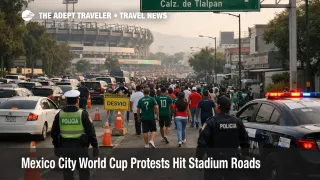
Mexico City World Cup protests have moved from a political backdrop to a live transport warning for travelers using the Estadio Banorte corridor. On March 29, protesters turned a major road near the stadium into a makeshift football pitch as Mexico City staged the Mexico versus Portugal warm up match and authorities deployed 4,000 emergency workers around the reopening event. For travelers, the practical takeaway is that match day access in the south of the capital is now vulnerable not only to ordinary congestion, but to overlapping protest action, road controls, and security perimeters. Anyone planning airport transfers, rideshares, private drivers, or tight hotel arrival windows around stadium dates should build more buffer now, not later.
Mexico City World Cup Protests Hit Stadium Access
What changed is that the risk is no longer theoretical. Reuters reported that demonstrators used a major Mexico City highway as an improvised football pitch to protest what organizers called dispossession linked to World Cup preparations, while a separate Reuters stadium report described road closures, long walks to the gates, unclear entry directions, and limited parking around the reopening of Estadio Banorte, formerly Estadio Azteca. That combination matters more than the protest alone. A host venue rehearsal already produced the same kind of stacked friction that can break event day planning, delayed road approach, reduced vehicle access, slower pedestrian flow, and confusion at the last mile.
The main traveler consequence is on the ground, not in the air. A fan flying into Benito Juárez International Airport or Felipe Ángeles International Airport can still land on time and still miss a carefully planned stadium arrival if surface access deteriorates near the venue. That is the real warning from this weekend. A warm up event that should have showcased readiness instead showed how quickly public protest, traffic management, and venue security can interact.
Reporting tied the protest to Periférico Sur near the stadium area, while other local coverage placed closures and traffic controls on surrounding approaches including Calzada de Tlalpan and nearby access roads. Even when the protest later shifted aside and some traffic resumed, the event showed that a politically charged demonstration does not need to last all day to damage a travel plan built on narrow margins.
Which Travelers Face the Most Disruption
The most exposed travelers are not ordinary city visitors with flexible schedules. They are fans booking short match trips, hospitality clients using fixed transfer windows, families relying on rideshares, and anyone trying to combine airport arrival, hotel check in, and stadium entry on the same day. South Mexico City hotel guests are also more exposed than travelers staying farther from the venue and moving earlier.
Drivers and private transfer operators face the first order disruption because road controls can be imposed quickly and reroutes can push traffic into already stressed corridors. Rideshare users face a second problem, because even if cars are still moving, pickup and drop off points can be pushed farther from the venue perimeter. That changes walking distances, arrival timing, and post match exit plans. Travelers with mobility limits or children should treat that as a serious planning issue, not a minor inconvenience.
This also matters for June even if the exact protest groups and demands change. In an earlier Adept Traveler article, Mexico City Anti Tourism Protests Warn World Cup Fans noted that anti tourism and anti displacement pressure was already building in the capital before this stadium reopening. In another earlier Adept Traveler article, Mexico City CNTE Strike Hits Centro And Reforma showed how localized demonstrations in Mexico City can quickly spill into transfer friction well beyond the protest footprint itself. The difference now is that the pressure has touched the World Cup venue corridor directly.
What Travelers Should Do Now
Travelers planning stadium dates should stop treating same day timing as efficient. For any event at Estadio Banorte, especially once June match traffic begins, the smarter move is to separate airport arrival from stadium attendance whenever possible. Arrive the day before, or stay close enough to remove a long cross city drive from the itinerary. If you must travel and attend on the same day, add a large buffer for both the road approach and the final pedestrian stretch.
For hotel planning, favor properties that reduce dependence on a single transfer window. A cheaper room farther away can become the more expensive choice once late rides, missed check ins, and backup transport are added. Travelers using private drivers should agree on fallback pickup points in advance, and rideshare users should expect that official perimeters may force a longer walk than mapping apps suggest.
The decision threshold is straightforward. If your plan depends on landing, clearing the airport, driving across the city, checking in, and reaching the stadium with less than several hours of slack, the plan is weak. If June approaches without clear, stable guidance on access roads, pickup zones, and pedestrian routing, that is a reason to buy flexibility, not to hope the day will run cleanly. Travelers should monitor venue access instructions, city traffic controls, and any sign that protest calls are targeting stadium dates or nearby corridors again.
Why This Is Happening, and What Comes Next
The mechanism is bigger than one protest. Mega events concentrate public spending, construction, policing, and traffic management into a small number of visible corridors. That makes those corridors attractive protest stages because they are symbolically tied to the event and operationally hard for authorities to ignore. In Mexico City, that effect is stronger because the stadium sits inside a dense southern urban zone where routine congestion is already heavy and where security perimeters can quickly reshape local traffic patterns.
That does not mean every June match day will be blocked. It does mean travelers should expect the risk profile to stay elevated. FIFA has confirmed that Mexico City Stadium will host the opening match of the 2026 World Cup on June 11, 2026, which raises the odds of tighter controls, larger police operations, and more scrutiny of surrounding roads as the event nears. Reuters also reported that the reopening match functioned as a stress test for the venue. Stress tests matter because they reveal not just whether a stadium can open, but whether the transport system around it can absorb real crowds, protests, and security pressure at the same time.
The next thing to watch is whether authorities respond by stabilizing access rules or by layering on more restrictions. More controls could improve safety and pedestrian order, but they could also push vehicle access farther out and lengthen arrival times. For travelers, the lesson from these Mexico City World Cup protests is already clear, the stadium may be open, but the road approach remains a live planning risk.