

Gulf Air Bahrain Dammam Transfer Plan Through March 28
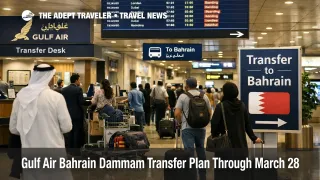
Gulf Air's Bahrain Dammam transfer plan has turned some Bahrain itineraries back into bookable trips, but not back into normal ones. With Bahrain International Airport (BAH) still suspended under the Bahraini airspace closure, Gulf Air says travelers can book select international flights through King Fahd International Airport (DMM), Dammam, Saudi Arabia, and use an airline arranged road segment across the King Fahd Causeway through March 28, 2026. That gives Bahrain bound and Bahrain originating passengers a real operating workaround, but it also shifts the weak point from the runway to the border, the road transfer, and the document chain.
## Bahrain Dammam Transfer Plan: What Changed The practical change is that Gulf Air is no longer treating Dammam only as an ad hoc rescue point. Its temporary network page says passengers can now book direct flights to select destinations across the carrier's network through Dammam while Bahrain flights remain suspended, and that eligible Bahrain itineraries can include shuttle transport and transit visa handling as part of the ticketed journey. For travelers starting in Bahrain, the airline says bookings made with Bahrain as the origin include ground transport from the Golden Tulip Bahrain Hotel to Dammam and include the Saudi transit visa for those using Gulf Air's arranged transportation. For travelers arriving toward Bahrain, Gulf Air says tickets booked to Bahrain include the air segment to Dammam, ground transport onward, and drop off at Bahrain National Stadium. That is a meaningful upgrade from generic "check with your airline" disruption language. It creates a defined substitute airport, a defined road corridor, and defined pickup and drop off points. It also keeps the Bahrain side of the trip alive for some passengers even while Bahrain airport operations remain suspended under the official airspace closure notice. ## Which Travelers Can Actually Use It The workaround is best suited to travelers whose itinerary begins or ends in Bahrain and who can satisfy both sides of the border document chain. Gulf Air's rules are not a blanket promise that anyone can simply board a bus and continue. Passengers traveling on the airline's shuttle from Dammam into Bahrain must hold a valid Bahrain visa or Bahrain residency permit, while passengers choosing to travel individually are responsible for arranging all visas and travel documents required for movement over the King Fahd Causeway. Gulf Air also says only passengers who already hold a valid, confirmed ticket should proceed to the departure point or airport. That creates three obvious exposure groups. The first is travelers with clean paperwork and a single Gulf Air booking, who now have a usable path where there was previously only suspension. The second is travelers on separate tickets, or with onward plans outside Gulf Air's handled transfer flow, who face much more misconnect risk if the road segment runs late. The third is travelers who assumed Bahrain airport access had resumed, because the official Bahrain airport notice still says flight operations remain suspended, which means the workaround is not a normal Bahrain airport restart. In an earlier Adept Traveler article, [Bahrain Road Exit Planning Gets Real for Travelers](https://adept.travel/news/2026-03-06-bahrain-road-exit-planning-saudi-causeway) explained why Saudi paperwork and causeway timing had already become a serious traveler filter during this disruption. That logic still applies here, even with airline arranged transport, because a cleaner commercial pathway does not remove the border crossing itself. ## What Travelers Should Do Now Start by checking whether your exact booking is built as a Bahrain itinerary or a self managed Dammam itinerary. That distinction matters. Gulf Air says Bahrain origin bookings that use its shuttle include the road transfer and Saudi transit visa, while self arranged Dammam departures require the passenger to secure the necessary Saudi entry documents independently. Travelers inbound to Bahrain should verify that their booking is actually ticketed to Bahrain, not only to Dammam, if they expect the airline managed onward transfer. The next decision point is baggage, timing, and onward connection risk. A Bahrain Dammam transfer plan can preserve the trip, but it also adds a road leg, a border process, and a handoff between airport and surface transport. That means tight onward connections, separate tickets, prepaid same day tours, and nonrefundable hotel arrivals become more fragile than they were when Bahrain airport was functioning normally. Travelers with important onward sectors should build extra buffer, and travelers on separate tickets should assume the road leg can break the itinerary even if the flight itself operates. If your stay in Bahrain may run longer than planned, also check your immigration position rather than focusing only on the next flight. In an earlier Adept Traveler article, [Bahrain Visa Extension Update Reshapes Exit Timing](https://adept.travel/news/2026-03-09-bahrain-visa-extension-update-reshapes-exit-timing) documented how Bahrain's visa extension rules became part of the travel decision once departures stopped behaving normally. Travelers who are still waiting on a cleaner exit window should verify both Bahrain stay legality and the validity of any onward visas before assuming the Dammam workaround solves the whole trip. ## Why the Workaround Helps, and Where It Can Still Break The system logic here is straightforward. Gulf Air has created a substitute airport model while Bahrain airspace remains closed, using Dammam as the air gateway and the causeway as the final access leg into or out of Bahrain. First order, that restores some passenger movement and commercial booking capability. Second order, it moves the main failure points into road transfer timing, border processing, document eligibility, and onward reaccommodation if one piece slips. That also explains why this is more useful than a generic closure notice, but still weaker than a real airport reopening. Bahrain airport's own site continues to say operations are suspended, so the workaround should be read as an airline managed bridge around the closure, not proof that Bahrain's aviation system has normalized. Travelers should therefore watch for two separate signals over the next several days, whether Gulf Air keeps expanding or adjusting the temporary Dammam network, and whether Bahrain Civil Aviation Affairs lifts the airspace related suspension at Bahrain airport itself. Readers who need broader destination context while this remains fluid can use [Bahrain - Travel News and Guides from The Adept Traveler](https://adept.travel/destinations/bahrain). For the wider regional backdrop, Reuters has also reported that airlines across the Middle East and beyond continue to trim, suspend, or reroute services because regional airspace disruption is still affecting normal network planning. ## Sources * [Temporary Network via Dammam, Gulf Air](https://www.gulfair.com/en/Network) * [Bahrain International Airport, Bahrain Airport Company](https://www.bahrainairport.bh/) * [Flight Departures, Bahrain Airport Company](https://www.bahrainairport.bh/flight-departures) * [Civil Aviation Affairs: Temporary changes to flights at Bahrain International Airport following airspace closure, Bahrain News Agency](https://www.bna.bh/en/National/CivilAviationAffairsTemporarychangestoflightsatBahrainInternationalAirportfollowingairspaceclosure.aspx?cms=q8FmFJgiscL2fwIzON1%2BDmroeLeG5zEKixla8%2BZD730%3D) * [Airlines cancel more flights as Middle East conflict escalates, Reuters](https://www.reuters.com/business/aerospace-defense/airlines-cancel-flights-after-us-israel-strikes-iran-2026-03-16/)