

Oman Air Muscat Reroutes Widen Through March 31
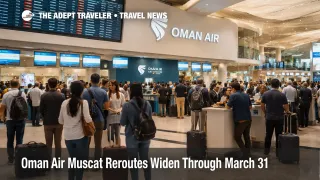
Oman Air Muscat reroutes became a bigger traveler problem after the airline said flights to and from nine cities, including Amman, Dubai, Bahrain, Doha, Dammam, Kuwait, Copenhagen, Baghdad, and Khasab, are canceled through March 31, 2026. Oman's airports and airspace are still operating, and much of Oman Air's wider network continues, but that does not make Muscat a simple fallback for Gulf connections. For travelers with trips in the next nine days, the practical question is no longer whether Oman is open, but whether Muscat can still connect to the city you actually need.
Oman Air Muscat Reroutes: What Changed
Oman Air's latest suspension list is broader and more concrete than a generic regional warning. The carrier says flights continue elsewhere on its network, but service to and from Amman, Dubai, Bahrain, Doha, Dammam, Kuwait, Copenhagen, Baghdad, and Khasab is canceled until March 31. That takes out several of the short haul Gulf and near Gulf spokes that made Muscat useful as a transfer point when larger hubs became unreliable.
The operational significance is meaningful disruption, and for some itineraries it rises to major itinerary risk. Muscat is still functioning, but the missing routes cut off direct access to several nearby capitals and business markets at the same time. That matters most for travelers who were using Oman as a workaround to avoid heavier disruption elsewhere in the Gulf. A functioning airport is not the same thing as a functioning network.
Oman Air is also advertising flexible booking support for passengers whose flights were affected, or whose original travel dates fall between February 28 and March 31, 2026. The airline's public guidance points travelers to manage bookings through its website, app, or contact channels. What is not fully visible from publicly indexed material is the exact reissue logic for every fare type, so passengers should not assume all reroutes, date changes, or refunds will work the same way across tickets.
Which Travelers Face the Most Disruption
The hardest hit group is travelers who planned to pass through Muscat to reach another Gulf city on the same ticket or on a tightly stitched self connection. Dubai, Doha, Bahrain, Kuwait, Dammam, and Amman are not marginal spokes in the current environment. They are cities people were using for onward corporate travel, family reunification, evacuation style exits, and improvised hub substitutions. When those links disappear together, the risk shifts from a simple rebooking problem to a broken routing problem.
Copenhagen and Baghdad widen the impact beyond regional shuttle traffic. Their inclusion means some Europe bound and Iraq linked itineraries lose a direct Oman Air option as well, while Khasab's cancellation matters for travelers trying to keep domestic or near domestic Oman plans intact. First order, passengers lose nonstop seats. Second order, they face more hotel nights, more baggage risk, and more chances for a missed onward leg if they rebuild the trip across separate carriers or border crossings.
Travelers who were counting on Muscat as an easy escape valve from the wider Gulf should be more skeptical now. Reuters reporting earlier in the crisis showed demand surging for overland rides from the UAE toward Oman as people searched for flights out, and Muscat's airport has been under extra strain as the region's normal hub pattern broke apart. That history matters because each new suspension turns Muscat from a clean workaround into a crowded sorting point with fewer usable spokes.
What Travelers Should Do Now
Passengers booked on Oman Air to any of the nine suspended cities should stop planning around the original nonstop and start with ticket control. Check whether the airline has already reprotected you, then decide whether you want a date change, a reroute, or a refund path. If your trip is discretionary and depends on one of those specific city pairs, waiting for the original routing to return before March 31 is a weak bet based on the current notice.
For Bahrain trips, travelers should specifically compare Oman Air alternatives with Gulf Air's temporary Dammam based operation, which remains available for selected international flights through March 28 and includes ground transport between Bahrain and King Fahd International Airport in Dammam. That is not a seamless substitute, but it is a defined substitute. For UAE linked trips, travelers should evaluate whether an overland segment into or out of Oman is realistic before ticketing a new flight, because the Muscat workaround only helps if the road piece and border timing are manageable.
The decision threshold is straightforward. Rebook now if you have a fixed event, a short international connection, or a trip that depends on arriving in one of the suspended cities before April. Wait only if your travel is flexible, your fare rules are favorable, and you can absorb several extra days of schedule drift. Over the next 24 to 72 hours, watch for any Oman Air extension beyond March 31, any further short notice Gulf airspace restrictions, and whether alternate road plus air combinations remain bookable at tolerable prices.
Why Muscat Is Harder To Use as a Workaround
Muscat's problem is not closure, it is network geometry. Oman's airspace has stayed open while much of the central Gulf corridor has been restricted or repeatedly disrupted, which made Muscat unusually valuable earlier this month. But the more the region depends on Oman as a bypass, the more fragile that bypass becomes when its own spokes are cut. A workaround airport still needs reachable destinations on the other end.
That is why Oman Air Muscat reroutes now deserve their own planning story. Travelers should think in terms of complete journeys, not open airports. The next development to watch is not whether Muscat stays operational, but whether enough suspended city pairs come back to make Muscat useful again as a connection point rather than just a place you can still depart from.
Sources
- Oman Air flight disruption update summary via The National
- Oman Air booking flexibility notice
- Oman Observer report on Oman airspace and airports operating normally
- Reuters, no easy way out for travelers leaving the Gulf
- Reuters, Muscat airport denies limiting private jets
- OPSGROUP, current operational picture for Middle East airspace
- Gulf Air expands temporary operations via Dammam
- Gulf Air temporary network via Dammam