

U.S. Airports ICE Plan Raises New Travel Risks
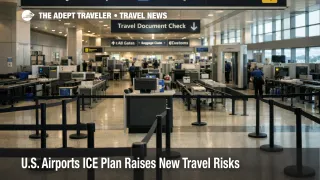
President Donald Trump said on March 22 that Immigration and Customs Enforcement agents would be sent to U.S. airports starting Monday to assist the Transportation Security Administration as the shutdown driven staffing crisis worsens. For travelers, the immediate issue is not just longer lines. It is that the administration is now floating a staffing workaround that appears more plausible for law enforcement presence and crowd control than for actual passenger screening, which is where the biggest airport bottleneck sits. Until a public implementation order spells out who will do what, travelers should plan for continued checkpoint volatility, added uncertainty inside terminals, and a higher chance that airport operations change faster than published line estimates.
ICE At Airports: What Changed
What changed over the weekend is the administration's move from threat to announced deployment. Reuters reported on March 21 that Trump threatened to send ICE agents to airports if the funding standoff continued, then reported on March 22 that he said the deployment would begin Monday to assist TSA. That came after TSA absenteeism rose above 10 percent nationally, with much worse rates at some major airports, and after hundreds of TSA employees had already quit during the shutdown. The result is that the airport story is shifting from slow screening alone to a broader continuity problem, where airports are trying to keep checkpoints open with an increasingly unstable workforce.
The practical problem is that "assist" can mean several very different things. TSA screening is a specialized function. Federal law says passenger and property screening at U.S. airports must be supervised by uniformed TSA personnel, and TSA's own structure centers checkpoint work on Transportation Security Officers or, at a limited number of airports, private screening contractors working under TSA oversight. That makes a rapid ICE takeover of checkpoint screening legally and operationally weak on the current public record. The more credible near term reading is that ICE could be used around the checkpoint rather than as the checkpoint, helping with law enforcement presence, responding to enforcement incidents, or taking on peripheral duties that free some TSA staff for screening.
Which Travelers Face the Most Disruption
Travelers at large hubs with already elevated absentee rates face the highest near term risk, especially those flying during the morning departure bank, spring break peaks, or on itineraries with short domestic to international connections. Recent reporting showed especially severe staffing pressure at New York JFK, San Juan, Atlanta, and Houston Bush, and some airports have already closed specific checkpoints or reduced where TSA PreCheck is available. For those passengers, even a politically dramatic ICE deployment does not solve the core problem if too few trained screeners are available to run lanes, manage bag searches, and process alarms.
International travelers and mixed status families also face a separate exposure. Trump and other coverage around the announcement framed the airport move partly in immigration enforcement terms, not just queue management. That raises the chance that some terminals, curbside areas, or public airport zones could feel more enforcement heavy even if checkpoint screening remains TSA led. For travelers, that does not automatically mean a passport check at the security line for domestic flights, but it does increase the possibility of extra law enforcement activity, more public confusion about who is conducting what function, and a more stressful terminal environment for some passengers.
What Travelers Should Do Now
For departures over the next 24 to 72 hours, travelers should assume checkpoint timing remains unstable even if ICE personnel appear at airports. The main reason is simple, only trained TSA screening staff can handle the core throughput tasks that actually clear passengers through security at scale. Arriving earlier still matters, especially at airports that have already consolidated checkpoints or shown irregular wait times. The first order effect is longer and less predictable screening. The second order effect is tighter pressure on rebooking, hotel nights, rental car extensions, and onward international connections when a missed flight breaks the rest of the itinerary.
The rebook versus wait threshold is also getting sharper. If your trip depends on a short same terminal connection, a final check bag close to departure, or a morning bank at a heavily affected hub, a proactive change can now make more sense than waiting for conditions to normalize at the airport. If you are flying point to point from an airport that has not reported major screening disruption, holding your itinerary may still be reasonable, but only with more buffer than usual. Travelers should watch three signals, checkpoint closures, sudden changes in PreCheck availability, and any public clarification from DHS or TSA on whether ICE personnel are doing anything beyond support and enforcement presence.
Why The Idea Is Hard To Execute, And What Happens Next
The feasibility question is where the proposal looks weakest. ICE's official aviation role is tied to detainee transport and removal operations, not civilian checkpoint screening. TSA, by contrast, runs screening operations at roughly 440 airports, and its job structure makes clear that TSOs perform searches, bag screening, pat downs, and other frontline checkpoint tasks, while lower level support staff only assist passenger flow and bin movement rather than conduct screening themselves. That matters because even TSA's own support model separates throughput support from actual screening authority. Switching in ICE agents without the same training, certification path, and legal operating framework would be a structural workaround, not a clean substitute.
What happens next depends on whether the administration issues a narrow operational plan or tries to use the announcement as political pressure. If the deployment is limited to perimeter support, incident response, and visible law enforcement presence, travelers may see little direct benefit in line speed while still experiencing a more enforcement heavy airport environment. If the White House or DHS tries to push ICE deeper into checkpoint functions, that would invite legal and operational scrutiny because the public record still points to TSA supervised screening as the governing model. For travel planning, the serious risk is not that ICE instantly fixes airport delays. It is that the proposal signals the shutdown has entered a phase where continuity measures are becoming more improvised, and improvised airport operations are usually less predictable for passengers.
Sources
- Trump deploys ICE agents to assist TSA at US airports
- Trump threatens to put ICE agents in airports over funding impasse
- US says TSA absences rose slightly to 10.2% Wednesday
- Security Screening, Transportation Security Administration
- Screening Partnership Program, Transportation Security Administration
- TSA at a Glance, Transportation Security Administration
- Transportation Security Officer, TSA Careers
- ICE Air Operations
- 49 U.S. Code 44901, Screening passengers and property
- TSA officers are quitting as a funding standoff forces them to staff airports without pay