

Azores Inter-Island Flights Face Two-Day Strike Risk
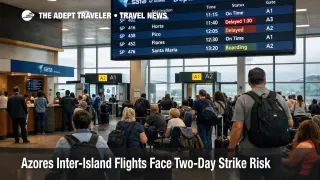
Travelers moving between the Azores islands on March 23 and March 24, 2026 now face a tighter connection window because SATA is warning of airport operational constraints on March 23 linked to a FESINAP action that includes IPMA, Portugal's weather agency, and is also warning that flight disruptions may occur from March 24 because of a SITAVA and SINTAC action covering additional working hours at SATA Air Açores. For island hoppers, the practical problem is that short domestic legs are the glue that holds hotel changes, tours, cruise embarkations, and long haul returns together. Travelers with same day onward flights should add slack now, not at the airport.
Azores Inter-Island Flights: What Changed
The March 23 risk is airport side. SATA says the FESINAP action, which includes IPMA, may disrupt SATA Air Açores operations at airports across the Autonomous Region of the Azores. The March 24 risk is airline side. SATA is separately warning that a SITAVA and SINTAC action regarding additional working hours at SATA Air Açores may disrupt flights from that date. That turns this into a two stage problem, first at the airport operations layer, then at the crew and staffing layer that keeps the inter island schedule moving.
That distinction matters because the Azores network depends on coordinated short sectors rather than a large pool of backup flights. SATA Air Açores plans around 572 inter island flights a week on 16 routes in summer 2026, and the group says schedule coordination between Azores Airlines and SATA Air Açores is a priority precisely so passengers can continue beyond their first island entry point with reduced connection times. When that coordination slips, the knock on effects arrive fast.
Which Island Hops Carry the Most Risk
The most exposed travelers are the ones using a domestic hop to reach or leave an international or mainland Portugal flight through Ponta Delgada or Terceira. SATA's own inter island routing system exists because many passengers enter the Azores through one island and continue to another, which means a delayed domestic sector can break the whole chain even when the long haul ticket itself is still operating. In an earlier Adept Traveler article, Azores Flight Cuts To Hit Budget Routes In March 2026, the site already noted how fragile Azores trips become when travelers rely on stitched connections rather than simple nonstop plans.
The pressure points are likely to be the higher demand inter island links that SATA itself highlighted for added summer flying, especially Ponta Delgada to Terceira, Pico, Horta, and Flores. Travelers heading to Faial, Pico, São Jorge, Flores, or Corvo are less protected than passengers staying on São Miguel or Terceira because backup options narrow quickly once a short sector cancels. Ferries do not solve that for the whole archipelago. Atlânticoline says it runs year round only between Corvo and Flores and among the Triangle islands, while broader Central Group links run from June to September.
What Travelers Should Do Now
Anyone booked on March 23 or March 24 should avoid treating an inter island sector as a routine short hop. A same day self connection from an outer island into Ponta Delgada or Terceira for a mainland or transatlantic departure is now the weak point. Travelers with cruise embarkations, fixed tours, or international returns should check flight status repeatedly, keep hotel and transfer bookings flexible where possible, and contact SATA before travel if their itinerary has a tight domestic to international handoff.
A useful planning threshold here is four hours as a minimum buffer for protected onward flights, and an overnight split for self ticketed long haul returns or cruise departures. That is an inference from the network structure, not a rule SATA has published, but it fits the reality of an island system where replacement capacity is finite and ferry substitution is geographically limited in March. For Triangle only trips, ferries may still offer a fallback. For most other island pairs, they will not.
Travelers who have not started their trip yet should think in terms of itinerary survival, not fare optimization. Waiting may preserve the original booking, but reworking a fragile same day chain before departure may save the trip if the domestic leg is the piece most likely to break. That is especially true for passengers connecting onward from João Paulo II Airport (PDL) or Lajes Airport (TER) to mainland Portugal, North America, or Madeira.
Why The Azores Risk Builds Fast
The Azores are unusually sensitive to small aviation disruptions because air links are not just about convenience. They are the archipelago's territorial glue. SATA's own routing rules show how many travelers depend on an entry island and a second flight to reach their true destination, while the carrier's summer plan shows the network is deliberately built around coordinated onward movement across the islands. When an airport operations issue is followed by a staffing action the next day, recovery can lag the headline event. Aircraft, crews, checked bags, and passenger flows all end up out of sequence.
What happens next depends on whether the March 23 constraints stay limited and whether the March 24 labor action materially reduces the airline's ability to cover short sectors with overtime. The first sign of stabilization would be normal operations across the Ponta Delgada, Terceira, Horta, Pico, and Flores links that SATA itself flags as core or high demand flows. The warning sign is not only cancellations. It is rolling delay that turns a 30 to 60 minute island hop into a missed long haul return, a lost hotel night, or an overnight hold on the wrong island.