

Newark Tower Evacuation Deepens New York Flight Risk
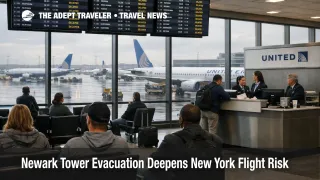
Newark tower evacuation became a bigger travel story on March 23 because it hit the New York air system only hours after LaGuardia Airport shut down following a fatal runway collision. Newark Liberty International Airport (EWR) briefly paused arrivals and departures after controllers evacuated the tower around 7:30 a.m. local time because of a burning smell linked to an elevator, and the Federal Aviation Administration said operations later resumed. By midafternoon, LaGuardia Airport (LGA) had reopened on single runway operations with a ground delay program, but that still left the metro system in a fragile recovery phase rather than a clean reset. Travelers with March 23 and March 24 itineraries through Newark, LaGuardia, John F. Kennedy International Airport (JFK), or tight same day connections should treat schedule recovery, reaccommodation capacity, and airport switching options as the main decision points.
Newark Tower Evacuation: What Changed
The new operational change is not that Newark stayed closed for long. It did not. The problem is that Newark lost reliability during the same recovery window when LaGuardia was already out of normal service. Reuters and AP both reported that Newark's stop lasted less than an hour and that controllers shifted to a backup tower before returning to the primary facility. On its own, that kind of interruption can be absorbed. In the middle of a New York system disruption day, it adds another choke point at the exact moment airlines are trying to reposition aircraft, recover crews, and protect onward passengers.
LaGuardia remained the heavier operational blow. The FAA said Air Canada Express Flight 8646 struck an Aircraft Rescue and Firefighting vehicle after landing around 1145 p.m. local time on March 22, and Reuters reported that the airport closed until 2 p.m. on March 23, with more than 500 cancellations. Delta then said at 215 p.m. ET that LaGuardia had reopened under single runway operations, with a ground delay program in place and additional schedule adjustments still expected. That is why the New York story changed from one airport accident to a metro area recovery problem.
Which New York Itineraries Are Most Exposed
The most exposed travelers are those on United heavy Newark itineraries, especially anyone connecting onward the same day to Europe, the West Coast, or smaller U.S. cities that do not have frequent backup options. United itself continues to market Newark as a major hub, which makes even a short EWR interruption more consequential than the clock alone suggests. Travelers booked through LaGuardia face a different problem, with Delta saying it suspended flights during the closure and continues to reaccommodate customers across LGA, JFK, EWR, and Westchester County Airport (HPN). That means New York area disruption is no longer airport specific once the rebooking wave starts. It becomes a region wide inventory and timing problem.
The itinerary types at highest risk are short layovers, separate tickets, last flight of the day trips, and airport switch plans that depend on predictable road or rail timing. When LaGuardia drops to single runway recovery and Newark is working through a same day tower interruption, displaced passengers do not stay neatly inside their original airport. They spill into JFK alternatives, rail bookings, nearby hotel inventory, and later departures. In an earlier Adept Traveler article, Flight Delays and Airport Impacts: March 18, the site noted how New York flow constraints can widen beyond the original airport trigger. That logic applies even more clearly here because the trigger is not weather, but two separate operational shocks.
What Travelers Should Do Now
For March 23 departures, the smart move is to stop treating a lifted ground stop as normal operations. Check whether your carrier has already shifted you to JFK, EWR, HPN, or a later departure before you leave for the airport. Delta said affected New York area customers can adjust travel across LGA, JFK, EWR, and HPN, and United posted an LGA closure waiver on March 23. Travelers who have a protected connection and no urgent timing need can wait a bit longer for the airline to reroute them. Travelers on separate tickets, cruise embarkations, timed tours, or international departures should lean toward earlier manual changes, because once the best substitutes are gone, the remaining itinerary often becomes more expensive and less protected.
The next decision threshold is whether New York recovery starts shrinking instead of spreading. If your airline app still shows rolling delays, airport changes, or unconfirmed reaccommodation by late afternoon or evening on March 23, assume March 24 first wave departures could remain messy. The same applies if your replacement itinerary adds an airport transfer inside New York. What looks like a simple rebook can fail on the ground if baggage, traffic, or late inbound aircraft break the handoff. In an earlier Adept Traveler article, U.S. Shutdown Airport Risk Shifts to Continuity, the site already flagged a weaker national recovery backdrop, which makes local shocks harder to absorb cleanly.
What Will Show the New York System Is Normalizing
Real normalization will need more than Newark reopening and LaGuardia turning flights back on. The first signal is LaGuardia moving beyond single runway recovery and ground delay management. The second is carriers reducing systemwide New York reaccommodation language rather than expanding it. The third is Newark delay pressure easing from the tower interruption instead of persisting into later banks. FlightAware showed Newark still averaging departure delays on March 23, which fits a slow recovery pattern rather than a full reset.
The larger mechanism is straightforward. Airports recover in banks, not in one clean moment. A closure or pause knocks aircraft, crews, gates, and passengers out of sequence. When two airports in the same metro system are hit before that sequence is rebuilt, the damage spreads into rebooking inventory, missed connections, overnight stays, and airport switching risk. Newark tower evacuation therefore matters less as an isolated safety incident, and more as the second hit that kept the New York system from stabilizing quickly on March 23.
Sources
- Federal Aviation Administration
- National Airspace System Status Map, FAA
- Statement on Air Canada Express Incident at LaGuardia Airport (LGA), FAA
- Newark airport's control tower evacuated after burning smell, FAA says, Reuters
- Air Canada jet collision shuts LaGuardia; pilots killed, dozens injured, Reuters
- A burning smell forces Newark airport control tower evacuation, briefly halting flights, AP News
- New York's LaGuardia Airport reopens, customers encouraged to check Delta app or delta.com for latest flight information, Delta News Hub
- Travel Waiver, New York LaGuardia Airport Closure, United Jetstream
- EWR Newark Liberty Intl Airport, FlightAware