

U.S. Shutdown Airport Risk Shifts to Continuity
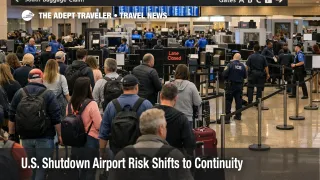
Spring break travelers in the United States are no longer dealing with a story that is only about long security lines. U.S. shutdown airport risk moved into a more serious phase between March 20 and March 22, when Transportation Secretary Sean Duffy warned that major airport delays could worsen, small airports could be forced to shut if staffing slips further, and the White House first floated, then announced, the use of Immigration and Customs Enforcement (ICE) agents to assist TSA at airports starting Monday. That shift matters most for travelers flying out of already stressed hubs, travelers on short connections, and passengers starting trips at smaller airports with fewer screening options. The practical move now is to build more buffer, avoid tight same day connections, and treat airport screening as a continuity risk, not just a wait time problem.
U.S. Shutdown Airport Risk: What Changed
What changed after March 20 is that the operating problem stopped looking like a staffing squeeze that could still be absorbed inside normal airport routines. On March 20, Reuters reported Duffy saying he was worried disruptions at major airports would increase, while Department of Homeland Security figures showed TSA absences at 9.8 percent nationwide on March 19, with much higher rates at major hubs including 32 percent at Hartsfield-Jackson Atlanta International Airport (ATL), more than 30 percent at both Houston airports, 29 percent at John F. Kennedy International Airport (JFK), 27 percent at Louis Armstrong New Orleans International Airport (MSY), and 23 percent at Baltimore/Washington International Thurgood Marshall Airport (BWI). By March 21, Reuters reported that the administration had escalated from warning about attrition to threatening the deployment of ICE agents at airports, while also saying more than 10 percent of TSA officers had called out on more than half of the previous seven days and more than 400 TSA workers had quit since the shutdown began. On March 22, Reuters then reported that ICE agents would in fact be deployed to assist TSA starting Monday.
That is a materially different travel story from the one Adept Traveler covered on March 20. In an earlier Adept Traveler article, TSA Shutdown Delays Deepen at U.S. Airports, the central question was how much worse checkpoint lines could get as another missed paycheck approached. In an earlier Adept Traveler article, U.S. Shutdown Airport Risk Grows This Weekend, the warning widened to system fragility. The new layer is policy instability at the checkpoint itself, because the government is now trying to patch an airport screening problem with personnel who Reuters reported are not specifically trained for TSA duties.
Which Travelers Face the Most Disruption
The worst exposed travelers are the ones who need the airport system to work cleanly at the first point of failure. That includes spring break leisure travelers departing from Atlanta, Houston, New York JFK, New Orleans, and Baltimore/Washington, because those airports were among the hardest hit in Reuters reporting on absentee rates. It also includes travelers beginning trips at smaller airports, because Duffy said those airports could shut down if staffing worsens, while larger hubs can at least compress operations by closing some checkpoints and routing passengers through fewer screening lanes.
International travelers face a sharper second order risk than domestic passengers. A two hour or three hour security delay is already enough to break a domestic itinerary, but on an international trip it can also trigger missed long haul departures, harder reaccommodation, extra hotel nights, rebooked ground transfers, and the loss of prepaid onward rail or cruise segments. Travelers with TSA PreCheck still have some protection because the program remained operational after DHS reversed an earlier suspension plan in February, but Reuters reported that TSA said it would adjust operations case by case as staffing constraints arise. That means PreCheck is still useful, but it is no longer a guarantee that a stressed airport morning will stay manageable.
What Travelers Should Do Now
Travelers flying in the next 24 to 72 hours should act as if screening is the least reliable part of the airport journey. For large hubs with known pressure, arriving earlier than usual is the obvious step, but the more important decision is to avoid building a fragile itinerary around a narrow checkpoint window. A short domestic connection, a same day cruise embarkation, or a long haul departure after a regional feeder flight now carries more risk than the published schedule suggests.
Rebooking early makes more sense when a trip starts at a smaller airport, when the first flight of the day is already thinly staffed, or when missing the outbound would break a nonrefundable sequence later in the trip. Waiting may still be reasonable for point to point domestic travelers with flexible timing and multiple daily backup flights. The next hard threshold is March 27, when TSA officers are set to miss a second full paycheck, because Duffy said the situation is likely to get worse as that date approaches.
Travelers should also monitor the quality of the workaround, not just its announcement. The real signal is whether airports stabilize after ICE support begins on Monday, or whether airports keep reporting checkpoint consolidations, long waits, and widening absences. If large hubs continue showing severe screening pressure after that change, the risk of partial airport shutdowns at smaller fields becomes easier to imagine as an operational outcome rather than a political warning.
Why the Disruption Is Spreading Through Travel
The mechanism is simple and ugly. TSA screening is a bottleneck system, so when enough officers stop showing up, delays do not rise in a straight line. They compound. A few missing staff can be absorbed by shifting lanes and extending waits, but once absences stay elevated for days, airports begin closing checkpoints, concentrating passengers into fewer lanes, and losing their ability to recover from weather, late bag drops, or a single burst of peak demand. Reuters reported that some airports had already closed security checkpoints, while others were raising money to help unpaid TSA workers buy food and other essentials.
That is why the continuity question now matters more than the line length itself. The administration's move to use ICE agents may change the politics of the fight, but it does not remove the core operational problem that Reuters identified, which is that ICE agents are not specifically trained for TSA screening duties and the shutdown has already driven hundreds of TSA workers to quit. In that environment, what happens next depends less on one morning's wait time and more on whether staffing attrition accelerates into the March 27 pay miss, whether more checkpoints consolidate, and whether smaller airports begin losing the minimum screening coverage needed to keep departures moving.
Sources
- US Says Airport Delays Will Worsen as Shutdown Continues, Reuters, March 20, 2026
- Trump Threatens to Put ICE Agents in Airports Over Funding Impasse, Reuters, March 21, 2026
- Trump Deploys ICE Agents to Assist TSA at US Airports, Reuters, March 22, 2026
- US Official Warns Small Airports Could Soon Shut Over TSA Absences, Reuters, March 19, 2026
- Security Lines Hit Three Hours at Some US Airports as TSA Absences Rise, Reuters, March 8, 2026
- Reversing Course, US Will Keep TSA PreCheck Program Operational, Reuters, February 22, 2026
- Oversight Hearing, Potential DHS Shutdown Impacts, TSA, February 11, 2026