

Jordan Travel Advice Hardens Around Amman Exit Runs
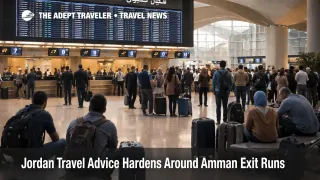
Jordan travel advice is no longer just a background risk note for travelers using Amman as a fallback exit point. On March 7, 2026, the UK Foreign, Commonwealth & Development Office, or FCDO, kept its warning against all but essential travel to all of Jordan outside the Syria border zone, and added more explicit operational guidance, including staying away from security, military, and U.S. government facilities, and following local shelter instructions when sirens sound. That is the meaningful change since Adept's March 6 coverage, because Queen Alia International Airport (AMM) may still be operating, but the ground environment around a same day airport run now carries more decision friction.
The practical takeaway is harsher than yesterday. Travelers can still use Amman, but they should treat Jordan as a constrained staging point, not a clean reset. That means building more transfer buffer, protecting at least one extra hotel night in Amman, and avoiding improvised border to airport sprints unless the flight is confirmed and the ground move is tightly controlled. Insurance also matters more now, because the FCDO explicitly says travel against its advice could invalidate coverage.
Jordan Travel Advice: What Changed for Travelers
The key update is not that Jordan closed. It did not. The FCDO page, current and updated on March 7, still says it advises against all travel within 3 kilometers of the Syria border and against all but essential travel to all other areas of Jordan. What changed is the specificity of the operating instructions attached to that warning. The page now tells British nationals to stay away from security, military, and U.S. government facilities, keep departure plans under review, and when sirens sound, stay indoors or move to the nearest safe building or designated shelter. It also warns that missiles moving through Jordanian airspace have been intercepted, with debris falling in some urban areas, and that Jordanian airspace can be affected with little notice.
That matters because it shifts Amman from "open enough to use" into "usable, but with tighter ground risk." The U.S. Embassy in Jordan said on March 7 that commercial flights are currently operating from Queen Alia, while also telling Americans to avoid protests and demonstrations and follow local official guidance. In other words, air access remains possible, but the safe way to use it is narrower than it looked a day ago.
This is a real escalation from Amman Exit Flights Make Jordan a Cleaner Exit Point, where the main decision was whether AMM remained a workable commercial outlet. On March 7, the better question is whether your ground plan inside Jordan is controlled enough to make that outlet worth using.
Which Travelers Face the Most Friction in Amman
The best fit is still the traveler who already has a confirmed seat out of Amman, a protected transfer plan, documents in order, and enough budget or policy flexibility to absorb an extra night if access slows or airport operations slip. Those travelers are not buying certainty, but they are reducing the number of things that can fail at once.
The highest risk group is the traveler treating Jordan as a same day improvisation. That includes people crossing overland and trying to reach the airport immediately, passengers arriving with a fragile onward connection on a separate ticket, and travelers who assume an operating flight means a stable airport commute. Under the new Jordan travel advice, that logic is weak. Security warnings, siren response instructions, and the possibility of sudden airspace disruption all raise the odds that a theoretically workable departure still turns into a missed check in, a forced overnight, or an unusable ticket.
Friday timing remains a separate drag on airport access. The FCDO says protests sometimes occur in Amman and other cities, and notes instances of Friday protests near the Jordan, Israel border area. Canada's Jordan advisory also warns that demonstrations can disrupt traffic and public transportation. Travelers moving on Thursdays or Fridays should therefore assume extra road friction, especially if their route passes politically sensitive areas or depends on tight urban timing.
For travelers who still have other exit choices, this is also where Jordan starts to look less clean relative to alternatives. UAE Oman Border Crossings Offer Overland Exit showed a different kind of fallback logic, one built around named land crossings rather than a capital city airport run inside a more explicit shelter and facilities warning environment.
What Travelers Should Do Now
Travelers using Amman should stop planning for a fast handoff and start planning for a staged departure. The safest workable pattern is to arrive in Amman with time to spare, sleep near the airport or on a controlled city to airport transfer, and keep food, power, medications, and offline documents ready in case sirens or localized disruption slow movement. Do not build an itinerary that assumes you can cross a border, clear the city, and board with no slack.
Rebook or reroute if your plan depends on a tight same day transfer, an uninsured nonessential trip, or a separate onward ticket that becomes worthless after even a short delay. Wait only if you have a protected booking, a reasonable buffer, and a strong reason to preserve the trip. The tradeoff is simple, waiting may preserve fare value, but early rerouting may preserve the trip itself. Travelers also need to review whether their policy still responds under a destination that the FCDO advises against except for essential travel.
Over the next 24 to 72 hours, monitor airline notices, Jordanian airspace status, local protest conditions, and any new embassy alerts before you move toward Queen Alia. For document prep and border basics, Jordan Entry Requirements For Tourists In 2026 remains useful background, but entry compliance is now only one piece of the decision. The harder problem is whether your timing, route, and insurance posture still make Jordan travel advice compatible with a safe airport exit plan.
Why Amman Is Still Usable, but Less Forgiving
The mechanism here is straightforward. A partially open airport does not remove the ground risk around it. The more official guidance emphasizes sirens, shelter behavior, sensitive facilities, debris risk, and last minute airspace disruption, the less Jordan functions like a normal transit platform and the more it behaves like a narrow release valve.
First order, travelers can still leave from AMM on operating flights. Second order, more people will protect themselves by arriving earlier, holding hotel rooms longer, and using more conservative transfer timings. That pushes cost and room demand into Amman, raises pressure on airport area transport, and makes separate ticket strategies even more fragile. It also means that travelers who are technically "out of the worst zone" may still be operating inside a city where road timing and shelter instructions can suddenly matter. That is why the FCDO's March 7 update changes the decision even without a full airport closure.
The broader security picture also explains why the tone hardened. On its Jordan safety page, the FCDO says Iran aligned militia groups have threatened U.S. interests across the region, claimed attacks in Jordan, and are very likely to continue carrying out attacks in Jordan. Whether or not a traveler ever goes near a target, that changes how authorities, embassies, insurers, hotels, carriers, and travelers all price risk. For now, Amman remains a possible exit point. It is just no longer an easy one.