

Iraq Airspace Closure Forces Overland Exit Decisions
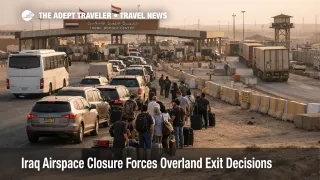
Iraq remains an overland only travel problem on March 13, 2026. The U.S. Embassy in Baghdad says Iraq airspace is closed, commercial flights are not operating, and travelers looking to leave are being pointed toward land routes to Jordan, Kuwait, Saudi Arabia, and Türkiye. That is a different traveler decision from Adept's recent Lebanon and UAE coverage, because the main question is no longer which seat to buy, but whether you can clear a border legally, safely, and with enough time to catch an onward flight that still operates. For most travelers, the right move is to treat any Iraq exit as a document first, route second plan, and to avoid same day improvisation.
The practical problem is not only the lack of flights. Iraq also remains under a U.S. Level 4, Do Not Travel advisory, with the State Department saying Americans should leave now if they are there and noting the U.S. government's limited ability to provide emergency services in country. That makes border rules, driver reliability, and onward ticket protection more important than headline airfare.
Iraq Airspace Closure: What Changed for Travelers
What changed is that Iraq now clearly belongs in the overland exit category, not the disrupted flight category. Embassy messaging on March 12 again stated that airspace is closed, commercial flights are not operating out of Iraq, and overland routes to Jordan, Kuwait, Saudi Arabia, and Türkiye remain the available options. The same embassy guidance warns that most land border crossings are open now, but may close without prior notice, and that travelers should expect long delays.
That turns the operational center of gravity from airports to border posts. In practice, the most likely corridors are Trebil to Karameh for Jordan, Safwan to Abdali for Kuwait, Jadidat Arar for Saudi Arabia, and Ibrahim Khalil to Habur for Türkiye. Trebil is Iraq's only official entry point to Jordan, and Ibrahim Khalil is the main Iraq to Türkiye road crossing.
The regional backdrop also matters. Saudi Arabia is still operating commercial flights, but under a fresh U.S. Level 3 advisory tied to drone and missile risk, while southeast Türkiye is under tighter U.S. personnel restrictions and the U.S. Consulate in Adana has suspended consular services. So crossing the border is not the same thing as crossing into a stable onward travel environment.
Which Iraq Exit Plans Are Most Viable, and for Whom
The Jordan route is still the cleanest on paperwork for many U.S. travelers. State Department guidance says Jordan generally requires six months of passport validity and issues visas on arrival to U.S. citizens at most international land crossings. That makes the Trebil to Karameh corridor the most workable option for travelers who can secure a vetted driver, tolerate a long road move, and stage an onward departure from Amman. It is also the route most likely to strain under demand, and Jordan's current security messaging still tells travelers to avoid protests and demonstrations. Adept's own Jordan Entry Requirements For Tourists In 2026 is useful background before anyone commits to that border plan.
Türkiye looks attractive on paper because U.S. citizens do not need a tourist visa for stays under 90 days, but the route is not friction free. The Ibrahim Khalil crossing feeds into southeast Türkiye, where the State Department says Americans are strongly encouraged to depart now and where Adana consular services are suspended. That makes Türkiye better suited to travelers already positioned in northern Iraq with a short road move and a fast onward plan, not to travelers in Baghdad or farther south trying to build a long rescue chain through multiple checkpoints.
Kuwait and Saudi Arabia are narrower options. Kuwait issues visas or visas on arrival to U.S. citizens, with six months of passport validity expected, so Safwan to Abdali can work for travelers who already have a driver and a confirmed flight from Kuwait City. Saudi Arabia is harder, because U.S. travelers need a visa, and the country is operating under a tougher threat environment even though commercial flights continue. Saudi therefore works better for travelers who already hold valid entry rights or who can secure them before moving, not for people hoping a border officer will solve the problem on the day.
What Travelers Should Do Now
Start with a hard paperwork screen before you leave your hotel, residence, or compound. You need a passport with enough validity for the next country, proof that you can legally enter it, cash and cards that will still work after a long road transfer, hotel backup near the border or onward airport, and a ticket out of the neighboring country that has enough buffer to survive checkpoint delays. Travelers on separate tickets should be especially conservative, because one missed land handoff can break the whole itinerary without protection.
The main threshold is simple. Attempt self evacuation only if you have a legal right to enter the next country, a trusted transport plan, and an onward air option you can still reach after a long delay. Do not attempt it if your passport is near expiry, your visa situation is uncertain, you are moving with children, elderly travelers, or medical needs, or you are relying on a driver, border opening, and onward flight all lining up on the same day. In those cases, you need formal assistance or a much more controlled departure plan, not a hopeful border run. The same logic sits behind Adept's recent Lebanon Beirut Exit Planning Gets Harder and UAE Airport Access Tightens for Stranded Travelers, even though Iraq is now a harder version of that problem.
Over the next 24 to 72 hours, monitor embassy alerts for Iraq and the destination country, changes in border status, and whether onward carriers are actually operating from Amman, Kuwait City, Riyadh area gateways, or Turkish airports. The biggest mistake now is treating a border crossing as the finish line. It is only the midpoint. The real goal is a complete exit chain that survives delays, document checks, and fast changing regional security conditions.
Why the Disruption Spreads Beyond Iraq's Airports
The first order effect is obvious, no commercial air exit from Iraq. The second order effect is where travelers get hurt. Once everyone is funneled onto roads, pressure shifts to checkpoints, drivers, fuel stops, hotels near crossing points, and last minute air inventory in neighboring countries. That is why Iraq is no longer just an aviation shutdown story. It is a border logistics story, and those fail in slower, messier ways than canceled flights do.
There is also a support problem. The State Department says it ordered non emergency U.S. government employees out of Iraq on March 2, and its country page stresses that the government's ability to provide emergency services inside Iraq is limited. When support capacity thins, travelers lose fallback options first, then time, then money. A missed border crossing can turn into an overnight stay, a missed onward departure, and a more expensive rebooking chain in a second country.
That is why the best Iraq exit plan right now is not the theoretically shortest route. It is the route with the fewest legal unknowns and the widest timing buffer. For many travelers, that still points to Jordan first, Türkiye second if they are already in the north, and Kuwait or Saudi Arabia only when their entry status and onward plan are already clear.
Sources
- Security Alert, U.S. Embassy Baghdad, Iraq, March 12, 2026
- Iraq International Travel Information, U.S. Department of State
- Jordan International Travel Information, U.S. Department of State
- Kuwait International Travel Information, U.S. Department of State
- Türkiye International Travel Information, U.S. Department of State
- Türkiye Travel Advisory, U.S. Department of State
- Saudi Arabia International Travel Information, U.S. Department of State
- UNODC Supports Iraq's Border Management in Trebil
- UAE Airport Access Tightens for Stranded Travelers
- Lebanon Beirut Exit Planning Gets Harder
- Jordan Entry Requirements For Tourists In 2026