

U.S. TSA Shutdown Travel Waivers Expand at Key Hubs
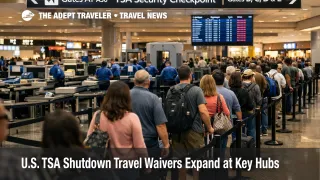
U.S. TSA shutdown travel waivers are no longer just a broad traveler complaint story, they are now producing targeted airline flexibility at some of the country's most strained hubs. Delta has posted an Atlanta waiver tied to longer security wait times, United is listing a Houston flexibility alert, and Allegiant has gone further with a temporary policy that lets eligible customers across its network change or cancel without penalty during the shutdown. The shift matters most for travelers flying in the next several days through Hartsfield-Jackson Atlanta International Airport (ATL), George Bush Intercontinental Airport (IAH), and other airports where TSA staffing gaps are stretching lines into a real missed flight risk.
TSA Shutdown Travel Waivers: What Changed
The new development is not just long checkpoint lines. Airlines are now formalizing flexibility around them. Delta's current Atlanta advisory says travel originating from ATL may be affected by longer security wait times, covers travel dates from March 23, 2026 through March 30, 2026, and allows eligible customers to rebook with the ticket reissue and new travel start deadline set for April 6, 2026.
United's travel alerts page is also showing a Houston flexibility waiver for George Bush Intercontinental Airport, with the search result indicating IAH is covered and that the alert applies to tickets originally purchased on or before March 22, 2026. Because United's public page is not exposing the full waiver text cleanly in the live open view, the most defensible reading is that Houston is now part of United's active flexibility program, but travelers should still open the live alert before relying on the exact permitted rebooking window.
Allegiant has taken a broader approach. On March 23, 2026, the carrier announced a temporary "Travel with Confidence" policy for new and existing bookings, saying customers with flights departing between now and the end of the partial government shutdown can change or cancel without penalty. Allegiant says the policy includes no change fees for eligible bookings and the option to cancel for a refund without penalty.
Which Travelers Face the Most Disruption
The travelers under the most pressure are not just anyone flying during the shutdown. The highest risk is concentrated among passengers departing from large hubs where TSA absences have spiked, especially those with checked bags, family groups, early morning departures, or tight same day onward connections. Reuters reported on March 25, 2026 that TSA officer absences were above 10 percent nationally, above 30 percent at some major airports, and that some travelers were waiting more than four hours. Acting TSA leadership also warned Congress that worsening staffing shortages could force airport closures in some cases.
Atlanta and Houston stand out because they combine very high passenger volume with visible staffing strain. Delta's Atlanta waiver confirms the carrier sees enough operational risk to offer flexibility there, while Houston has become a focal point of the shutdown travel problem as United's Houston alert went live.
There is also a political side effect that does not directly help ordinary travelers, but does show how seriously airlines view the disruption. Delta has temporarily suspended specialty services for members of Congress, including airport escort style services, while keeping a reservations line open. That does not change airport operations for most passengers, but it signals that carriers are reallocating attention and service resources during the shutdown.
What Travelers Should Do Now
Travelers flying out of Atlanta or Houston in the next several days should stop treating published departure time as the real clock. The main pressure point is now the security checkpoint, not only the gate. If you are on Delta from Atlanta, the current waiver gives you a clean reason to move an at risk itinerary earlier or later while the flexibility window remains open. If you are on United from Houston, check the live travel alert before leaving for the airport and screenshot the waiver details in case the page changes.
For Allegiant customers, the temporary shutdown policy creates a different decision. Travelers who are price sensitive but schedule flexible now have more room to avoid the worst departure days entirely, instead of gambling that airport lines will normalize in time. That is especially useful at smaller airports where Allegiant operates, because the carrier is framing the policy as network wide rather than tied to only one hub.
The main decision threshold is simple. Rebook now if your trip depends on a same day connection, a cruise embarkation, a prepaid tour, or an event with little recovery room. Wait only if your trip is nonstop, easily moved, and your airline has already posted a waiver that protects you. Over the next 24 to 72 hours, travelers should watch for three signals, additional airport specific waivers, longer airline recommended arrival times, and any fresh TSA warning about checkpoint consolidation or airport closures.
Why the Shutdown Is Spreading Into Airline Policy
The mechanism is straightforward. TSA staffing losses do not only slow screening, they compress the usable departure window for every traveler behind the line. Once that happens at a major hub, the effect spreads outward. First order, passengers miss flights or arrive too late to check bags. Second order, rebooking inventory tightens, later flights fill, nearby hotels get dragged into the disruption, and travelers with onward rail, cruise, or international connections lose the cushion that normally absorbs a bad airport morning.
That is why the current airline response matters. Delta is using a hub specific waiver where the checkpoint problem is acute, United appears to be doing the same in Houston, and Allegiant is using a broader confidence policy to reduce booking friction during an unstable operating period. None of that fixes the core problem, which remains unpaid TSA staffing during the partial shutdown. Until funding resumes or staffing stabilizes, travelers should expect more carrier by carrier flexibility notices rather than a clean nationwide reset.
Sources
- Delta Atlanta Flexibility Advisory
- Delta Current Advisories
- United Travel Alerts
- Allegiant Launches "Travel with Confidence" Policy
- Reuters, Long lines reported at major U.S. airports as more TSA officers quit
- AP, TSA boss warns of airport shutdowns, but no deal yet on day 40 of Homeland Security funding fight
- Reuters, Delta suspends special treatment for Congress as shutdown sows chaos in airports