

Flight Delays and Airport Impacts: March 27
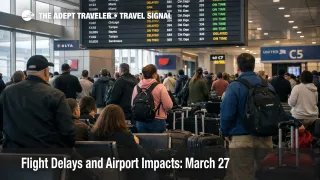
March 27 flight delays are less broad than March 26, but the Federal Aviation Administration is still flagging several pressure points that can break tight itineraries. The main trouble bands are New York area flow, low ceilings in San Diego, possible ski country flow controls later in the day, and Florida routing pressure tied to high snowbird and Caribbean volume. For travelers, this looks more like a corridor problem than a nationwide meltdown. Leave more buffer if you are connecting through the Northeast, San Diego, Denver area mountain markets, or South Florida, and expect the risk to rise into the afternoon if the FAA moves from warnings to active traffic management programs.
March 27 Flight Delays: What Changed
The FAA's March 27 operations plan is narrower than the March 26 setup. The daily air traffic report on March 26 warned about wind in New York and Philadelphia, thunderstorms in Chicago, Detroit, and Denver, plus low clouds in Houston and San Diego. By contrast, the March 27 operations plan points to wind pressure around the New York and Philadelphia flow, thunderstorms affecting Chicago and nearby airspace, low ceilings in San Diego, and heavier traffic management attention on ski country, Caribbean traffic, and Florida routes. LaGuardia Airport still carried the most concrete early delay signal, with the FAA showing a traffic management program that was delaying some arriving flights by an average of 2 hours and 22 minutes as of the latest posted status, while Newark Liberty International Airport (EWR), Chicago O'Hare International Airport (ORD), John F. Kennedy International Airport (JFK), and Philadelphia International Airport (PHL) were showing lighter general delay conditions at the time checked. In an earlier Adept Traveler article, Flight Delays and Airport Impacts: March 26 the FAA picture was spread across more major hubs at once. March 27 looks more targeted, but targeted disruption can still be expensive when it hits dense connection banks.
Which Travelers Face the Most Disruption
The most exposed travelers are people connecting through the New York metro system, flying into or out of San Diego International Airport (SAN), heading to ski country airports later in the day, or moving through South Florida routings that can get pinched when the FAA starts layering route controls onto heavy leisure demand. The FAA's current plan lists a possible ground stop in San Diego after 1200Z, possible ski country ground stop or delay programs after 1500Z, a possible Newark ground stop or delay program after 1530Z, and a possible Palm Beach International Airport (PBI) program after 1700Z. It also notes a staffing trigger in Jacksonville Center, which covers large parts of the Southeast and Florida overflight structure, and says additional route structure and miles in trail restrictions may be needed on Florida's west coast. That matters even for travelers who are not flying to Florida, because constrained overflight routes can slow aircraft rotations and push later departures off schedule. In an earlier Adept Traveler article, March 26 Weather Delays Shift to New York, Chicago the risk was more clearly split between New York wind and Midwest storms. On March 27, the risk tilts more toward connection timing, reroutes, and late-day flow controls.
What Travelers Should Do Now
If you are flying through LaGuardia Airport (LGA), Newark, San Diego, Denver area ski gateways, or South Florida on March 27, the smart move is to treat short connections as optional rather than dependable. A schedule can look fine at departure and still degrade later once the FAA activates a ground stop, a ground delay program, or route restrictions. That is especially true on days when weather, staffing, and traffic volume interact across several centers rather than at one airport alone.
Travelers deciding whether to rebook should use timing, not anxiety, as the threshold. If your trip depends on a same day meeting, cruise embarkation, timed entry booking, or a final flight of the evening, extra buffer is worth more than waiting for a formal waiver. If you are on an earlier nonstop and the airport status still shows only minor taxi or airborne delay, waiting may be reasonable. If you are on a late afternoon or evening connection through an airport the FAA has already flagged for possible traffic management programs, moving earlier or shifting to a nonstop is the safer play. Travelers also need to watch the front end of the trip, not just the flight status board. In an earlier Adept Traveler article, Airport Security Delays Could Outlast the Shutdown the broader checkpoint risk remained a separate layer that can compound any FAA flow issue.
Why the Pressure Is Concentrated, and What Happens Next
The mechanism on March 27 is a classic network compression pattern. Wind in the Northeast can reduce arrival efficiency in already dense airspace. Low ceilings at San Diego can force spacing changes and reduce operational flexibility. Ski country volume can require flow programs even when the weather signal is not the biggest headline. High snowbird and Caribbean demand then adds pressure to Florida routings, and the FAA's operations plan shows that Jacksonville Center staffing could further tighten the Southeast flow picture. The first order effect is delay at the affected airport or route. The second order effect is what travelers actually feel, late inbound aircraft, weaker rebooking options, longer connection walks with less margin, and a greater chance that one delayed segment breaks the rest of the itinerary.
What happens next depends on whether the FAA's planned programs stay precautionary or turn active in larger numbers. Early checks showed LaGuardia carrying the heaviest posted average arrival delay among the major airports reviewed, while Newark, JFK, Chicago O'Hare, and Philadelphia were still operating with relatively limited general delays. That means March 27 begins as a manageable day in much of the system, but it is not a low risk day everywhere. Travelers should monitor airport specific FAA status pages, airline app updates, and connection viability through the afternoon rather than assuming the morning picture will hold.
Sources
- FAA Daily Air Traffic Report
- FAA Current Operations Plan Advisory, March 27, 2026
- LaGuardia Airport Real-time Status
- Newark International Airport Real-time Status
- Chicago OHare International Airport Real-time Status
- John F Kennedy International Airport Real-time Status
- Philadelphia International Airport Real-time Status