

Flight Delays and Airport Impacts: March 29
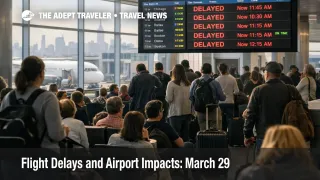
March 29 flight delays are no longer a scattered, low level nuisance. The FAA is showing a much sharper problem at LaGuardia Airport (LGA), where a traffic management program is delaying some arrivals by an average of 3 hours and 9 minutes, while South Florida is already posting weather related departure friction at Miami International Airport (MIA). The broader FAA operations plan also flags thunderstorms around Miami, Fort Lauderdale, and Palm Beach, wind at Orlando International Airport (MCO) and Harry Reid International Airport (LAS), low ceilings at Los Angeles International Airport (LAX) and San Diego International Airport (SAN), and likely mountain airport pressure later in the day. For travelers, this is a protect the itinerary day, especially if the trip depends on New York, Florida, a late connection, or a last flight bank.
March 29 Flight Delays: What Changed
What changed from March 28 is that the pressure is more uneven, and more dangerous for the travelers caught inside it. In an earlier Adept Traveler article, Flight Delays and Airport Impacts: March 28, the FAA picture was fragmented, with smaller drag points spread across the map. On March 29, the live problem is more concrete. The FAA airport status page for LaGuardia shows destination delays averaging more than three hours, which is a materially harder operating problem than the modest New York slowdown seen a day earlier.
The FAA's current operations plan also shows the rest of the network is not clean behind that headline. South Florida is under thunderstorm related constraints, the agency has active Florida and ski country flow programs, and it is still warning about low ceilings in Southern California and wind at Orlando and Las Vegas. That combination matters because it creates more than one place where a delay can be inherited. A New York arrival program, a Florida reroute, or a late mountain turn can all break an itinerary that looks manageable on a departure board early in the day.
There is one important limit to the problem. This is not yet a coast to coast meltdown. Chicago O'Hare International Airport (ORD), John F. Kennedy International Airport (JFK), Newark Liberty International Airport (EWR), and San Diego were still showing only light general delays when checked. The danger is not a national collapse. It is a day where one strong choke point and several secondary drag zones can punish tight schedules.
Which Travelers and Airports Face the Most Risk
The most exposed travelers are anyone flying into LaGuardia, anyone connecting through New York airspace on a short domestic bank, and anyone whose trip depends on South Florida or Orlando staying fluid into the afternoon and evening. Miami was already posting weather driven gate hold and taxi delays of 31 to 45 minutes and rising when checked. That is still far below LaGuardia's headline delay, but it is enough to damage a connection or narrow same day rebooking options once Florida demand stacks into the late day push.
Mountain airport travelers also carry more risk than a calm origin screen might suggest. The FAA plan shows active ski country flow initiatives and warns of high snowbird volume across the National Airspace System. That means the most vulnerable itineraries are not only the ones beginning in trouble spots. A traveler leaving a normal looking airport for a connection into Denver, Vail, Aspen, or another mountain market can still inherit a late aircraft, a metered arrival, or a missed onward segment.
There is also a separate airport front end risk that has not fully disappeared. In an earlier Adept Traveler article, TSA Pay Order Leaves U.S. Airport Delays Live, the central warning was that checkpoint recovery would lag the political headline. That still matters on March 29. Even where the FAA flow picture is manageable, long screening lines or weakened staffing can remove the time cushion travelers need to absorb a moderate flight delay.
What Travelers Should Do Now
Treat today as a decision timing day. If your trip depends on LaGuardia, a short connection through the New York system, a Florida airport after midday, or a mountain airport arrival late in the day, protecting time is worth more than waiting for a bigger headline. The best early signal is usually your inbound aircraft, not your own departure time. If that aircraft is already late, the risk to the rest of the itinerary is real even if your origin airport still looks calm.
Rebooking early makes the most sense when the trip breaks if one segment slips. That includes cruise embarkations, fixed event arrivals, international departures, and the last practical flight of the day. Waiting is more reasonable if you are flying early, nonstop, and your airport is still showing only minor general delays. The tradeoff is simple, waiting may preserve your original plan, but moving early can preserve the trip itself.
The next few hours matter more than broad national headlines. Watch whether LaGuardia delay averages improve or worsen, whether South Florida weather restrictions broaden, and whether ski country controls begin to slow more inbound traffic. Travelers who want more system context on why localized FAA constraints spread so easily can read U.S. Air Traffic Control Privatization: Reality Check.
How the Pressure Can Spread Through Tonight
The mechanism on March 29 is straightforward. When weather, low ceilings, wind, or volume reduce how many flights can safely arrive, the FAA meters traffic with delay programs, routing restrictions, and flow controls. First order, that slows departures and arrivals at the affected airport. Second order, aircraft and crews arrive late somewhere else, later flight banks lose resilience, and same day reaccommodation thins out.
That is why March 29 flight delays can stay costly even if only a few airports look bad on paper. A hard LaGuardia delay program can distort New York timing well beyond LGA itself. South Florida thunderstorms can slow aircraft that are supposed to turn north later in the day. Mountain airport volume can hit after the system has already lost slack. Add in the Washington area air traffic fragility seen on March 27 and 28, and a day that starts with one major pressure point can still finish with broader airport impacts. The traveler takeaway is clear, March 29 flight delays are most dangerous for late connections, inherited aircraft turns, and trips with no room for recovery.
Sources
- Current Operations Plan Advisory, ATCSCC ADVZY 052 DCC 03/29/2026
- Current Reroutes
- La Guardia Airport Real-time Status
- Miami International Airport Real-time Status
- San Diego-Lindbergh Field Airport Real-time Status
- FAA Says Traffic Resumes at Washington Area Airports
- Washington-area Airports Halt Flights Due to Chemical Smell at Air Traffic Center