

TSA Pay Order Leaves U.S. Airport Delays Live
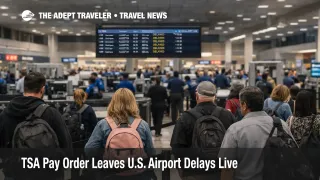
President Donald Trump's March 27, 2026 memorandum changes the airport story, but it does not finish it. The White House directed DHS and OMB to use funds tied to TSA operations to pay TSA employees, and DHS said officers should begin seeing paychecks as early as Monday, March 30. That should reduce the immediate financial pressure driving absences and resignations. It does not end the partial Department of Homeland Security shutdown, and it does not instantly restore normal checkpoint throughput at stressed airports.
TSA Pay Order Airport Delays: What Changed
What changed is that the administration created a temporary pay bridge for TSA after Congress split into two incompatible tracks. The Senate had already approved funding for TSA and most of DHS, but House Republicans rejected that path and instead passed a separate short term bill to fund the full department through May 22, 2026. Senate Democratic leaders signaled that House bill would not pass the Senate, which leaves the broader shutdown unresolved even though TSA pay is now moving on a separate executive track.
For travelers, that means the main risk shifted from "Will TSA workers be paid at all?" to "How fast can airport operations recover after weeks of damage?" The White House memorandum itself says more than 60,000 TSA employees were affected, including about 50,000 officers performing airport security functions, and says nearly 500 officers left their positions during the shutdown. Reuters reported that nearly 12 percent of airport security officers did not report to work on Thursday, March 26, and that some lines stretched to four hours or more.
Which U.S. Travelers Still Face the Most Delay Risk
The travelers most exposed are people flying this weekend, anyone departing during morning rush banks, families checking bags, and passengers whose trip breaks if one segment slips. That includes cruise passengers, people on the last flight of the day, and anyone booked on short domestic connections. Pay restoration helps the system, but it does not instantly replace workers who quit, normalize attendance, or rebuild lane coverage at airports that have already been running thin.
The risk is also uneven. Reuters reported especially severe absenteeism and long lines at New York's John F. Kennedy International Airport (JFK), Baltimore/Washington International Thurgood Marshall Airport (BWI), George Bush Intercontinental Airport (IAH), and Hartsfield, Jackson Atlanta International Airport (ATL). That matters because uneven recovery is harder to read than a full system collapse. One airport may stabilize quickly once pay resumes, while another can keep producing long screening lines because staffing, local demand, and recent attrition do not recover at the same speed.
In an earlier Adept Traveler article, U.S. Airport Delays Stay High After House Rejects TSA Fix, the core point was that the political headline had changed before the airport problem had. That remains true now. In an earlier Adept Traveler signal, Airport Security Delays Could Outlast the Shutdown, the warning was that screening recovery would lag any funding fix. The executive pay move makes that lag the central traveler issue.
What Travelers Should Do Now
Travelers flying on Saturday, March 28, 2026, through the rest of the weekend should keep extra airport buffer in place rather than cutting it because of the pay announcement. If your airport or airline is still warning about security delays, act on the local advisory, not the national headline. A political step in Washington can improve the staffing outlook without changing your checkpoint time that same morning.
The next decision point is whether your itinerary can absorb a screening failure. Rebook early, switch to a later departure, or move to a nonstop if missing the flight would wreck the trip. Wait only if your departure airport is operating normally, your connection is not tight, and you can tolerate a delay without losing a cruise, hotel night, tour, or event. Travelers driving to the airport should also build extra road and parking time, because the problem is not only the queue itself, but the way long queues compress everything upstream of the checkpoint.
Over the next 24 to 72 hours, the most useful signs are airport specific, not political. Watch for airports dropping emergency wait warnings, reducing unusually early arrival guidance, and returning to normal screening footprints. If those signals do not appear even after pay starts landing, the system is still absorbing the effects of a six week staffing shock.
Why Recovery Still Looks Uneven
The mechanism is simple. Airport screening is a trained labor system, not a switch that flips back on when money restarts. The memorandum authorizes TSA compensation using funds with a "reasonable and logical nexus" to TSA operations, but it also says regular funding still has to be restored. Reuters separately reported that it remains unclear how long the emergency funding can last. So the pay order is operational relief, not a durable settlement.
First order, resumed pay should lower some immediate absentee pressure and reduce the risk of further short term workforce erosion. Second order, travelers may still see missed flights, weaker same day rebooking, extra hotel nights, rental car substitutions, and spillover to nearby airports while checkpoint staffing stabilizes. Congress also leaves Washington with the House and Senate on different bills, which means the wider DHS funding fight is still unresolved.
What happens next depends on whether the pay move buys enough operational stability for airports to recover before the broader shutdown fight is settled. The traveler takeaway is straightforward. Conditions should improve from the worst point, but this is not a clean all clear.
Sources
- Paying Our Great Transportation Security Administration Officers and Employees
- DHS orders payment of 50,000 US airport workers in emergency action
- Trump signs executive action to pay TSA employees
- U.S. Airport Delays Stay High After House Rejects TSA Fix
- Airport Security Delays Could Outlast the Shutdown