

U.S. Airport Security Lines Ease, Recovery Stays Fragile
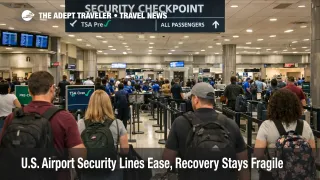
U.S. airport security lines eased at several major hubs on Monday, March 30, 2026, after TSA officers began receiving pay following President Donald Trump's March 27 emergency directive. Airports in Baltimore, Houston, New York, New Orleans, and Dallas reported much shorter lines after weeks of severe disruption tied to the 45 day partial Department of Homeland Security shutdown. For travelers, the improvement is real, but it is not the same thing as a full recovery. The immediate play is to keep extra screening buffer, especially at airports that had multi hour waits late last week, because the system is still absorbing staff losses, elevated absences, and spring break demand.
U.S. Airport Security Lines: What Changed
What changed on March 30 is that checkpoint pressure finally started to ease at some of the airports that had become symbols of the shutdown's airport damage. Reuters reported very short lines Monday in Baltimore, Houston, New York, New Orleans, and Dallas after TSA workers began seeing pay hit their accounts. That is a meaningful operational shift from the late week pattern, when some airports were reporting waits of up to four hours and Friday absenteeism reached 12.4 percent nationally, with especially sharp no show rates in Houston, New York JFK, Baltimore, Atlanta, and New Orleans. More than 500 TSA officers have quit since February, which means the recovery starts from a weaker staffing base than the one the shutdown disrupted.
That makes this an early stabilization signal, not a clean return to normal. In an earlier Adept Traveler article, TSA Pay Order Leaves U.S. Airport Delays Live, the main warning was that restarting pay would not instantly rebuild checkpoint throughput. Monday's shorter lines support the first half of the recovery case, but not the second. Hundreds of Immigration and Customs Enforcement and Homeland Security Investigations personnel remain deployed at 14 airports to support screening operations, which shows the federal response is still compensating for a system that has not yet fully healed.
Which Travelers Still Face the Most Risk
The most exposed travelers are still those departing from large hubs during banked morning departures, travelers trying to keep tight airport routines, and anyone depending on fast checkpoint passage to protect a short connection, same day cruise embarkation, or fixed arrival window. The airports that improved Monday are also some of the airports that had seen the most visible strain, which means recovery may stay uneven by terminal, by hour, and by staffing shift even if the national picture looks better on average. The Washington Post reported that Houston's George Bush Intercontinental Airport dropped from extreme waits to far shorter lines Monday, but New York LaGuardia still had at least one checkpoint running much longer than others.
Spring volume is what keeps this from becoming a simple good news story. Airlines for America said on February 24 that U.S. airlines expected to carry 2.8 million passengers a day from March 1 through April 30, with 171 million passengers projected for the season. High volume reduces the system's margin for error. First order, a smaller staffing gap can still create long security lines if departures bunch at the same time. Second order, those longer lines can spill into missed bag drop cutoffs, failed airport transfers, missed onward flights, and more expensive same day rebooking. In an earlier Adept Traveler article, Houston TSA Line Sitters Draw Airport Warning, the local effect of that stress was already visible in passenger behavior.
What Travelers Should Do Now
Travelers flying in the next 24 to 72 hours should treat Monday's improvement as permission to stop assuming worst case waits at every airport, but not as a reason to go back to normal timing. The safest move is still to build more buffer than usual before security, especially at airports that were warning about unusually long lines late last week. If your trip includes a short domestic connection, a cruise embarkation, a conference arrival, or a same day event, protecting the front end of the itinerary remains more valuable than squeezing airport time.
The decision threshold is straightforward. If your airport has removed its earlier emergency arrival warnings and checkpoint times remain stable through your departure window, you can start stepping back from extreme buffers. If the airport is still reporting long waits, terminal specific bottlenecks, checkpoint consolidation, or unusually early arrival guidance, keep the larger cushion. Travelers who have flexibility should still favor nonstop flights over tight hub connections until the known pressure airports show several consecutive days of normal screening performance. In an earlier Adept Traveler signal, Airport Security Delays Could Outlast the Shutdown, the core warning was that staffing recovery would trail any political funding fix. That remains the right reading now.
Why the Recovery Could Still Stall
The mechanism is simple. Restarting pay can improve attendance quickly, but it does not instantly replace officers who quit, restore morale, or rebuild full screening resilience across large airport networks. Reuters reported more than 500 departures from TSA since February, and that matters because airport security is a trained staffing system, not just a headcount system. A thinner roster can look manageable on a calm Monday morning and still fail more quickly when weather, uneven shift coverage, or a concentrated departure bank adds pressure.
What happens next depends on whether the visible airport improvement turns into a sustained staffing recovery while the broader DHS funding fight remains unresolved. The clearest stabilization signs would be multiple days of normal waits at the hardest hit hubs, fewer airport warnings about early arrival, and a continued drop in absenteeism. The clearest warning signs would be renewed multi hour lines, continued dependence on temporary federal support at airports, or new terminal specific choke points as spring break traffic continues. In an earlier Adept Traveler article, U.S. Airport Delays Stay High After House Rejects TSA Fix, the useful distinction was that a political shift did not automatically solve the airport problem. March 30 brought the first real sign that the airport side may finally be improving, but travelers should still read that improvement as fragile.
Sources
- Major US airports return to normal as TSA workers get paid, Reuters
- DHS orders payment of 50,000 US airport workers in emergency action, Reuters
- U.S. Airlines Prepare for Record Number of Passengers this Spring Amid Government Shutdown, Airlines for America
- Airport wait times improve as TSA agents begin to get paychecks, The Washington Post