

Houston TSA Line Sitters Draw Airport Warning
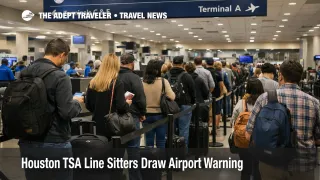
Unofficial line-holding services are starting to show up around U.S. airport security queues as the government shutdown keeps TSA staffing strained and wait times elevated. That turns a staffing story into a passenger-conduct story. Travelers facing multi-hour lines may be tempted by people offering to stand in security for them, but Houston Airports has now warned passengers not to pay unvetted individuals to hold their place in line. For travelers, the practical takeaway is simple: treat paid queue-holding as an airport risk, not a travel hack, and build more buffer instead.
TSA Line Sitters: What Changed
The new development is not the long lines themselves. It is that private, for-hire queue holders are being marketed as a workaround for those lines. TravelPulse reported on March 28 that Same Ole Line Dudes, a New York City service founded in 2012, says it has been offering "placeholding concierge" help for years at $25 per hour with a two-hour minimum, while travel advisor Jimmy M. Payne promoted a similar idea for TSA lines on social media. Houston Airports then pushed back publicly, warning passengers not to pay people offering to hold their place in line because those individuals are not authorized or vetted.
That warning landed in the middle of a still-active checkpoint crunch. Houston Airports says TSA lines at George Bush Intercontinental Airport (IAH) could reach four hours or longer, with some lines extending outside terminal buildings, while AP reported on March 29 that several major U.S. airports were still telling travelers to arrive hours early even after the White House moved to restart TSA pay. In an earlier Adept Traveler article, TSA Pay Order Leaves U.S. Airport Delays Live, the core point was that pay restoration would not instantly rebuild checkpoint throughput. That remains true.
Which Travelers Face the Most Disruption
The most exposed travelers are those departing from large hubs during morning or banked departure periods, especially passengers trying to arrive on a normal pre-shutdown schedule and those relying on TSA PreCheck or CLEAR to compress their airport time. Houston Airports has already said PreCheck and CLEAR were not available at some points during the staffing shortage at IAH, which removes the margin many frequent travelers normally use to absorb congestion.
Families, infrequent flyers, and anyone checking bags late are also more vulnerable because line-holding does not solve the full airport process. Even if someone occupies a spot in a queue, the passenger still has to manage check-in timing, baggage rules, ID checks, and screening in person. Houston Airports explicitly told passengers to remain with their belongings and use only official airport queues, which cuts against the basic promise of these services.
There is also a fairness and enforcement problem. Local television reporting on Payne's proposal noted that while standing in line for someone is not automatically illegal, airports may have their own rules, and passengers could be sent to the back of the line or removed at an agent's discretion. That means the traveler buying the service may still lose time, lose money, and trigger conflict at the checkpoint. In an earlier Adept Traveler article, Worst TSA Lines Hit Atlanta, Houston, and New York, the bigger issue was uneven airport-by-airport stress. Paid queue holding adds another layer of inconsistency on top of that.
What Travelers Should Do Now
The best immediate move is still the least glamorous one: leave earlier, check the airport's own updates, and assume long lines can outlast the headline that TSA pay may restart. Houston Airports says it is manually updating wait time estimates because staffing and passenger flow are changing, and AP reported that airport websites and social accounts are currently more reliable than assuming conditions have normalized.
For fragile itineraries, the decision threshold is simple. If missing the flight would break a same-day cruise embarkation, a tour departure, a wedding, or an international connection, do not gamble on a line sitter, and do not plan around best-case queue times. Build extra hours into the airport arrival window, consider shifting to a later flight if the schedule allows, and reduce carry-on complexity so screening itself moves faster once you reach the front. Houston Airports has gone as far as telling some passengers to consider rebooking and to reduce carry-on items when possible.
Over the next several days, travelers should watch for three signals: whether airports reopen more checkpoints, whether premium or expedited lanes return consistently, and whether official arrival guidance starts moving back toward normal. AP reported on March 29 that experts still expected longer lines to linger for another week or two because one restored pay period does not immediately reverse resignations, absences, or checkpoint consolidation. As a result, TSA line sitters look less like a durable service model than a symptom of a screening system that is still running below normal resilience.
Why the Workaround Is Emerging, and What Happens Next
The mechanism here is straightforward. Once security lines become unpredictable enough, time itself becomes a market. Someone with flexible hours can try to sell queue time to someone with a tighter schedule. That is exactly the kind of side market long waits tend to create, but airports and checkpoint operators have different incentives. Their concern is controlled passenger flow, visible ownership of bags, and keeping the official queue from turning into a gray market with uneven enforcement. Houston Airports' warning makes clear that at least one major airport system sees these services as a security and accountability problem, not an efficiency tool.
What happens next depends less on entrepreneurial interest than on whether checkpoint operations stabilize. If staffing recovers and multi-hour waits retreat, the business case for line sitters weakens quickly. If shutdown effects keep producing four-hour guidance and closed or consolidated lanes, more copycat offerings will likely appear on social media and around stressed hubs. What is not yet clear is whether other airports will issue explicit policies, whether TSA itself will speak directly to the practice, or whether enforcement will remain local and improvised. For now, the traveler-safe reading is conservative: TSA line sitters are a byproduct of an abnormal shutdown-era airport system, and using them can add uncertainty instead of removing it.
Sources
- Government shutdown impacts TSA, passengers, Houston Airports
- TSA Wait Times & IAH Airport Security Updates, Houston Airports
- It remains to be seen if Trump's order to pay TSA officers shortens passenger wait times, AP News
- Some Travelers Resort to Paying for Line Sitters Amid TSA Delays, TravelPulse
- Don't pay someone to wait in TSA line for you, Bush Airport announcement says, Click2Houston
- Baton Rouge man's joke about standing in TSA lines turns into potential business idea, WVTM 13