

Azerbaijan Advisory Hardens After Nakhchivan Strike
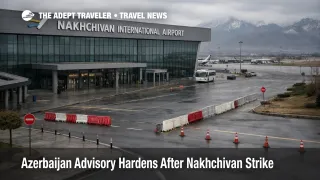
Azerbaijan travel advisory planning changed in a more operationally serious way after the U.S. State Department raised the country to Level 3 on March 12, 2026, then tied that warning directly to armed conflict spillover from Iran and a March 5 drone strike at Nakhchivan International Airport. For travelers, this is no longer only a background security note. It is a map problem. Flight reliability, airport choice, and any idea of using Azerbaijan as an overland release valve from Iran now require place by place decisions, not a single country level assumption.
Azerbaijan Travel Advisory: What Changed
The State Department now tells U.S. travelers to reconsider travel to Azerbaijan because of terrorism, armed conflict, and the risk of landmines. It says the advisory level was increased to 3 on March 12, 2026, while also noting that the underlying risk indicators did not change. That distinction matters. The official U.S. posture hardened even though Washington did not present this as a wholly new threat set. Instead, it updated the summary around a more dangerous operating environment that now includes direct spillover from the Iran conflict.
The most concrete new trigger is Nakhchivan. The advisory says a March 5 drone strike hit Nakhchivan International Airport and that commercial flights were seriously disrupted. Reuters reported that one drone fell on the terminal building, verified footage showed smoke near the airport and damage inside the terminal, and Azerbaijan shut its southern airspace for 12 hours after the attack. That moves the story from abstract regional tension to a confirmed airport disruption with consequences for real itineraries.
Which Travelers Face the Most Risk
The exposure is not evenly distributed across Azerbaijan. Baku, Azerbaijan, still sits in a different planning category from Nakhchivan and from the southern border region with Iran. The State Department specifically says travelers should not go to the southern border area unless it is their best overland exit from Iran, and it separately warns against the Armenia border and the former Soviet era Nagorno Karabakh Autonomous Oblast and surrounding territories because of landmines. That means the highest risk is tied to border geography and the exclave, not to every hotel booking or business trip in central Baku.
The travelers who need the most caution are those trying to use Azerbaijan as a fallback corridor during wider regional disruption. Reuters reported that more than 1,100 people had crossed from Iran into Azerbaijan via Astara in the early phase of the crisis, while also noting that Azerbaijan's land borders remain closed to travelers in general unless special permission is granted. The practical effect is that Azerbaijan can appear on evacuation maps, but it is not a simple public exit route in the way a normal open land border would be. That raises failure risk for anyone assuming they can improvise an overland move from Iran into Azerbaijan and then fly onward.
There is also a second layer for air travelers who are not going anywhere near Nakhchivan. In an earlier Adept Traveler article, Europe Asia Flight Corridors Tighten as Risks Spread tracked how fallback air routes over Azerbaijan and Central Asia have become more crowded as other conflict zones close off options. When one part of that wider corridor map takes a direct hit, airlines and passengers lose slack. Delays, longer routings, and weaker recovery options can spread well beyond the airport that was struck.
What Travelers Should Do Now
Travelers with existing Azerbaijan bookings should start by separating trip purpose and geography. If the trip is discretionary and touches Nakhchivan, the southern border area, or any overland movement linked to Iran, the better decision is usually to defer, reroute, or hold only fully flexible inventory until the risk picture stabilizes. If the trip is limited to Baku, the decision is narrower. In that case, monitor airline operations, embassy alerts, and the security environment rather than treating the whole country as functionally closed.
Anyone considering Azerbaijan as an exit corridor from Iran should not treat the March 12 advisory as a green light with caveats. Treat it as a conditional route of last resort. In an earlier Adept Traveler article, Iran Armenia Land Border: Agarak Crossing Status showed the same broader lesson from another frontier, when aviation systems break down, land borders become pressure points and can fail without much warning. The decision threshold here is simple. Do not rely on Azerbaijan unless you have verified border access, onward transport, documentation, and a realistic fallback if the crossing or flight chain breaks.
Insurance and continuity planning also need a harder look. A Level 3 Azerbaijan travel advisory does not automatically void coverage, but it can change how claims, waivers, duty of care decisions, and employer approvals are handled. Travelers on corporate trips should review security protocols and hotel contingency planning now, not after arrival. Leisure travelers should check whether their policies treat advisory changes, conflict spillover, or airport disruption as covered events, and whether alternate airports or overnight changes would be reimbursable. That matters more when one airport has already taken a strike and the southern border carries its own official warning.
Why This Is Happening, and What Comes Next
The mechanism is regional spillover, not a routine advisory refresh. The State Department explicitly links the Azerbaijan warning to hostilities that began on February 28 between the United States and Iran, then cites ongoing drone and missile threats from Iran as the reason the southern border and Nakhchivan now matter more. Reuters also reported that Azerbaijan accused Iran of responsibility for the March 5 drone incident, while Iran denied targeting Nakhchivan. Travelers should keep that split clear, the airport strike and disruption are confirmed, but responsibility remains contested between the two governments.
What happens next depends on whether the conflict remains contained or produces more cross border incidents. The most likely near term outcome is not a blanket shutdown of travel to Azerbaijan. It is a more fragmented risk map, Baku functioning under higher caution, border zones carrying sharper warnings, and Nakhchivan remaining the part of the country that most clearly proves the risk is operational, not theoretical. In an earlier Adept Traveler article, Azerbaijan Level 3 Advisory Recasts Caucasus Trips captured the advisory shift itself. The next decision point is whether Azerbaijan travel advisory language changes again after any further strikes, airspace limits, or border pressure.