

Travel Bankruptcy Risk Rises if Fuel Stress Lasts Into Summer
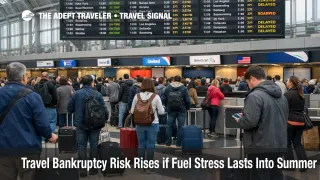
Travel bankruptcy risk is no longer a theoretical side note to the Iran war fuel story. It is becoming a real sector sorting mechanism. Airlines face the sharper near term danger because jet fuel prices have roughly doubled in recent weeks, many carriers no longer hedge meaningfully, and analysts cited by Reuters are already warning that weaker low cost airlines are the most exposed if elevated fuel prices persist. Cruise lines are under pressure too, but the immediate effect is more likely to appear first in lower earnings, higher fares, fewer discounts, and altered deployment rather than outright bankruptcy at the largest operators. For travelers, the practical issue is not just whether a company fails. It is that even before a bankruptcy filing, stressed operators usually cut frequencies, shrink fleets, reduce service, narrow refund flexibility, and leave fewer recovery options when something goes wrong.
Travel Bankruptcy Risk, What The Current Evidence Shows
The strongest bankruptcy exposure today sits in weaker airlines, especially carriers with thin margins, limited liquidity, high lease burdens, or recent restructuring. Reuters reported on March 30 that low cost airlines were already viewed by Moody's and S&P Global as the most vulnerable part of the U.S. market as fuel prices surged, and named JetBlue, Spirit, and Frontier as the kinds of carriers now in greater jeopardy. Spirit is the clearest warning sign because it is still shrinking sharply after bankruptcy, plans to cut down to roughly 76 to 80 aircraft by the third quarter of 2026, and has had to rebuild around a much smaller network just as fuel volatility rises again. In Brazil, Gol and Azul are emerging from debt restructuring into a 54.8 percent April jet fuel price increase, which shows how quickly fresh energy stress can hit airlines that have only recently stabilized their balance sheets.
Cruise bankruptcy risk looks different. The large public cruise groups still have a meaningful demand cushion, and Reuters reported that Carnival still has strong 2026 bookings and even announced a $2.5 billion share buyback despite cutting profit guidance. That is not a bankruptcy setup in the immediate term. It is a margin compression setup. The more credible near term cruise signal is that fuel costs can weaken profitability, reduce promotional room, and make fly cruise vacations harder to price, especially for companies with less hedging protection. Carnival is the clearest mass market example because Reuters, citing company filings, reported that a 10 percent increase in fuel cost per metric ton would reduce its 2026 net income by about $145 million, compared with about $57 million for Royal Caribbean and about $90 million for Norwegian. That is serious, but it still points first to pricing pressure and slower expansion before it points to insolvency.
Where Airline And Cruise Bankruptcy Risk Is Showing First
Air travel is the more fragile side of this signal because fuel is a larger immediate operating lever, schedules can be cut quickly, and many airlines cannot fully pass costs through without damaging demand. Reuters reported that global airlines had expected about $41 billion in profits for 2026 before the latest shock, but the doubling in jet fuel costs is already forcing fare hikes, surcharges, and capacity cuts. That means the sector does not need an actual bankruptcy filing to become materially worse for travelers. A carrier under stress can pull unprofitable routes, thin out off peak flying, defer growth, or retreat from marginal cities long before it runs out of cash. That is already visible in the broader airline response, from United's cuts to global fare increases, and it is the stage where a travel signal becomes operationally important.
Cruise lines are more likely to show pressure through bundled vacation economics. Fuel affects the ship, but it also affects the airfare many guests need to reach embarkation ports. Reuters noted that Carnival itself warned higher fuel prices can raise operating costs and lift airfare enough to weaken overall demand. Norwegian has separately warned that fuel cost uncertainty and pressured bookings are already weighing on outlook. That combination matters because cruise insolvency usually comes from a multi variable squeeze, not one fuel spike alone. You need sustained high bunker costs, softer bookings, weak onboard spending, and refinancing pressure at the same time. Right now, the booking side still looks more resilient than the airline side at the largest listed operators, which is why cruise bankruptcy risk remains lower in the immediate window.
What Travelers Should Watch Now
For airlines, the practical threshold is duration. If the Iran conflict driven fuel shock fades within several weeks, the damage is more likely to stay concentrated in higher fares, selective cuts, and weaker second quarter earnings. If uncertainty lasts through April and into May, the risk profile changes because carriers then have to make summer scheduling and fuel purchasing decisions with less confidence. Ryanair's chief executive said this week that if the conflict continues through April, fuel shortages could emerge in Europe from June, and Reuters reported that analysts already see current sustained disruptions supporting oil in a very wide $100 to $190 range. That is the kind of window where weaker airlines can shift from coping to restructuring risk.
The rough rule is this. A few weeks of uncertainty is painful. One full quarter of elevated fuel and planning instability is where airline bankruptcy risk becomes materially more believable for weaker carriers. Two quarters, or a shock that lasts into late summer, is where consolidation, forced asset sales, deeper restructuring, and route exits become much more likely. The reason is simple, airlines sell a perishable product, have large fixed commitments, and cannot easily rebuild lost demand once travelers change behavior. Cruise lines usually get a bit more time because they can slow promotions, adjust deployment, and lean on advance bookings, but if fuel pressure lasts through the core summer sailing period and fly cruise demand softens with it, the sector could move from pricing pain into broader balance sheet stress by late 2026. That is a slower clock than aviation, not a harmless one.
Travelers do not need to panic book around headline bankruptcy fears. They do need to stop treating weak carriers and cheap fly cruise combinations as equally resilient. The better response now is to prefer nonstop or high frequency routes when possible, avoid thin once daily services on financially weaker airlines, keep hotel and onward transport more flexible where summer cuts could widen, and be more cautious with prepaid add ons around fly cruise trips that depend on separate air tickets. If this fuel shock de escalates in April, the signal may stall at higher prices and tighter schedules. If it persists into a full summer planning cycle, travel bankruptcy risk becomes less a headline and more a system level sorting event that travelers will feel through lost options first, and actual failures second.
Why This Pattern Could Spread, Or Stall, Next
The mechanism is straightforward. The Iran conflict has not just lifted crude prices, it has pushed jet fuel disproportionately higher, which matters because aviation buys a refined product that can spike faster than benchmark oil. IATA's fuel monitor showed the global average jet fuel price last week at $195.19 per barrel, far above the roughly $88 per barrel level it had assumed for 2026 in its prior December outlook. That gap is why an industry that expected a profitable year is now cutting guidance, adding surcharges, and testing how much demand it can hold onto while raising prices. It also explains why airlines are the first bankruptcy watch zone, refineries and product spreads are hitting them harder and faster than a simple crude chart suggests.
The signal can still stall. Markets have already shown that expectations of a shorter war can pull oil lower quickly, and Reuters reported that prediction markets were assigning a meaningful chance of the conflict ending by mid May or the end of June. If that happens soon enough, the sector may avoid the harsher part of the cycle. Airlines would still be left with a more expensive spring, but not necessarily a solvency event. Cruise lines would still face a weaker pricing environment, but likely not the kind of prolonged squeeze that turns margin pain into bankruptcy risk. If the conflict instead remains unresolved long enough to keep fuel, insurance, route planning, and consumer confidence unstable through the second quarter, then this stops being just a fuel story. It becomes a travel balance sheet story.