

Flight Delays and Airport Impacts: April 14
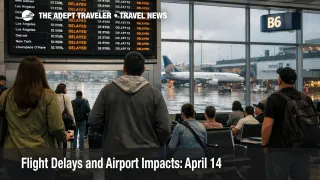
April 14 flight delays are centered on Chicago, not the whole U.S. system, but that still puts a large share of connecting passengers at risk. The Federal Aviation Administration said on Tuesday, April 14, 2026 that wind could slow flights in New York, Denver, and Las Vegas, while thunderstorms could cause delays in Detroit and Chicago. By late morning, Chicago O'Hare International Airport (ORD) was already under a traffic management program tied to thunderstorms, with destination delays averaging 1 hour and 22 minutes and departure delays running 31 to 45 minutes and increasing. Travelers with ORD or Chicago Midway International Airport (MDW) in the middle of the itinerary should treat today as a buffer day, not a precision day.
April 14 Flight Delays: What Changed
The FAA's daily report and command center plan show a day that has already hardened in Chicago while several other hubs remain in the watch list. The FAA said wind could affect John F. Kennedy International Airport (JFK), LaGuardia Airport (LGA), Newark Liberty International Airport (EWR), Denver International Airport (DEN), and Harry Reid International Airport (LAS), while thunderstorms could disrupt Detroit Metropolitan Wayne County Airport (DTW), ORD, and MDW. In the operations plan, ORD had already exited a ground stop into a variable rate ground delay program, and the FAA said multiple reroutes were published around storms affecting the south southeast arrival gates.
That makes Chicago the clearest live pressure point, but not the only one worth watching. The FAA plan also listed possible later programs for SFO after 300 p.m. Zulu, DEN after 700 p.m. Zulu, JFK after 800 p.m. Zulu, and ORD and MDW again after 1000 p.m. Zulu. FAA airport status pages were still showing only minor general delays at JFK, LGA, EWR, and DEN when those warnings were posted, which means the national picture was still mixed rather than uniformly degraded.
Which Travelers Face the Most Risk
The most exposed travelers are the ones connecting through Chicago, especially passengers moving from smaller spokes into ORD and then onward to long haul, last flight, cruise, tour, or separate ticket segments. When an airport like ORD is put on a delay program, the damage is not limited to local weather. Aircraft leave late from origin, crews turn late, gates stay occupied longer, and later banks in other cities inherit the delay even if local skies are usable.
The second group to watch is travelers whose itineraries depend on late day performance in New York, Denver, San Francisco, or Midway. The FAA had not posted major airport wide delays there early, but the command center had already flagged those airports and surrounding airspace for possible programs later in the day. That is the dangerous middle stage for travelers, where the departure board can still look manageable while the system is already preparing to meter arrivals and reroute flows.
What Travelers Should Do Now
Travelers flying today should plan from the FAA risk map, not just the current airport board. If your trip depends on ORD or MDW working normally, build more layover time, look at earlier alternatives before they disappear, and avoid assuming a short posted delay will remain short. For New York, Denver, or San Francisco connections later today, the better move is to protect any itinerary that would become expensive if one segment slips, especially separate tickets, nonrefundable hotels, and same day onward ground transport.
The main decision threshold is simple. Rebook early if a missed connection would force a hotel night, lost event, cruise miss, or international misconnect with few backup seats. Waiting makes more sense when the trip is nonstop, the arrival time is flexible, and the airline still shows multiple later options on the same route. Travelers should also check airline alerts directly, because FAA pages describe airport level conditions, not flight specific outcomes.
Why Chicago Leads, and What Happens Next
The broader weather setup helps explain why Chicago is active first and why other hubs could tighten later. The National Weather Service said severe thunderstorms and heavy rain were expected from the Southern Plains to the Great Lakes on April 14, while the FAA operations plan listed en route thunderstorm constraints across a wide band of control centers from the Northeast through the Midwest and into the Mountain West. That kind of footprint gives the system less room to reroute cleanly once a major hub starts losing efficiency.
In an earlier Adept Traveler article, Flight Delays and Airport Impacts: April 13, the same basic pattern was visible, an initially manageable map that could harden later. In an earlier Adept Traveler article, FAA Controller Hiring Push Signals Longer Delay Risk, the staffing backdrop behind these delay days was already clear, and the Insight U.S. Air Traffic Control Privatization: Reality Check explains why weather driven disruptions spread faster when the network has limited slack. For April 14, the next decision point is whether Chicago recovers enough to stop exporting delays, or whether late day programs at JFK, DEN, SFO, and MDW turn a regional problem into a broader evening connection problem.
Sources
- FAA Daily Air Traffic Report, April 14, 2026
- FAA Current Operations Plan Advisory, April 14, 2026
- Chicago O'Hare International Airport Real-time Status
- John F Kennedy International Airport Real-time Status
- La Guardia Airport Real-time Status
- Newark International Airport Real-time Status
- Denver International Airport Real-time Status
- National Weather Service National Forecast Headline, April 14, 2026
- Flight Delays and Airport Impacts: April 13
- FAA Controller Hiring Push Signals Longer Delay Risk
- U.S. Air Traffic Control Privatization: Reality Check