

Flight Delays and Airport Impacts: April 18
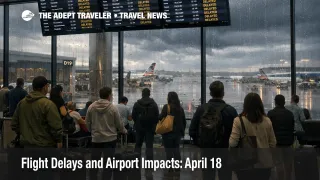
April 18 flight delays are starting as a Dallas weather problem with a wider afternoon risk map behind it. The Federal Aviation Administration said on Saturday, April 18, 2026 that Dallas Fort Worth International Airport (DFW) was under a ground stop due to thunderstorms, while LaGuardia Airport (LGA) was already posting average arrival delays of 1 hour and 20 minutes because of low ceilings. Travelers connecting through North Texas or New York, especially on short layovers and late bank itineraries, should treat today as a protect-the-itinerary day rather than a wait-and-see day. Chicago O'Hare International Airport (ORD), Boston Logan International Airport (BOS), Newark Liberty International Airport (EWR), and Philadelphia International Airport (PHL) were still mostly in minor-delay territory in the FAA snapshots reviewed this morning, but the FAA's planning map shows several of those hubs could tighten later.
April 18 Flight Delays: What Changed
The clearest live change is that Dallas moved from forecast concern into active control action. The FAA operations plan said DFW had a ground stop in effect at the start of the period, flagged a possible ground delay program there until 1600 Zulu, and warned that Dallas Love Field (DAL) could also face a ground stop. The same plan shows a later expansion risk, with possible ground stops or delay programs after 2000 Zulu or 2100 Zulu for Austin-Bergstrom International Airport (AUS), San Antonio International Airport (SAT), William P. Hobby Airport (HOU), George Bush Intercontinental Airport (IAH), LGA, EWR, PHL, John F. Kennedy International Airport (JFK), BOS, Ronald Reagan Washington National Airport (DCA), Baltimore/Washington International Thurgood Marshall Airport (BWI), Washington Dulles International Airport (IAD), and San Francisco International Airport (SFO).
The live airport status pages show why Dallas and New York deserve more attention than Chicago right now. At DFW, the FAA said inbound traffic management was active because of thunderstorms and that departures destined for DFW would not be allowed to leave until at or after 9:30 a.m. CDT. At LGA, the FAA said low ceilings were causing average arrival delays of 1 hour and 20 minutes. By contrast, ORD, BOS, EWR, PHL, and JFK were each still showing only general gate hold, taxi, or airborne delays of 15 minutes or less in the FAA snapshots reviewed.
Which Travelers Face the Most Disruption
The most exposed travelers are the ones using Dallas or New York as connection machinery rather than as simple origin or destination airports. A thunderstorm-driven ground stop at DFW can pinch aircraft rotation, crew timing, and inbound bank reliability across American Airlines heavy connecting flows, while a sustained low-ceiling program at LaGuardia can spill into already tight Northeast short haul schedules. Travelers on separate tickets, last flights of the day, same-day cruise embarkations, or fixed car service pickups have less slack than travelers on simple point-to-point trips.
Chicago remains important, but not because it is already the hardest-hit airport. The FAA plan still showed possible ORD and Chicago Midway International Airport (MDW) arrival route pressure through 1400 Zulu, and that matters because even a mild Chicago slowdown can widen missed-connection risk later when weather is also active farther south and east. In an earlier Adept Traveler article, Flight Delays and Airport Impacts: April 17, the risk map was broader earlier in the day. Saturday looks narrower in the morning, but more fragile if Dallas problems hold and the Northeast hardens in the afternoon.
What Travelers Should Do Now
Travelers going through DFW or LGA today should check the inbound aircraft on their airline app, not just the departure board. A gate that still shows on time can fail quickly when the arriving aircraft is trapped by a destination hold or a delay program upstream. If your itinerary depends on a short connection through Dallas, New York, or another East Coast hub in the FAA watch list, extra buffer is worth more than schedule optimism today.
Rebooking early makes the most sense if you are still before departure and your trip includes a short hub connection, a final flight of the day, or a nonrefundable downstream booking. Waiting makes more sense if you are traveling nonstop, have several later alternatives on the same carrier, or are at ORD, BOS, EWR, PHL, or JFK where the FAA picture was still relatively manageable in the latest snapshots reviewed. The tradeoff is simple, rebooking early may cost flexibility, but waiting can cost the entire itinerary once the later East Coast and Texas programs start stacking together.
Over the next several hours, the decision points are whether Dallas shifts from a contained storm disruption into a longer recovery problem, whether LaGuardia's low-ceiling delay average rises further, and whether the FAA converts its later Northeast and Texas warnings into more formal ground stops or delay programs. Travelers should also watch Houston and San Francisco if those airports sit in the middle of an onward itinerary, because the FAA specifically listed them in the later risk window.
How the Disruption Spreads Through Travel
The mechanism today is weather plus network timing, not a national system collapse. The FAA plan ties Dallas directly to thunderstorms, and the National Weather Service office covering Fort Worth and Dallas said a cold front was moving through North Texas with additional shower and thunderstorm development expected late morning into early afternoon. Around Boston, official conditions at Logan included fog or mist, overcast skies, and 3.00 miles of visibility late this morning, which helps explain why the FAA kept BOS on its later watch list even though the live delay picture there was still modest.
Once that kind of pressure appears at multiple hubs, the first order effect is obvious, flights depart late, arrive late, or stop moving. The second order effect is where travelers get hurt. Aircraft and crews miss their next assignments, same-day rebooking space thins, hotel stays become more likely on thinner evening banks, and ground transfers at the far end start failing even when the original airport headline does not look severe. That is also why Chicago still matters today even with only minor live delays. In an earlier Adept Traveler article, FAA Caps Chicago O'Hare Summer Flights Through October, the FAA's new scheduling cap was already identified as a structural limit on slack at ORD. For a broader structural read on U.S. network fragility, U.S. Air Traffic Control Privatization: Reality Check gives useful context on how thin margins and operational constraints can amplify ordinary weather into larger delay days.
Sources
- FAA Current Operations Plan Advisory, April 18, 2026
- FAA Dallas Fort Worth International Airport Status
- FAA LaGuardia Airport Status
- FAA Chicago O'Hare International Airport Status
- FAA Boston Logan International Airport Status
- FAA Newark Liberty International Airport Status
- FAA Philadelphia International Airport Status
- FAA John F. Kennedy International Airport Status
- National Weather Service, Fort Worth/Dallas Forecast Office
- National Weather Service, Boston Logan Current Conditions