

Spain Tower Strike Flights Stay Active Through May 31
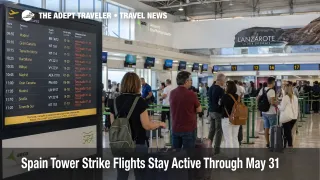
Spain tower strike flights remain an active risk at nine airports after controllers at SAERCO managed towers began an indefinite strike on April 17, 2026. The latest operational point is not a full shutdown. Spain's Transport Ministry has imposed minimum service rules through May 31, which should keep many flights operating but can still leave travelers exposed to delay, cancellation, and thin recovery options at island and regional gateways. The highest planning risk sits with Canary Islands trips, short mainland connections, and arrivals tied to hotel transfers, tours, or repositioning aircraft.
Spain Tower Strike Flights: What Changed
The strike covers tower controllers employed by SAERCO at Jerez Airport (XRY), A Coruña Airport (LCG), Madrid-Cuatro Vientos Airport (ECV), Seville Airport (SVQ), Vigo Airport (VGO), El Hierro Airport (VDE), Fuerteventura Airport (FUE), César Manrique-Lanzarote Airport (ACE), and La Palma Airport (SPC). USCA and CCOO notified the strike on April 6, and the Transport Ministry resolution says the walkout began at 12:00 a.m. local time on April 17 with an indefinite character.
The correction to the seed is important. Adept Traveler does have prior coverage of this labor action. In an earlier Adept Traveler article, Spain Tower Strike Hits Canary And Regional Flights, the strike had just moved from warning to active disruption. The new angle is that the strike remains open ended, while the government minimum service resolution now gives travelers a clearer operating frame through May 31.
The Ministry says the first month of the strike period, from April 17 through May 16, involved nearly 20,000 scheduled movements and more than 2.95 million seats across affected airports, with about 2.6 million passengers potentially exposed. That does not mean all of those travelers will be delayed. It does mean the strike touches enough scheduled capacity that the risk cannot be treated as a minor local labor note.
Which Spain Airport Routes Face The Most Risk
The Canary Islands carry the most fragile traveler exposure because island flights have fewer ground substitutes and weaker same day recovery options. The Ministry's minimum service table protects domestic routes to or from non peninsular territories at 76 percent for Lanzarote in April and May, 77 percent in April and 75 percent in May for Fuerteventura, 72 percent in April and 73 percent in May for La Palma, and 66 percent for El Hierro. Those percentages are high enough to prevent a simple collapse, but low enough that a bad day can still break tight itineraries.
Mainland and international routes also remain exposed. For routes connecting Spanish peninsular cities where public transport alternatives take five hours or more, and for international routes, the resolution shows protected service levels of 54 percent in April and 51 percent in May for Lanzarote, 55 percent in April and 53 percent in May for Fuerteventura, 56 percent in April and 54 percent in May for La Palma, and 59 percent for Seville. That is where UK, mainland Spain, and holiday traffic can run into aircraft positioning problems even when a traveler's own airport is not the original pressure point.
A Coruña and Vigo deserve separate attention because the Transport Ministry says the temporary closure of Santiago Airport from April 23 through May 27 is increasing flights at both airports. More diverted or substituted activity means less slack if tower capacity, ground handling, weather, or aircraft rotation problems stack on the same day.
What Travelers Should Do Now
Travelers flying through the Canary Islands should avoid same day onward commitments that depend on a narrow arrival window. A late arrival into Lanzarote, Fuerteventura, La Palma, or El Hierro can become more than an airport inconvenience if it breaks a pre booked hotel transfer, rental car pickup, ferry, tour, or inter island connection. Build at least a half day of protection before fixed activities, and avoid last flight of the day arrivals when the trip depends on being in place that night.
For mainland connections, the decision threshold is connection length. If the itinerary uses Seville, Jerez, Vigo, A Coruña, or a Canary gateway as part of a same day connection, treat anything under 2.5 to 3 hours as vulnerable during the strike period. Travelers connecting onward to long haul flights, cruises, or prepaid tours should consider moving to an earlier flight, adding an overnight, or shifting to a larger hub with more rebooking options.
Passenger rights should be separated from cash compensation expectations. Under EU air passenger rules, airlines may still owe care, rerouting, or reimbursement during long delays and cancellations, but compensation can be denied when the disruption is caused by extraordinary circumstances that could not have been avoided with reasonable measures. Air traffic control disruption often falls into that harder compensation category, so travelers should keep receipts, preserve boarding passes, and focus first on rerouting and care rather than assuming a cash payout.
Why Minimum Services Do Not Remove The Strike Risk
Minimum service rules are designed to preserve essential mobility, not guarantee normal airline schedules. The Ministry resolution protects 100 percent of emergency flights, organ transport, firefighting, ambulance, rescue, civil protection, and certain police or state related movements. For scheduled passenger flights, protection varies by airport, route type, month, and available substitutes, which means the real traveler impact depends on where the flight sits in the protected service hierarchy.
The mechanism is simple. A tower capacity constraint can slow departures and arrivals at the airport itself. First order, flights may be delayed, consolidated, or canceled to fit the protected operating level. Second order, aircraft can arrive late into their next rotation, crews can time out, ground transfers can miss passengers, and airlines may have fewer spare seats for rebooking at smaller airports.
The next decision point is May 31, 2026. The Ministry says the current resolution remains valid until that date and that, if the strike has not been called off before then, a new minimum service resolution must be requested. Until the strike is formally withdrawn, Spain tower strike flights should remain on the watch list for Canary Islands, Galicia, Andalusia, and regional Spain itineraries.
Sources
- USCA, USCA y CCOO convocan huelga indefinida en SAERCO por recortes de plantilla y riesgos para la seguridad operacional
- CCOO, Convocada huelga indefinida a partir del 17 de abril en el control de tránsito aéreo de Saerco por la falta de plantilla
- Ministerio de Transportes y Movilidad Sostenible, Resolución de servicios mínimos para la huelga de SAERCO
- Your Europe, Air Passenger Rights
- Adept Traveler, Spain Tower Strike Hits Canary And Regional Flights