

Cuba Fuel Tanker Signal Tests U.S. Thaw
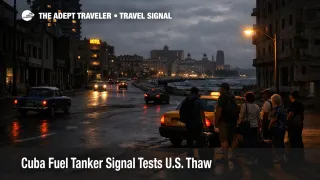
Cuba's next meaningful signal may not be another blackout, another official speech, or another warning about shortages. It may be how Havana handles Russian fuel while the island is under acute domestic pressure and quietly engaging the United States on at least one narrow security file. Cuba's grid has failed repeatedly this month, AP reported that the country is producing only about 40 percent of the fuel it needs, and Reuters confirmed rare FBI cooperation tied to the February speedboat incursion investigation. That does not prove a broader thaw with Washington, but it does create a sharper question. If Cuba is under real social and operational pressure to take near term fuel relief, what would it mean if Havana slows, sidesteps, or politically reframes that relief instead of embracing it?
Cuba Fuel Tanker Signal: Why This Decision Matters
The Cuba fuel tanker signal matters because it forces Havana to show what it values more in the short term, immediate energy relief or strategic room to maneuver. One part of the tanker story is already clear. Reuters reported on March 20 that the Sea Horse, a vessel carrying Russian origin diesel that had been watched as a possible Cuba bound shipment, diverted to Trinidad and Tobago instead of continuing on to the island. The second vessel is the harder test. Reporting around the sanctioned Russian tanker Anatoly Kolodkin said it was still expected to head toward Cuba with a much larger crude cargo, but I have not seen high quality confirmation, as of March 24, that Havana has either received it or publicly rejected it. That uncertainty is exactly why the next move matters. A live signal is more valuable than a settled one.
The signal is not simply whether Russian fuel exists offshore. It is whether Cuba treats that fuel as a straightforward rescue, a politically awkward necessity, or a bridge it is willing to avoid if another channel is opening. In an earlier Adept Traveler article, Cuba Blackout Travel Risk Rises After Second Grid Collapse showed how another grid failure had already pushed Cuba back into a nationwide reliability crisis. In an earlier Adept Traveler article, Cuba Power Restored, But Travel Still Looks Fragile explained why restoration did not end the underlying problem. The new layer is geopolitical. If Havana has even a narrow opening with Washington, then the way it handles Russian fuel becomes more revealing than the fuel itself.
Where The Cuba Fuel Tanker Signal Is Showing Up Now
The first place this signal is showing is inside Cuba's domestic pressure chamber. Reuters reported violent unrest in Bayamo on March 14 after prolonged blackouts, and Reuters separately reported residents queuing for water in Havana as electricity failures disrupted basic services. Those are not isolated travel anecdotes. They are signs that energy scarcity is spilling into public order, daily life, and movement reliability. If the government can ease that pressure by accepting outside fuel, doing so is the easy move. If it does not, analysts should pay attention.
The second place the signal is showing is in Cuba's unusual willingness to cooperate with the FBI after the February 25 speedboat incursion. Reuters reported on March 13 that Cuba said the FBI would send a team to assist in the investigation. That public rationale is narrow, and it should stay framed that way. It does not prove a diplomatic breakthrough. But it does show that Havana is willing to work with Washington on a sensitive file during a moment of severe pressure, which is not a normal background condition.
The third place the signal is showing is in official rhetoric itself. Reuters reported on March 20 that Cuba acknowledged talks with the United States while rejecting any negotiation over its political system or the presidential term. Reuters also reported on March 22 that Cuban officials said they were ready to defend against any potential U.S. attack, while also indicating such a scenario was unlikely. That combination, contact on one channel, hard public rhetoric on another, looks less like a clean break and more like bargaining under stress.
For travelers, the practical relevance is not that Cuba is about to flip alignments overnight. It is that the island's operating environment is now shaped by both energy fragility and geopolitical uncertainty. In an earlier Adept Traveler article, Cuba Protest Warning Adds New Travel Friction showed how outages and shortages were already creating movement risk. In an earlier Adept Traveler article, Cuba Collapse Risk: Blackouts, Fuel, Travel Limits laid out the deeper systems weakness behind that risk.
What Travelers Should Watch Now
Travelers do not need to treat this as a cue for immediate blanket cancellation, but they should treat it as a reason to monitor Cuba more like a politically stressed operating environment than a destination working through a normal infrastructure outage. The immediate watchpoints are concrete. First, does Havana publicly acknowledge receiving the Russian cargo, and if so, how does it describe the shipment. Second, does the government pair any fuel arrival with more cooperative language or additional practical coordination with U.S. authorities. Third, do blackouts and protest incidents ease, or do they continue despite outside fuel support.
A stronger traveler response becomes more reasonable if the next several days bring another nationwide grid failure, broader visible unrest, more transport degradation, or evidence that fuel relief is not translating into more stable daily operations. Travelers with near term Cuba departures should keep itineraries simpler than usual, avoid tight same day connections, carry more cash than they normally would, and confirm directly with lodging or operators what remains functional during outages. Cuba is still a destination where small failures can compound fast.
What would count as stabilization instead is also clear enough to monitor. A confirmed fuel arrival, fewer large scale outages, calmer street conditions, and a return to more predictable airport, hotel, and transfer operations would suggest that the immediate pressure wave is easing. But even then, the Cuba fuel tanker signal would still matter, because the political wrapper around that stabilization would tell us whether Havana is leaning back into old dependency or trying to widen its options.
What Happens Next If Cuba Absorbs The Pain
The most revealing scenario is not that Cuba accepts Russian fuel under pressure. That would be understandable, and in purely operational terms it would be the easier survival move. The more revealing scenario is that Cuba absorbs domestic pain, or at least delays obvious relief, while keeping the door open to Washington. If that happens, it would suggest Havana sees some value in preserving a possible U.S. channel even while shortages, blackouts, and unrest are raising the internal cost of waiting.
That does not mean a deal is imminent. It means the government may be signaling that strategic flexibility now matters more than automatic alignment. A refusal, delay, or conspicuously quiet handling of Russian fuel would be harder to explain as ideology alone when the island is already facing repeated outages and public frustration. It would point instead to bargaining, hedging, or a belief that another path may be opening sooner rather than later.
That is why the Cuba fuel tanker signal is worth watching more closely than the slogans around it. The broad crisis is already visible. The real question now is whether Havana tries to relieve that crisis in the familiar way, by taking Russian energy support and reinforcing the old pattern, or whether it accepts more near term strain in exchange for a different political outcome. For travelers and planners, that distinction matters because it will shape whether Cuba's next phase looks like temporary relief inside the same failing system, or the start of a more consequential shift.