

Cuba Blackout Travel Risk Rises After Second Grid Collapse
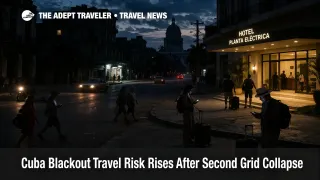
Travelers to Cuba now face a harder reliability decision after the country's national grid collapsed again on March 21, 2026, the second nationwide blackout in a week and the third major outage this month. Reuters and the Associated Press reported that the failure cut electricity across the island, disrupted cell and internet service, and forced officials to prioritize emergency power for hospitals, water systems, and other essential services. For travelers, the problem is no longer just whether power eventually returns. The near term risk is that core trip functions, including payments, hotel operations, airport coordination, and ground transfers, can all degrade at the same time.
Cuba Blackout Travel Risk: What Changed
What changed on March 21 was not a local outage or another night of rolling cuts. Cuba's Ministry of Energy and Mines said the national system suffered a total disconnection, and Reuters later reported that authorities traced the latest collapse to a failure at the Nuevitas plant in Camagüey province that triggered a broader cascade through the grid. By March 22, microsystems had been activated across all provinces, and some generation points, including gas plants in Varadero and Boca de Jaruco, were supporting essential services while recovery work continued. That is a real restoration effort, but it is also a signal that Cuba is operating in emergency mode, not normal travel conditions.
The operational consequence for visitors is straightforward. A hotel with a generator may still struggle on water pressure, food storage, elevator service, connectivity, or card processing if the wider grid and telecom network remain unstable. Airports can keep basic functions moving, but the surrounding system, taxis, fuel access, mobile data, and airline communication, can still fail unevenly. First order, travelers lose confidence that simple trip tasks will work on demand. Second order, even minor itinerary changes become harder to execute because the backup systems travelers normally rely on may also be degraded.
Which Cuba Trips Now Carry the Most Exposure
The most exposed travelers are those with near term departures, multi stop Cuba itineraries, independent ground arrangements, or payment needs that depend on stable connectivity. That includes visitors moving between Havana, Varadero, Santiago de Cuba, and regional destinations on fixed schedules, especially where a missed transfer can break the rest of the trip. Travelers on escorted programs may have slightly more resilience if operators are handling transport and lodging adjustments, but even that buffer has limits when the island's infrastructure is failing repeatedly.
This latest collapse also changes the decision for travelers who were treating the March 16 blackout as a one off event. In an earlier Adept Traveler article, Cuba Island Blackout Deepens March Travel Risks, the key concern was whether power restoration would stabilize the system. In an earlier Adept Traveler article, Cuba Power Restored, But Travel Still Looks Fragile, the warning shifted to weak recovery rather than total darkness. A second nationwide collapse inside one week makes that fragility the main story. It suggests travelers should stop assuming that restoration equals reliability.
What Travelers Should Do Before Committing to Cuba
Travelers due to depart within the next several days should treat Cuba as a destination where core services may function only intermittently. That means carrying enough cash for basic disruption costs, assuming cards and ATMs may fail, downloading any airline, hotel, and transfer documentation for offline use, and avoiding tight same day connections inside Cuba. If your trip depends on dependable internet, routine remote work access, or frictionless payment acceptance, the safer choice is to postpone or reroute.
For travelers already booked, the next decision point is whether your supplier is offering a meaningful exit or rebooking path. Intrepid Travel has already canceled Cuba tours through April 30, 2026, which is one concrete signal that some operators no longer view current conditions as reliably executable for near term departures. Independent travelers should apply the same logic to themselves. Rebook sooner if your plan relies on multiple timed handoffs, private transfers, or nonrefundable services that become hard to reach when communications fail. Wait only if your lodging has verified backup power, your itinerary is simple, and you can absorb delays without a larger knock on effect.
Over the next 24 to 72 hours, travelers should watch for evidence that the grid is moving from emergency islanded service back to sustained national stability, not just scattered restoration announcements. They should also monitor airline notices, operator waivers, and the U.S. State Department's standing warning that Cuba has unreliable electrical power. The main threshold is not whether some lights are back on. It is whether transport, lodging, communications, and payments are working together consistently enough to support a trip without constant contingency planning.
Why Cuba's Outages Now Matter More for Travel
The broader mechanism is that repeated grid failures compress the margin for recovery. When a national system fails once, operators can often restore service while preserving some public confidence. When it fails again days later, every travel dependent layer becomes less predictable, because travelers, carriers, hotels, and local transport providers are all drawing from the same weakened infrastructure. Reuters and AP both describe a system strained by aging generation assets and fuel shortages, while Cuban officials have emphasized the pressure on essential services. The precise political cause remains contested, but the traveler facing result is clear, the system is brittle, and another failure would be less surprising than it should be.
What happens next depends on whether Cuba can move from microsystems and partial plant recovery to stable, continuous service across the island. That may happen in stages, but repeated March failures suggest the island remains in a low resilience phase where each new shock can spread quickly. For travelers, that shifts Cuba from a destination with inconvenience risk to one with meaningful itinerary risk. The practical reading is blunt, trips that can tolerate outages, cash reliance, and communications gaps may still go forward, but trips that require dependable execution should not be treated as normal right now.
Sources
- Cuba begins recovery efforts after second grid collapse in a week
- Cuban power grid collapses for second time in a week amid US oil blockade
- Cuba's power grid collapses leaving it without electricity for the 3rd time this month
- Cuba Travel Advisory
- Cuba International Travel Information
- UNE informa sobre nueva desconexión del Sistema Electroenergético Nacional
- Cuba Island Blackout Deepens March Travel Risks
- Cuba Power Restored, But Travel Still Looks Fragile
- Intrepid Cuba Tours Canceled Through April 30