

Chicago Winter Storm Cancels Flights November 29
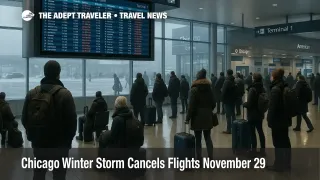
Chicago winter storm flights are seeing widespread disruption at Chicago O Hare International Airport (ORD) and Chicago Midway International Airport (MDW) on November 29, 2025, as a major snowstorm and strong winds spread across the Midwest. By midmorning, local reports counted at least 466 cancellations at O Hare and 76 at Midway, making Chicago one of the hardest hit aviation nodes in the country. Travelers using Chicago as a hub, whether on domestic connections or long haul routes to Europe and Asia, need to treat their plans as fragile and be ready to move quickly on weather waivers, alternative routings, or even a one day delay.
The core change for travelers is that a broad winter storm warning and airline waivers now cover Chicago and much of the upper Midwest, meaning Chicago winter storm flights are likely to face rolling delays and cancellations through November 29 and into November 30 rather than a short, sharp disruption.
Forecasters at the National Weather Service office in Chicago, Illinois, have a Winter Storm Warning in effect from 300 a.m. on November 29 through 600 a.m. on November 30, with bands of heavy snow expected to push totals toward 6 to 12 inches across parts of northern Illinois and northwest Indiana. Local TV outlets describe this as the city's most significant November snowfall in several years, with light snow in the morning giving way to heavier rates and gusty winds through the afternoon and evening, a combination that usually slows arrival and departure rates at both O Hare and Midway even if runways remain open.
Regional coverage also shows that this is not just a Chicago problem. Snow and high winds are spreading from the northern Plains into Iowa, Wisconsin, and Michigan, with winter storm warnings and advisories stretching from the Dakotas across central Iowa, northern Illinois, and southwestern Wisconsin into the Great Lakes. That means flights that never touch Chicago can still be delayed if crews, aircraft, or earlier legs are trapped in the storm zone.
On the aviation side, O Hare is providing the clearest signal that the system is stressed. By Saturday morning, its cancellation tally had already crossed 460 departures and arrivals, with Midway adding more than 70 cancellations of its own. Bloomberg and other national outlets report that Chicago is contributing a disproportionate share of nationwide cancellations as airlines pare back schedules to avoid having aircraft and crews stuck in blizzard conditions. The practical effect is fewer same day rescue options, longer standby lists, and crowded rebooking desks through the day.
For anyone planning to route from the West Coast to Europe via O Hare, or from smaller Midwestern cities into Chicago and onward to the coasts, the storm turns ordinary one stop itineraries into high risk bets. Late afternoon and evening banks are particularly exposed because they depend on inbound aircraft from smaller cities in Wisconsin, Iowa, and Michigan that may see whiteout stretches or airport slowdowns as the storm matures. If you are still in the shopping phase, it is worth considering routings through hubs outside the core snow bands, such as those in the southern United States, even if it means a longer flight path.
Major airlines have already moved into waiver mode, which is usually the best lever for travelers who can change plans before they get stuck at the airport. Delta has issued a Midwestern Winter Weather waiver that applies to travel to, from, or through dozens of upper Midwest cities, including Chicago, Detroit, and Minneapolis, for trips on November 29 and November 30. Tickets must generally be rebooked and reissued by December 3, with change fees waived when customers keep the same origin and destination and travel in the same cabin, although fare differences can still apply outside limited fare buckets.
American Airlines has parallel winter weather alerts on its travel advisory page, including a specific notice for Chicago, Illinois. For American, the Chicago alert covers travelers who bought tickets by November 25, 2025, are scheduled to travel on November 29, and can move their trips into a window running roughly from November 26 to December 1 while keeping Chicago as their origin, destination, or connection point. Within those rules, American is waiving change fees if customers rebook in the same cabin, though a fare difference may still appear if the original fare class is sold out.
United Airlines, which uses O Hare as one of its main hubs, has posted an "Upper Midwest Winter Weather" travel waiver that explicitly lists Chicago among the impacted airports and covers travel dates on November 29 and November 30. Passengers whose itineraries touch airports in the waiver list can change flights within the specified date range without standard change fees, using a waiver code noted in the policy, again subject to keeping origins and destinations the same and booking within normal validity limits. Other carriers serving the region, such as low cost and regional airlines, are publishing similar flexibility on their own alert pages, but rules and covered dates can vary by brand and fare type.
How It Works: Weather Waivers And Rebooking
Weather waivers are airline policies that temporarily relax normal change rules when events like snowstorms, hurricanes, or volcanic ash make disruption likely across a region. Instead of waiting for a flight to cancel, eligible customers can pro actively switch to a different flight or date within a limited window, often with change fees waived and sometimes with fare differences waived if they stay in the same cabin and market. The key is that waivers are tightly defined by travel dates, ticket purchase dates, and affected airports, so it is not enough to know that "Chicago has a waiver" without checking whether your itinerary fits all the criteria.
In practical terms, this Chicago storm means that travelers who can move their flights off November 29 and November 30, or shift into earlier Saturday departures before the worst bands arrive, should do so as soon as they see a waiver that applies. Same day change inventory will only get tighter as the day progresses, and waiting until a flight is formally posted as delayed or canceled can leave you competing for a smaller pool of seats.
The storm is also tightening pressure on road and ground transport. As snow spreads across Illinois, Iowa, Wisconsin, and Michigan, local outlets are reporting hazardous travel on interstates and regional highways, with low visibility, slick surfaces, and the potential for temporary closures as crews work to clear accidents and drifting snow. That matters for self drivers heading to or from the airports, as well as for passengers booked on intercity buses that use the same corridors. A two hour driving leg to catch a flight could easily become a four hour slog in these conditions, which in turn increases the risk of missing check in cutoffs even if your flight itself is running on time.
For complex itineraries, the safest move is to separate your risk. If you are flying on separate tickets, for example a low cost carrier into Chicago followed by a separate transatlantic flight on another airline, consider consolidating onto a single ticket or rerouting through a hub outside the storm footprint so that one carrier has a legal obligation to protect you on your onward journey. At a minimum, leave three hours or more between scheduled arrival and any onward departure through Chicago this weekend, and avoid planning same day positioning legs by car or bus that assume ideal road conditions.
Travelers who are already at the airport or in transit should monitor both their airline app and broader tools such as FlightAware's Misery Map, which shows where delays and cancellations are stacking up across the United States, to understand whether issues are localized to Chicago or rippling through the network. If your crew or aircraft is coming from another storm hit region, you may face rolling delays even if the weather briefly improves at your departure point.
Finally, anyone with non essential trips that depend on tight connections or inflexible arrival times should consider pushing travel into early next week instead. Forecasts show the core of the storm exiting the region by November 30, with road and airport operations gradually recovering thereafter, which should restore more normal same day rebooking options and reduce the risk of forced overnight stays. For a broader view of how this storm is affecting airports outside Chicago, readers can pair this alert with Adept Traveler's daily national breakdown in "Flight Delays And Airport Impacts: November 29, 2025," and consult our evergreen guide to airline weather waivers and rebooking strategies for more detailed step by step advice.
Sources
- Over 500 flights canceled at Chicago airports amid winter storm
- Winter storm warning in effect for Chicago area with 6 to 12 inches of snowfall possible
- Chicago weather forecast, several inches of snow expected Saturday
- NWS Forecast Office Chicago, IL
- Major Winter Storm Will Disrupt Travel This Weekend
- Winter storm warnings and advisories issued as the post Thanksgiving storm makes way into the northern U.S.
- Midwestern Winter Weather travel waiver, Delta Air Lines
- Midwestern Winter Weather, Delta Professional advisory
- Winter weather, Midwest U.S. and Chicago, Illinois travel alerts, American Airlines
- Upper Midwest Winter Weather travel waiver, United Jetstream
- Snow, rain and cold in store for some travelers over holiday weekend
- Major winter storm slams Midwest with snow, travel troubles
- FlightAware MiseryMap