

Winter Storm Bellamy To Snarl U.S. Thanksgiving Travel
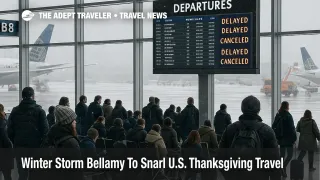
Winter Storm Bellamy travel delays are already hitting Chicago, Minneapolis, and other Midwest hubs on November 29 2025, as more than 1,100 U.S. flights are canceled and thousands delayed at the peak of the post Thanksgiving rush. The same storm is dropping heavy snow from the northern Plains through the Great Lakes, with state police reporting crashes and spinouts in Minnesota and western Michigan while highway crews race to keep key interstates open. Travelers trying to get home this weekend should treat Saturday and Sunday as a two day gauntlet, adding time, padding connections, and being ready to reroute or even overnight if their paths run through storm exposed hubs.
In practical terms, Winter Storm Bellamy travel delays are turning the Midwest into the main pinch point on Saturday, then shifting the worst disruption to major East Coast airports on Sunday as snow gives way to rain, low ceilings, and crosswinds along the Interstate 95 corridor.
How Bad The Storm Already Is
National Weather Service winter storm warnings and winter weather advisories now stretch from Montana to New York, with forecasters expecting six to twelve inches of snow, and in some cases more than a foot, across parts of Iowa, Illinois, Wisconsin, and Michigan by late Saturday. Additional lake effect bands downwind of Lakes Superior, Michigan, Erie, and Ontario could push totals higher in northern lower Michigan and central New York, while short lived but intense snow squalls threaten whiteout conditions in sections of the interior Northeast.
At the airports, the concentrated impact is already clear. By early afternoon on November 29, more than 1,100 U.S. flights had been canceled and over 3,400 delayed, with Chicago O Hare International Airport (ORD) and Chicago Midway International Airport (MDW) accounting for well over 600 cancellations after an early ground stop and a prolonged ground delay program that at times pushed average delays toward several hours. Minneapolis Saint Paul International Airport (MSP), Detroit Metropolitan Wayne County Airport (DTW), and other Great Lakes hubs are also reporting deicing queues, runway slowdowns, and mounting delays as the storm expands east.
Road conditions are deteriorating in parallel. Minnesota outlets describe a steady rise in crashes and spinouts along the Interstate 94 corridor and across the southern part of the state, where snow totals could reach ten inches, while earlier reports from western Michigan highlighted multiple Thanksgiving Day accidents as lake effect bands crossed key routes. South of the snow, heavy thunderstorms and saturated ground are raising flash flooding risks along the western Gulf Coast, especially in parts of Texas and Louisiana where Bellamy's southern flank is all rain.
Saturday, November 29, 2025, Midwest And Gulf Focus
Saturday is the core air travel pain day for the central United States. The Weather Channel expects Bellamy to produce widespread snow and gusty winds through the upper Mississippi Valley and Great Lakes, with major airports at highest risk including Chicago O Hare, Chicago Midway, Dallas Fort Worth International Airport (DFW), George Bush Intercontinental Airport (IAH), Kansas City International Airport (MCI), Minneapolis Saint Paul, Detroit, and St Louis Lambert International Airport (STL).
For flyers, that combination means slower departure and arrival rates, longer taxi and deicing times, and a higher chance that tight connections misconnect even when flights technically operate. Airlines are sequencing departures to maximize safety, not on time performance, so it is normal to see rolling delays cascade across mid day and afternoon banks. Travelers with options should prefer early morning departures, which usually face shorter queues and give more daylight hours to recover if a leg is canceled.
On the ground, highway risk is highest across snow and blowing snow zones around the Great Lakes, including Illinois, Wisconsin, Michigan, and parts of Iowa and Minnesota. Drivers should avoid night travel in open country where squalls can erase visibility in seconds, stick to main routes that are plowed more often, and identify small cities along the way where they can stop if conditions suddenly deteriorate.
Sunday, November 30, 2025, East Coast And Return Rush
By Sunday, Winter Storm Bellamy's core snow shield moves farther east, and the travel risk shifts with it. Weather Channel forecasters flag Atlanta's Hartsfield Jackson Atlanta International Airport (ATL), the New York City airports, Boston Logan International Airport (BOS), Philadelphia International Airport (PHL), Washington's three airports, Orlando International Airport (MCO), New Orleans Louis Armstrong International Airport (MSY), Detroit, Pittsburgh, and even Denver International Airport (DEN) later in the day as hubs likely to see weather related delays.
Along the Interstate 95 corridor from Washington through New York to Boston, most of Bellamy's precipitation will fall as rain, not snow, but that is still enough to slow runway operations and create go arounds and holding patterns, especially if winds and ceilings also worsen. In the interior Northeast, including parts of Pennsylvania and upstate New York, a mix of snow and rain, plus lingering lake effect bands, will keep some secondary airports and mountain passes in difficult shape. Sunday night, fresh snow could redevelop in the central and southern Rockies and adjacent High Plains, adding late day risk for Denver and for drives across Colorado, western Kansas, northern New Mexico, and the Texas Panhandle.
Sunday is also likely to be one of the busiest air travel days in U.S. history. Airlines for America expects U.S. carriers to fly roughly 2.8 million passengers per day over the Thanksgiving period, and travel industry summaries of Transportation Security Administration projections indicate that more than 3 million people could pass through TSA checkpoints on Sunday November 30 alone. AAA's Thanksgiving outlook adds that nearly 82 million people are expected to travel at least fifty miles between November 25 and December 1, so even small weather related slowdowns at key hubs can ripple across a very full network.
Airline Waivers And How To Use Them
Several major airlines are now offering Winter Storm Bellamy or upper Midwest weather waivers that let eligible travelers move trips without paying change fees. American Airlines' current travel alerts include a Winter Storm Bellamy notice for the Midwest, plus a specific winter weather bulletin for Chicago, that waive change fees for customers who bought tickets by late November and are scheduled to travel November 29 or 30, as long as they keep the same origin and destination and rebook into approved dates in early December.
United Airlines has issued an Upper Midwest Winter Weather waiver covering a long list of regional and hub airports, including Appleton, Cedar Rapids, Des Moines, Green Bay, Grand Rapids, Kansas City, Milwaukee, Omaha, Chicago O Hare, Peoria, South Bend, St Louis, and Sioux City, with impacted travel dates on November 29 and 30 and a published waiver code for agents to use. Customer facing travel alert pages confirm that qualifying passengers can generally reschedule within the validity window without extra change fees, although fare differences may still apply on some dates and routes.
Delta, Southwest, and other carriers are also posting weather waivers and flexible change policies tied to Bellamy and related Thanksgiving storms, usually centered on Midwest and Great Lakes airports for Saturday and on East Coast hubs for Sunday. Travelers should check their airline's alerts page or app, not just third party sites, because the exact booking date rules, eligible cities, and alternate date ranges differ by carrier.
From a traveler's perspective, the most effective way to use these waivers is to move out of the bullseye rather than hoping to be the lucky flight that operates on time. That can mean shifting from a Saturday afternoon connection through Chicago to a Sunday or Monday itinerary, moving from a two leg routing through a snowbound hub to a more expensive but nonstop flight, or changing an evening arrival into a morning arrival that leaves more daylight for recovery if something goes wrong.
Road Trips, Buses, And Trains
Airline disruptions are only part of the Bellamy picture. The same storm that is snarling airport operations is also making life difficult for long distance drivers, intercity bus passengers, and rail travelers, especially across the Midwest and Great Lakes. The Associated Press and local papers in Michigan and Minnesota note that winter storm warnings and lake effect snow have already produced multiple vehicle crashes, and that conditions are likely to remain risky well into Sunday in Great Lakes snow belts.
For long drives, that means conservative planning. Avoid overnight runs through the heaviest snow zones, leave extra time for food and fuel stops when plows are operating, and assume that average speeds will be much lower than a clear day, especially on secondary highways. Travelers using buses or regional trains should monitor operator alerts, because even when vehicles can run, they may do so on modified schedules to avoid the worst of the storm.
How This Fits Into The Broader Thanksgiving Pattern
This Bellamy focused update builds on Adept Traveler's earlier coverage of Thanksgiving winter storms hitting U.S. flights and roads and Thanksgiving storms disrupting U.S. return flights, which flagged the risk of a second weekend system landing directly on the main return window. The storm is arriving exactly when forecast, and it is hitting exactly the hubs that were highlighted: Chicago and other central nodes on Saturday, then the East Coast arc on Sunday and into Monday.
From here, the key variables are snowfall rates in the core Midwest snow bands, how quickly lake effect patterns reorganize once the main low passes, and whether Sunday's rain and wind in the East are enough to trigger widespread ground delay programs at multiple hubs at once. Travelers who have already built buffer into their plans, who are willing to accept reroutes, and who make use of airline waivers will still face inconvenience, but they are much less likely to get completely stranded than those holding on to tight, non flexible connections through Bellamy's core.
Sources
- Winter storm warnings stretch across the northern US, bringing snow, cold and risky conditions
- Winter Storm Bellamy To Snarl Holiday Travel This Weekend
- Over 1,100 flights canceled as Midwest snowstorm disrupts travel
- Over 600 flights canceled at Chicago airports amid winter storm
- Snow, rain and cold in store for some travelers over holiday weekend
- Nearly 82 Million Americans Projected to Travel over Thanksgiving Holiday Travel Period
- FAA Expects Busiest Thanksgiving Travel Period in 15 Years
- TSA Warns Travelers to Prepare for Sunday, Nov. 30
- Travel alerts, American Airlines, Winter Storm Bellamy, Midwest U.S.
- Travel Waiver, Upper Midwest Winter Weather, United Airlines
- Thanksgiving Winter Storms Hit US Flights And Roads
- Thanksgiving Storms Disrupt US Return Flights
- Flight Delays And Airport Impacts: November 28, 2025