

Greek Farmer Blockades Hit Borders And Highways In December
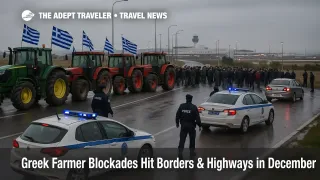
Greek farmer border blockades are now a real obstacle for travelers crossing northern Greece in December, not just a local political story. Convoys of tractors are periodically closing highway junctions and key border crossings towards Bulgaria, North Macedonia, and Turkey, forcing long detours for trucks, coaches, and self drive visitors. In Thessaloniki, riot police have already used tear gas to stop farmers from driving onto the main access roads to the city's international airport, a sign that protest tactics are brushing up against critical travel infrastructure even while flights and ferries continue to operate.
In practical terms, the Greek farmer border blockades mean that road based travel across northern Greece, especially anything involving same day border hops, is the most exposed. Airport and ferry operations are still running, but detours and rolling roadblocks around them could add hours to transfer times, particularly for trips that rely on fixed schedule buses or tight private transfers.
What has changed for travelers
Farmers in northern and central Greece have moved from symbolic roadside protests to direct, time limited blockades of highways and land borders as part of a dispute over delayed European Union backed subsidies. Convoys of tractors have blocked routes to North Macedonia, Bulgaria, and Turkey, including the Promachonas and Evzones customs stations, where organizers have already demonstrated their willingness to close crossings for several hours at a time and warn that de escalation depends on government concessions.
Several reports describe trucks halted in long queues at border points with Bulgaria and Turkey while farmers control access and police divert other traffic onto slower secondary roads. At some periods, cars and coaches have been allowed to pass while heavy vehicles are held, but protest leaders have publicly floated the option of full closures if talks stall, so the pattern can change from day to day.
The demonstrations have also crept closer to major cities and airports. Near Thessaloniki, tensions escalated when farmers tried to move their tractors onto the main approach roads to Thessaloniki Airport Makedonia (SKG). Riot police responded with tear gas and set up cordons, and by the end of that confrontation authorities reported that they had kept the central access route open, though at least one nearby road was blocked by tractors and required diversions.
Where the blockades are concentrated
Most of the disruptive action so far is in northern Greece along the main northbound corridors and at the land borders. Local and international outlets all point to Promachonas on the Bulgarian border and Evzones on the North Macedonian border as primary pressure points, with tractors parking across lanes for blocks of several hours, sometimes reopening briefly to let queues clear.
Further east, farmers have also affected traffic towards Turkey. Regional reporting from the Bulgarian and Turkish sides notes that heavy vehicle crossings at some points on the Bulgaria Greece and Turkiye Greece borders have been halted, with special exemptions granted only for perishable or critical cargo such as food, flowers, and medicines. That pattern is more damaging to freight than to holidaymakers in cars, but long truck queues can still choke approach roads and spill back towards junctions used by tourist traffic.
Inside Greece, tractor lines have appeared on segments of the main Patras Athens Thessaloniki Evzonoi motorway and at key toll stations near Thessaloniki, such as Malgara, where images show long parallel rows of tractors and diverted passenger vehicles. In central Greece, earlier waves of the protest have hit junctions near Nikaia and other links that funnel traffic between Thessaly and the north, and organizers warn that new roadblocks can be announced at short notice as negotiations rise and fall.
Timeframe and likely duration
The immediate trigger is a subsidy shortfall tied to an investigation into alleged large scale fraud in Greece's farm payment system. The European Public Prosecutor's Office has described a scheme involving falsified land and livestock to tap into EU funds, and Greek authorities have responded by scrutinizing tens of thousands of applications, freezing or delaying payments that many legitimate farmers were counting on to buy seed and fertilizer.
In response, farmers argue that they are being punished collectively for the misdeeds of a smaller group and say they cannot plant fields or feed livestock without the funds. That grievance is not something that can be solved overnight, which is why border agencies in neighboring countries are already warning that blockades and heavy vehicle restrictions could continue until at least December 21, 2025, unless a settlement is reached.
For travel planning, that means the entire mid December stretch should be treated as a period of elevated risk for road journeys through northern Greece and its land borders, with the possibility that protests will ease or shift but not disappear entirely.
Airports, ports, and public transport
Despite the dramatic scenes around tractors and riot police, airports and ports in Greece remain open, and no major carrier has warned of systemic flight cancellations tied directly to the farmer protests. The most serious airport related incident so far was the attempt to blockade Thessaloniki's airport access road, which police ultimately prevented, though clashes and tear gas canisters are not the backdrop anyone wants on the way to a holiday flight.
The larger operational risk is indirect. Travelers who rely on road transfers to reach airports or ferry terminals in northern Greece could face surprise delays if a tractor line forms between their accommodation and the airport, or if a diversion sends them down narrower, slower roads. Regional coach services and cross border buses are particularly exposed, because many use the same highways and customs posts that farmers are targeting and cannot easily reroute without adding several hours.
Rail services are less central to this protest than in a classic transport strike, but any itinerary that strings together bus, train, and ferry segments on a tight same day schedule should be treated with caution while blockades continue.
Background, how the subsidy dispute works
Under the European Union's Common Agricultural Policy, farm subsidies are paid based on land area, crop type, and livestock holdings, with national agencies responsible for vetting claims before funds are disbursed. In Greece, that role sits with OPEKEPE, a state body that handles roughly €2.5 billion in EU aid each year. Investigations by the European Public Prosecutor's Office and Greek authorities uncovered what they describe as systematic fraud, including phantom fields and animals, which led to the resignation of several officials and the phased shutdown of parts of the agency.
As a result, tens of thousands of subsidy applications are now under deeper review, creating a cash flow crunch for genuine farmers who had planned their winter and spring planting around the usual payment calendar. The tractor blockades are meant to pressure the government into releasing funds faster or offering interim support, but ministers have publicly insisted that they will not allow major transit routes, ports, or airports to be shut down, even as they keep a negotiation channel open.
Practical planning advice for December trips
For travelers, the main task is not to decode the subsidy system, but to adapt itineraries to a protest landscape that changes from day to day. Anyone planning a self drive trip through northern Greece in December, especially routes that cross into Bulgaria, North Macedonia, or Turkey, should build generous buffers into daily plans and avoid assuming that a specific border crossing will be passable at a specific hour.
If your route currently uses Promachonas or Evzones, ask your rental company or local contact about realistic alternatives, such as crossing at a secondary checkpoint that has seen less protest activity, even if it looks longer on a map. For coach and bus travelers, monitor operator updates closely and be prepared for re timed departures or temporary suspensions on some cross border routes.
For flights from Thessaloniki, Athens, or island airports, the headline advice is to increase your transfer buffer rather than cancel trips. Leave significantly earlier for the airport than you would on a normal day, watch local news and mapping apps for signs of road closures, and be ready to accept a longer, meandering route if your driver needs to avoid tractor lines or police cordons. For ferry departures from northern ports or the Adriatic gateways, the same principle applies, particularly if your sailing leaves in the middle of the day when protests are more likely to be active.
Travel insurance and flexible tickets matter here as well. If your itinerary involves a same day cross border drive followed by a nonrefundable flight, you may want to rebook onto a later flight, or move the overnight stay to the city or country where the flight departs, so that a surprise blockade does not strand you on the wrong side of the line. When possible, avoid stacking separate tickets that depend on everything running exactly on time.
Finally, keep safety in mind. Tractor blockades are political protests, not tourist attractions. Do not drive up to a line of tractors looking for photos, follow police instructions on diversions, and if you encounter tear gas or clashes, close windows, move away from the area, and wait until the situation calms before continuing your journey.
Sources
- Greek farmers block border crossings in escalating dispute over delayed EU subsidies
- Greek farmers block border crossing routes in dispute over delayed EU subsidies
- Defying a government warning, Greek farmers block border crossings in wake of EU subsidy scandal
- Greek police fire tear gas at protesting farmers threatening to blockade airport
- Greek police fire tear gas at protesting farmers threatening to blockade Thessaloniki airport
- Heavy vehicle crossings halted at Bulgaria Greece and Turkiye Greece borders due to farmer protests
- Farmers block border crossings
- Greek farmers block roads as costs and culls hit rural livelihoods