

East London Bus Strike Hits Stagecoach Routes Jan 8-9
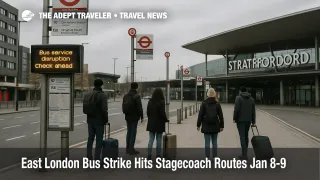
East London bus strike action on January 8 and January 9, 2026 is expected to leave little or no service on several Stagecoach operated routes across east and northeast London. Travelers staying in neighborhoods that lean on buses for the last mile, including parts of Hackney, Stratford, and Docklands, are the most exposed to missed timed entries, delayed day plans, and brittle airport transfers. The practical move is to start every essential trip on rail first, then finish by walking or a licensed taxi, and to add buffer if your usual first leg is a bus.
The East London bus strike matters because TfL has warned that Stagecoach routes operated from Lea Interchange Bus Garage will be affected on Thursday, January 8, 2026, and Friday, January 9, 2026, with little or no service expected on multiple lines and knock on crowding likely elsewhere.
TfL's customer notices tie the disruption to Stagecoach services from Lea Interchange, and the affected list includes routes 58, 97, 135, 236, 276, 308, 339, 488, 678, D8, W13, and W14. TfL also warns that route 86 may see delays, cancellations, or reduced service rather than a full shutdown, which is exactly the sort of detail that can trap travelers who assume a "nearby route" is a safe backup.
How It Works
London's red bus network is run under contract, which means a dispute at one operator or one garage can knock out a cluster of routes that share the same driver base and vehicle pool. During a walkout, there is no realistic way to replace a full garage worth of drivers at short notice, so the operational outcome is usually a mix of no service on some routes, limited service on others, and heavy crowding on the corridors that remain. Even when the Tube and rail networks are not part of a dispute, road congestion and stop crowding can rise quickly because thousands of short trips are forced onto fewer options.
For visitors, the risk is rarely the headline problem of "getting across London," because rail can usually still do the heavy lifting. The real pain point is the last mile, meaning the short hop from a hotel to a station, from a station to an attraction, or from a restaurant area back to accommodation at night. East London itineraries often involve exactly those short hops, for example moving between neighborhoods and interchanges around Stratford, Hackney, and Docklands, where buses are a common default because they are simple with luggage, strollers, or shopping bags.
On strike days, treat any bus dependent plan as an uncertainty. If your route plan begins with one of the affected lines, build your plan around a nearby rail station instead, even if that means a longer walk at the start. In practice, that means leaning on the London Underground for cross city moves, the London Overground for orbital links across east and north London, the Docklands Light Railway for Docklands connections, and the Elizabeth line when you want a fast, high capacity option through central London and into the east.
Stratford is the anchor fallback for many east side itineraries because it concentrates the Central line, the Jubilee line, the Elizabeth line, the Overground, and the DLR in one place. If you can get to Stratford by foot, by an unaffected bus, or by a short taxi ride, you can usually rebuild the rest of your day with rail. Hackney and Dalston corridors can often pivot onto the Overground for hops to major interchanges, while Docklands travelers can usually solve the middle of the trip with the DLR, then walk or cab for the final few blocks when a bus would normally do the job.
Airport transfers are where the strike can do the most financial damage, because a missed train, a missed check in cutoff, or a missed bag drop can cascade into rebooking fees or a forced overnight. Travelers starting in east London should apply a simple rule for January 8 and January 9, 2026, if a bus is your first leg, add at least 60 minutes, and if you are checking a bag or traveling at peak commute hours, add 90 minutes. That buffer is not about the flight itself, it is about giving yourself enough slack to switch modes if your bus does not show, or if the first available taxi is slow to arrive.
For London City Airport (LCY), the safest pattern is rail first to a DLR station, then DLR to the airport, because the DLR is the backbone link for that airport. The strike risk is getting stranded on the wrong side of Docklands without a dependable bus, so pre plan a walking route to the nearest DLR station you can realistically reach with luggage, or pre book a licensed taxi for a fixed pickup time.
For London Stansted Airport (STN), many travelers rely on a rail departure from Liverpool Street, which means your real vulnerability is reaching that station on time. If your hotel area normally uses a Stagecoach route to feed into that corridor, switch to a Tube, Overground, Elizabeth line, or a taxi based first leg, and aim to arrive at Liverpool Street earlier than usual so you are not forced onto the next train by a last minute ground delay.
For London Heathrow Airport (LHR), the Elizabeth line can reduce reliance on buses because it links east London interchanges into central London and onward to the airport terminals. For London Gatwick Airport (LGW), rebuilding the plan often means getting onto rail routes that feed into Thameslink or other National Rail options, and the same logic applies, do not let a bus be the fragile first step that decides whether you make the train you need.
The strike is also likely to push more travelers onto nearby routes that are running, which can make "normal" services feel abnormal. That shows up as longer queues at stops, fuller trains at key interchanges, and slower road speeds where taxis and rideshares are competing with diverted traffic. If you have timed tickets, tours with a strict meeting point, or dinner reservations you cannot move, build your day around arriving early and waiting nearby, rather than cutting the timing close and hoping the last mile behaves normally.
The most reliable prep is simple. Check your exact route number against TfL's live status before you leave, lock a rail based alternative that does not depend on one bus, and decide in advance where you would switch to a taxi if the first leg fails. That is the difference between a minor inconvenience and a day that collapses into missed bookings.
If negotiations change the plan, TfL will update its strike and line status pages, and that is the final source of truth for day of decisions. Until that happens, travelers in east and northeast London should treat January 8 and January 9, 2026 as days to start on rail, avoid tight connections, and carry extra buffer for anything that has a hard cutoff.