

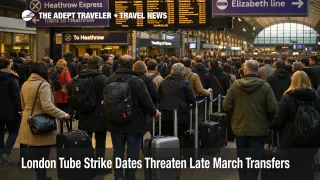
London Tube Strike Dates Threaten Late March Transfers
Chicago O'Hare International Airport (ORD) summer planning has moved beyond a weather delay debate and into a formal capacity fight that could change flights already on sale. Reuters reported on March 16, 2026, that the Federal Aviation Administration now wants to cut ORD to 2,608 daily flights this summer, down from the 2,800 level it floated publicly in late February, and far below the roughly 3,080 daily flights airlines had scheduled. The hearing resumes on Thursday, March 19, 2026, which means the next phase is not abstract signaling, it is the lead-in to a final FAA order that could force timetable cuts, retimed banks, and thinner recovery options at one of the country's biggest hubs.
The practical traveler issue is not that every ORD booking suddenly becomes invalid. It is that an itinerary sold before the final order may still be legal to sell today while remaining operationally too optimistic for the summer system the FAA says it can actually run. That makes flexibility, connection margin, and backup options more important than the published schedule alone.
O'Hare Summer Flight Cuts: What Changed
What changed since prior coverage is the floor moving lower. The FAA first proposed a 2,800 daily limit for Summer 2026, but Reuters now reports the agency has reduced its working target to 2,608 daily flights and plans to allocate reductions proportionally based on last summer's schedules so the burden is shared across carriers rather than concentrated on one airline. The agency first convened the meeting on March 4, adjourned it, and now plans to resume on Thursday, March 19.
That matters because 2,608 is not a cosmetic trim. It sits below last summer's average of 2,680 daily flights at ORD, not just below the published Summer 2026 peak schedule. In other words, the FAA is no longer trying to shave back an aggressive growth plan to a familiar operating level. It is signaling that the workable summer ceiling may be lower than what O'Hare actually averaged last summer.
The final order has not been published yet, so travelers should not treat every summer ticket as doomed or every specific flight as already cut. But the process is formal. In its March 3 Federal Register notice, the FAA said it would consider written submissions and then publish a final order on delay reductions at ORD, expected to apply through the Summer 2026 scheduling season from March 29 through October 25, 2026.
Which Travelers And Airlines Are Most Exposed
United Airlines and American Airlines are the clearest exposure points because they drove much of the schedule expansion that triggered the fight. Reuters reported that United planned about 780 daily ORD flights this month, up from 541 per day last year, while American said its summer daily departures would rise to 526 from 484 last summer after announcing 100 added daily departures to more than 75 destinations.
For travelers, the highest risk is not every nonstop. It is itineraries that need O'Hare to function as a clean transfer machine. Domestic to international connections, late day onward banks, separate ticket builds, same day event or cruise joins, and premium itineraries built around narrow timing windows are the most fragile if airlines lose duplicate frequencies or backup departures. That is the real consequence of structural cuts, fewer ways to recover when an inbound runs late, a gate change drags, or weather takes even a small bite out of the day. For prior Adept coverage, see FAA pushes O'Hare summer cuts deeper into peak season and Chicago O'Hare Summer Flight Cap Planned by FAA.
There is also a second order effect outside Chicago. ORD is a national connection hub, so peak hour cuts can change aircraft utilization, misconnect patterns, and same day reaccommodation across Midwest and transatlantic flows. If ORD banks get thinner, displaced demand does not vanish, it spills into rival hubs, alternate departure times, and higher pressure on remaining seats.
What Travelers Should Do Before The Final Order
Travelers with flexible leisure trips should treat current summer ORD schedules as provisional until the FAA issues its final order and carriers reflect any cuts in their timetables. That does not mean panic rebooking every June, July, or August trip. It means favoring tickets with easy change terms, avoiding self-built tight connections, and being skeptical of itineraries that rely on the last practical onward flight of the day.
The main decision threshold is tolerance for failure. If a trip can absorb a modest retime or a later same day reaccommodation, keeping an ORD booking may still be reasonable while you monitor for schedule changes. If a missed connection would break a cruise embarkation, wedding, tour start, or long haul departure, the safer play is to add margin now, either by booking a nonstop, choosing an earlier connection, or arriving the night before.
Travelers should also watch for the order to hit bookings in two stages. First comes the FAA's final order, which sets the operating constraint. Then comes the airline response, which is when specific flights are retimed, combined, or removed from sale. The first visible clue may not be a cancellation email, it may be a quiet schedule change, a vanished duplicate departure, or a weaker same day backup. Broader system context is in U.S. Air Traffic Control Privatization: Reality Check.
Why The FAA Is Pushing Lower, And How The Risk Spreads
The FAA's core argument is straightforward. The published ORD summer schedule is too large for the airport and system to run reliably under current conditions. In late February, the agency said more than 3,080 daily operations were scheduled on peak days, versus about 2,680 last summer, and warned the increase would stress runway, terminal, and air traffic control systems. By March 16, it had moved to an even lower working target of 2,608 daily flights.
This is why the story matters even before summer storms hit. Overscheduling compresses the slack that usually helps a hub recover. When a bank is too dense, the first order effect is local, longer taxi times, slower turns, tougher gate management, and more fragile sequencing. The second order effect is network wide, missed connections, thinner reaccommodation, crew and aircraft displacement, and rising fare pressure on the flights that remain. Chicago has argued the FAA should not cut below 2,800, calling deeper limits unwarranted, but the agency is clearly prioritizing reliability over the airlines' published growth plan.
What is confirmed is that the FAA has a formal process, a resumed March 19 hearing, and a much lower current target than its original public benchmark. What is not yet confirmed is the exact final number that will appear in the order, and which specific flights or banks each carrier will sacrifice. Until that order lands, travelers should read ORD summer bookings as changeable inventory, not settled reality.
SourcesaLondon Tube strike dates are now fixed on the calendar, which turns a vague labor risk into a real late March planning problem for travelers using London, England, as a same day transfer city. Transport for London says strikes are planned on March 24 to 25, March 26 to 27, April 21 to 22, April 23 to 24, May 19 to 20, and May 21 to 22. The practical risk is not just a slower commute into central London, it is broken airport handoffs, longer road journeys, and tighter margins for Eurostar, theater, and onward UK rail connections. Travelers with fixed deadlines should build backup routes now, not after TfL publishes day by day service details.
What changed since Adept Traveler's earlier March 4 coverage is simple, the dispute now has six published 24 hour strike windows instead of a ballot threat with no dates. TfL says the action will affect all Tube lines, and that while the impact should be less severe than the September 2025 Tube strikes, travelers should still expect severe disruption from 12:00 p.m. on the Tuesday and Thursday strike starts, continuing through the following day. That timing matters because it can catch travelers who assumed the first half of a strike day would look normal, then leave them stranded when the network thins sharply in the afternoon and evening.
The London Tube strike dates matter most for travelers making same day moves between airports, central London hotels, and major rail hubs. Heathrow remains the most exposed airport because the Piccadilly line is the cheapest direct option to the terminals, and Heathrow's own guidance also points travelers toward the Elizabeth line and Heathrow Express as the main rail substitutes. When the Tube weakens, those alternatives become more valuable, but they also absorb displaced demand from central London and from inter airport travelers trying to salvage the day.
London Tube Strike Dates, What Changes for Travelers
The six strike windows are Tuesday, March 24 to Wednesday, March 25, Thursday, March 26 to Friday, March 27, Tuesday, April 21 to Wednesday, April 22, Thursday, April 23 to Friday, April 24, Tuesday, May 19 to Wednesday, May 20, and Thursday, May 21 to Friday, May 22. RMT says each walkout runs from 1200 p.m. to 1159 a.m. the next day, and TfL says service should be normal before noon on the Tuesday and Thursday start dates, then severely disrupted after midday and into the following day.
For late March travelers, that means the first practical risk window begins midday on March 24, not the morning. Someone landing at Heathrow after lunch, leaving a hotel for an evening Eurostar, or crossing London after a meeting could face a much harder journey than someone moving before noon. The same pattern then repeats two days later on March 26, which is why this is more dangerous than a one day transit scare. It creates two separate late March disruption pulses in the same week, with little time for travelers, taxis, coaches, and rail alternatives to reset in between.
TfL also says only some Tube drivers are involved, and Reuters notes the dispute centers on proposed compressed four day work patterns rather than a full network shutdown order. That matters because it introduces uncertainty about severity. Travelers should not assume total paralysis across every line, but they also should not plan on a normal Tube day with minor gaps. The right working assumption is patchy, network wide weakness, especially once crowding and interchange pressure start to spread.
Which Airports and Rail Hubs Are Most Exposed
Heathrow is the clearest pain point. Heathrow says central London travelers normally have three direct rail choices, Heathrow Express to London Paddington, the Elizabeth line to major stations including Paddington, Bond Street, Tottenham Court Road, Farringdon, Liverpool Street, and Stratford, and the Piccadilly line direct to all Heathrow terminals. The problem on Tube strike days is that the cheapest direct option, the Piccadilly line, is exactly the one under dispute, which pushes more travelers onto the Elizabeth line, Heathrow Express, coaches, taxis, and already busy roads. That is why Heathrow same day self connections and city to airport moves deserve the biggest caution flag.
Gatwick is less directly exposed because its core rail links are National Rail rather than the Underground. Gatwick says it is served by Gatwick Express, Southern, Thameslink, and Great Western Railway, with direct links into London Victoria, London Bridge, Blackfriars, City Thameslink, Farringdon, and St Pancras International. That gives travelers more ways to reach the airport without touching the Tube. The weak point is mode substitution inside London, especially if you planned to reach Victoria by Underground, or if you were relying on a Victoria to Paddington Tube hop for a Heathrow handoff. On strike days, Thameslink to Farringdon for the Elizabeth line is likely the cleaner Heathrow transfer path than Victoria plus Tube.
Stansted Airport is mainly a Liverpool Street, Tottenham Hale, and Stratford problem, not a whole London rail problem. Stansted Express runs every 15 minutes to Liverpool Street, with direct options also from Tottenham Hale and Stratford. That means travelers already near those railheads can still move, but anyone depending on the Victoria line, Central line, or other Tube segments to reach them becomes more fragile. Luton is similar. London Luton Airport says the Luton Airport Express and Thameslink routes feed Luton Airport Parkway, then the Luton DART covers the final four minutes to the terminal. So Luton remains workable from St Pancras, Farringdon, Blackfriars, and London Bridge, but cross London repositioning gets harder.
London City Airport is the one London airport with a built in relative advantage here because its station is on the Docklands Light Railway, not the Tube. But that does not make it immune. TfL crowding can still spill into DLR interchanges, road traffic can worsen as travelers abandon Underground plans, and airport access times can become less predictable across east and central London. Eurostar at London St Pancras International is also exposed less through train service and more through station arrival risk. Eurostar says all border and luggage checks happen before departure, and queues can build on peak days, so a delayed London approach can quickly become a missed train even if Eurostar itself is running.
How To Plan Around the Disruption
For Heathrow departures on the March 24 to 27 window, the safest posture is to avoid relying on the Piccadilly line if your flight matters. Use the Elizabeth line or Heathrow Express where they fit, or book a coach or car early enough that you are not buying scarce capacity on the day. If your itinerary is a same day Gatwick to Heathrow, or St Pancras to Heathrow, treat that as a vulnerable connection and consider moving the night before. London Underground Strike Risk Rises, Heathrow Transfers Hit remains the closest internal background on why Heathrow is the hardest airport to protect when the Tube weakens.
For Gatwick, Luton, and Stansted, the main strategy is to stay on through rail routes and avoid unnecessary Tube changes. Thameslink becomes especially valuable because it links Gatwick and Luton into central London stations without needing the Underground. For Stansted, position yourself close to Liverpool Street, Tottenham Hale, or Stratford before travel day if the timing is tight. For Eurostar, give yourself more margin than usual getting to St Pancras because the station process itself still takes time once you arrive. Adept's Eurostar French Strike Cancels London Paris Trains is a useful reminder that cross Channel trips fail fast when station arrival buffers disappear.
A realistic buffer rule is this, do not use London as a same day transfer city on the March strike dates unless you can absorb a long surface delay without losing the trip. That especially applies to cruise embarkations, last flight departures, theater tickets, fixed tour departures, and self connected long haul itineraries. Travelers staying in London proper can lower risk by choosing hotels near Paddington, Farringdon, St Pancras, Liverpool Street, or Victoria depending on their airport, because that reduces the amount of Tube travel needed on the day. London Travel Guide: The Ultimate 7-10 Day Itinerary for First-Time Visitors is not a strike guide, but it is useful for understanding which London districts sit closest to the rail routes that matter most when the Underground becomes unreliable.
The next decision point is not abstract. It is the moment TfL publishes more detailed day by day service expectations and your booking enters the March 24 to 27 window. If you have a hard deadline, act before then. If your trip is flexible, monitor official updates and keep a backup route priced. The biggest mistake with the London Tube strike dates is treating them like a local commuter problem when they are really a network timing problem that can break airport, rail, and hotel handoffs across the city.
Why This Is Happening, and How the Disruption Spreads Through Travel
RMT says the dispute is about an imposed compressed four day working pattern for Tube drivers, with concerns about shift lengths, fatigue, safety, work life balance, and related allocation processes. Reuters reports the same core issue, and TfL characterizes the action as unnecessary while still warning that all Tube lines will be affected. The exact labor merits are disputed, but for travelers the operational point is simpler, the conflict is about working patterns at the driver level, which is why the risk shows up first in line frequency, service coverage, and interchange reliability.
The first order effect is reduced Underground service. The second order effect is substitution pressure. Heathrow travelers crowd onto Heathrow Express and the Elizabeth line, Gatwick to Heathrow transfers tilt toward Farringdon and coach services, road traffic rises as more people book cars, and major stations such as Paddington, Farringdon, St Pancras, Liverpool Street, and Victoria become chokepoints rather than simple pass throughs. That is why a Tube strike can damage an itinerary even when your airport train, your flight, or your Eurostar departure still appears to be operating.
There is also a timing multiplier here. TfL says the worst disruption begins at noon on strike start days and runs through the following day, which catches both afternoon and morning travel banks. One day's crowding can then carry into the next day's station flows, especially when travelers rebook onto later trains, hold onto hotel rooms longer, or switch from cheap public transport to scarce last minute road options. For late March, the closeness of the March 24 to 25 and March 26 to 27 windows is what turns this from an inconvenience into a planning story. The London Tube strike dates are not just dates on a calendar, they are two back to back disruption waves that can reshape how travelers should cross London.
Sources
RMT launches Tube strike action over imposed four-day compressed hours plan, RMT
London Tube drivers to begin strikes later in March, Reuters
Travelling to London Luton Airport from London or the South, London Luton Airport
FAA to resume hearing Thursday on plan to reduce flights at Chicago O'Hare, Reuters
FAA plans to reduce flights at Chicago O'Hare, cites boost in schedules, Reuters
Chicago says FAA should not cut daily flights below 2,800, Reuters