

Spain Azul Handling Strikes Delay Baggage at Airports
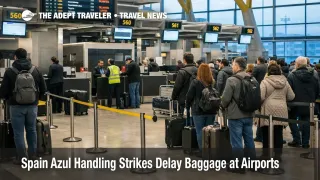
Azul Handling strike action at Spanish airports continues in predictable, recurring windows that can slow baggage, check in, and aircraft turnarounds even when flights still operate. The travelers most exposed are those flying on routes handled by Azul, commonly Ryanair group operations, plus anyone relying on quick bag drop, tight connections, or same day onward rail. For plans that cannot absorb delays, the practical next step is to avoid checking bags when possible, add connection and transfer buffer, and use airline change options before you are stuck in airport queues.
The Spain Azul Handling strikes matter because the repeated time blocks can reliably land on peak departure and arrival banks, which is when airports have the least slack to absorb slower ground handling.
Who Is Affected
The strike pattern is published as recurring walkouts on specific weekdays through December 31, 2025, with three daily time blocks that tend to coincide with morning departures, midday turns, and late evening arrivals. For the late December travel wave, that recurring cadence places elevated risk on Friday, December 26, Saturday, December 27, Sunday, December 28, and Wednesday, December 31, 2025, with the same three windows repeating on each of those strike days.
Operationally, the travelers most likely to feel friction are those who need staffed processes, including document checks at the counter, bag drop acceptance, oversize or special baggage handling, and gate or ramp steps that depend on full teams to keep a turn on schedule. Even when minimum service requirements keep much of the flying program moving, slower handling can still produce long lines landside, missed bag cutoffs, late pushbacks, and delayed baggage delivery on arrival.
The scope is not limited to a single terminal or a single city. Reporting and union notices have repeatedly tied the walkouts to Azul Handling work at major airports used by Ryanair group airlines, including Adolfo Suárez Madrid Barajas Airport (MAD), Josep Tarradellas Barcelona El Prat Airport (BCN), Málaga Costa del Sol Airport (AGP), Palma de Mallorca Airport (PMI), and Valencia Airport (VLC), among others. Travelers should also account for stacking risk in Madrid, where a separate ground handling strike schedule has been publicized for specific dates and time blocks that can overlap the same holiday period, which can concentrate disruption in the same airport ecosystem.
What Travelers Should Do
Start by removing single points of failure that depend on baggage timing. On strike days, carry on only is the cleanest risk reduction because it sidesteps bag drop, sortation, and loading, and it also protects you if baggage reclaim delivery slows on arrival. If you must check a bag, plan for longer lines, arrive earlier than you normally would for that airport, and treat the airline's bag drop cutoff as a hard stop rather than something you can negotiate at the counter.
Set decision thresholds before you travel, and act on them early. If your departure or arrival sits inside, or within about 60 to 90 minutes of, a published strike window, and your itinerary breaks with a delay of roughly one to two hours, it is rational to rebook to a non strike day or to a flight well outside the time blocks. The same logic applies if you have a protected connection that is short, or any separate ticket connection, especially when the onward leg is the last flight or last train of the day. For travelers routing through Madrid during the holiday period, compare your exposure to the additional Madrid handling strike blocks outlined in Madrid Airport Strike Dates, Barajas Dec 26 to Jan 7.
Over the next 24 to 72 hours, watch signals that predict whether your specific flight is likely to be messy. Monitor your airline app for schedule shifts that move you into a strike window, monitor airport and airline advisories about expected queues or baggage delivery delays, and watch for any carrier issued flexibility that allows fee free changes. If you see repeated early day delays building, assume the disruption will propagate into later rotations through aircraft and crew positioning, and protect any same day hotel check ins, tours, cruise embarkations, or rail departures with extra buffer or a backup plan.
How It Works
Ground handling strikes propagate differently than air traffic control constraints or weather, and that difference is why travelers can be caught off guard. The first order effect often hits the most staffing dependent touchpoints, check in desks, bag drop acceptance, ramp loading, pushback coordination, and baggage delivery on arrival. A flight can still depart, but it departs late because the aircraft turn runs long, or it departs on time while some checked bags miss the cutoff and arrive later, which creates a second trip interruption at baggage reclaim and claims desks.
The second order ripple spreads across at least two layers of the travel system. When departures push late, inbound aircraft arrive late to their next station, and that breaks subsequent turns, compresses boarding, and can create crew duty time pressure that forces equipment swaps or last minute cancellations later in the day. Separately, when baggage delivery stretches out, travelers miss fixed departure connections, especially high speed rail and pre booked transfers, and those missed links convert a delay into an unplanned hotel night, higher last minute ground transport pricing, and lost prepaid activities. During peak holiday load factors, the knock on effect is amplified because reaccommodation options are thinner, and displaced passengers compete for the same limited inventory across alternate flights, trains, and nearby hotels.
Sources
- UGT convoca huelga en el handling de Ryanair a partir del 15 de agosto - FeSMC - UGT
- Christmas travel chaos: All the European airport strikes to expect in December | Euronews
- Resolución de Servicios Mínimos, Huelga Azul Handling (MITRAMS)
- La huelga del servicio de tierra de la filial de Ryanair comienza en plena operación salida por el puente de agosto | RTVE
- Días de huelga en varias empresas de handling - Actualidad Aeroespacial