

Flight Delays and Airport Impacts: December 30, 2025
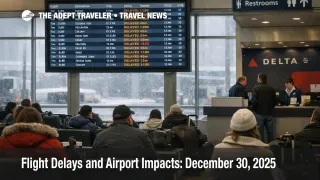
Airline networks across the United States remained connection fragile as the FAA tracked winter weather and capacity constraints that pushed delays into multiple hubs on December 30, 2025. Travelers connecting through Detroit Metropolitan Wayne County Airport (DTW) and other Great Lakes, Northeast, and Midwest gateways, plus those on separate tickets, face the highest misconnect risk. Check the FAA airport status page for your hubs, add buffer for same day connections, and set a firm cutoff for when to proactively rebook.
US flight delays December 30 matter because the day's constraints were not limited to one storm footprint, instead, metering, reroutes, and runway capacity limits can shift delay time to your origin airport and break tight itineraries.
FlightAware's snapshot at 11:47 a.m. ET showed 12,019 delays and 589 cancellations worldwide, including 2,481 delays and 321 cancellations tied to U.S. operations, a signal that recovery and day of travel reliability were still uneven across the network. Within the FAA's own status indicators, DTW stood out with a traffic management program and average arrival delays of 1 hour and 10 minutes tied to runway and taxi maintenance, the kind of capacity reduction that tends to amplify late inbound aircraft and compress afternoon connection windows. FAA planning notices and system advisories also continued to point travelers toward wind and winter conditions in key corridors, which can flip a mostly normal morning into a metered afternoon when arrival rates tighten.
Who Is Affected
Travelers with an itinerary that touches DTW are the most directly exposed today, especially anyone relying on a short domestic connection, a same day international departure, or a last flight of the night. When a hub is metering arrivals, the first order impact is straightforward, arrivals wait longer, gates stay occupied, and departures inherit late turns, but the second order impact is what surprises travelers, because the delay often appears as a controlled departure time at the origin airport instead of a visible weather problem at the destination.
Travelers moving through Northeast and Midwest hubs are also in the higher risk bucket even when individual airport pages show only minor baseline delays, because wind, runway configuration changes, and winter operations can reduce arrival acceptance rates quickly. That reduction propagates into missed connections, then into reaccommodation pressure, and then into hotel and ground transport constraints around hubs when same day recovery fails. For continuity with the broader holiday recovery pattern and the FAA's day to day traffic management posture, see Flight Delays and Airport Impacts: December 29, 2025 and Flight Delays and Airport Impacts: December 28, 2025.
What Travelers Should Do
Start with immediate actions and buffers. Before leaving for the airport, check your departure and connection airports on the FAA status pages, then assume you could see a gate hold even if your airline app looks fine. If your itinerary includes a tight connection through a constrained hub, move to an earlier departure, build a longer connection, or add an overnight buffer, because the day's backlog usually concentrates into the afternoon and evening banks.
Use clear decision thresholds for rebooking versus waiting. If a delay eliminates your connection buffer, if you are pushed onto the last flight of the day, or if your hub shows an active program with average delays that are already trending up, rebook early while inventory still exists. Waiting is only rational when you have multiple later protected options the same day and you can absorb a second delay after landing without breaking a hard deadline.
Over the next 24 to 72 hours, monitor whether today's hub programs persist into the next morning bank, because repeat constraints are when schedules become brittle and reaccommodation queues lengthen. Watch for expanding reroutes and flow constrained areas that indicate enroute metering, since those can delay you even when local weather is quiet. Keep an eye on runway and taxi maintenance notes at major hubs as well, because reduced surface capacity often turns small arrival delays into missed departure slots later in the day.
How It Works
The FAA's Air Traffic Control System Command Center manages national demand when airport or airspace capacity drops, using tools such as ground delay programs, ground stops, traffic management programs, reroutes, and flow constrained areas. The traveler visible effect is that your delay may show up before takeoff, because metering is designed to keep aircraft from stacking in airborne holding and to protect arrival rates at the constrained airport.
Disruption propagates through the travel system in layers. First order impacts appear at the constrained airport where arrival rates drop and gates stay occupied longer, which delays departures on late turns. Second order ripples spread through connections and crew flow because the same aircraft and crews rotate across multiple legs, so a metered hub arrival can degrade later departures in unrelated cities. A third layer shows up off the aircraft, where late arrivals collide with limited late night ground transport, rental car counter hours, and hotel inventory, which is why small average delays can still produce expensive overnight outcomes when they hit the wrong bank.
Sources
- FlightAware, Flight Cancellations and Delays
- FAA ATCSCC, Detroit Metropolitan Wayne County Airport (DTW) Real-time Status
- FAA ATCSCC, Chicago O'Hare International Airport (ORD) Real-time Status
- FAA ATCSCC, National Airport Status Summary (Text Only)
- FAA ATCSCC, Current Reroutes
- FAA ATCSCC, FAA Daily Air Traffic Report: Travel Notice