

Madrid Barajas Ground Handling Strike Delays Jan 7
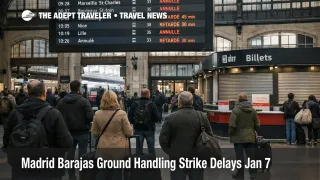
A ground handling labor action at Adolfo Suárez Madrid-Barajas Airport (MAD) is set to return on Wednesday, January 7, 2026, creating a higher risk of check in, baggage, and aircraft turnaround delays at Spain's biggest hub. Travelers flying on Iberia, Iberia Express, or Iberia Regional Air Nostrum to or from Madrid are the most directly exposed because the airline has warned that delays are possible even when flights operate. The practical move is to protect time sensitive itineraries now by shifting travel dates if eligible, padding connection buffers, and planning for slower checked bag flows around the stoppage windows.
The Madrid airport ground handling strike concentrates disruption into two partial stoppage blocks, which can still cascade into wider delays across the day as the operation tries to catch up.
Spain's transport ministry minimum service resolution for the handling company sets partial protections by flight category, which helps keep a baseline of operations moving but does not prevent lines, delayed departures, or late inbound aircraft from compounding into the evening bank. For travelers, the biggest difference versus a pure weather event is that the runway and airspace can be fine while the ground process, counters, bag rooms, and ramp activity become the constraint.
## Who Is Affected
Travelers departing Madrid are exposed first because check in, bag drop, and gate handling are the points where understaffed ground services show up as visible queues and slower processing. Passengers with checked bags, families traveling with strollers, and anyone needing special assistance should assume extra time for curb to gate movement, even if their flight status still shows on time early in the day.
Connecting travelers through Madrid are exposed second, and the risk is sharper on itineraries that depend on tight turn times between a short haul feeder and a long haul departure to Latin America, North America, or other long haul markets. When the first flight is late, the second flight may still depart on schedule, and that mismatch is how misconnects happen. If baggage transfer workflows slow at the same time, it is possible to make the flight but not the bag, which is especially painful on trips that continue beyond Madrid the same day.
Arriving passengers can also feel the strike in baggage reclaim, and then again on the curb if late arrivals push more people into the same pickup windows. If a flight arrives late enough, crew duty time limits can become a downstream constraint, and that can turn a delay into a cancellation late in the day, even if the original trigger was earlier ground handling friction.
What Travelers Should Do
If travel is optional on January 7, 2026, moving to a different day is usually the lowest risk play, especially for trips with cruises, tours, medical appointments, or long distance rail departures on the far end. If travel is not optional, treat the airport as the bottleneck, arrive earlier than normal, keep essentials in carry on, and avoid checking a bag when it is realistic to do so.
Rebooking versus waiting should be decided by connection tightness and ticket structure, not by the first delay alert you see. If you are on separate tickets, if your connection is under about two hours, or if a misconnect would strand you overnight, that is a threshold to rebook proactively to a later connection or a different routing while inventory still exists. If you are on one ticket with a longer connection and your plans can absorb a few hours of slip, waiting can be rational, but only if you can still make the day's last viable onward option.
Over the next 24 to 72 hours, monitor your specific flight number, your terminal, and any waiver language tied to Madrid, not generic strike headlines. Use Iberia's manage booking tools and flight status checker, confirm whether your ticket qualifies for changes, and make sure the airline has a working contact method for you so schedule changes do not land unseen.
How It Works
Ground handling is the set of services that turns an aircraft and processes passengers on the ground, including check in support, baggage acceptance and loading, ramp servicing, and coordination that keeps departures moving on schedule. When staffing drops in timed stoppage blocks, the system effect is not limited to those hours, because morning backlogs can push aircraft later into the day, and later arrivals can then collide with peak departure banks and airport curfews at other endpoints.
Spain's minimum service resolution for the handling strike at Madrid Barajas outlines how flight protections are set by category, with higher protection levels for flights that are harder to replace by other transport modes. The same document describes higher protections for domestic flights to or from non peninsular territories and a stronger protection share for international and longer domestic journeys than for shorter peninsular domestic routes, which means short haul shuttles are often where cancellations or consolidations become the pressure valve. Even with protections, travelers can still see long lines and irregular operations because minimum services are designed to preserve essential connectivity, not to maintain normal throughput.
In practical travel terms, the disruption propagates from counters and ramps into aircraft positioning and crew flow. If an inbound aircraft arrives late, the outbound departure can miss its slot or its passenger boarding window, which then pressures connections downstream. When those connections fail, travelers often shift to later flights, which raises load factors, reduces reaccommodation options, and increases the odds of unplanned hotel nights around the hub. Travelers who are also navigating Madrid surface access disruptions should factor that city side risk into transfer timing as well, since getting to the terminal late removes most of the remaining control a traveler has once lines build. Related context is available in Madrid Protest Blocks Serrano Transfers Jan 4-5 and Italy Transport Strike Hits Flights, Trains January 9-10.