

Milan Transit Strike Hits Airport Links Jan 15
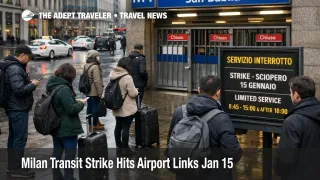
A 24 hour public transport strike in Milan, Italy is disrupting ATM operations on January 15, 2026, putting same day airport transfers at higher risk of delays and missed departures. Travelers moving between the city and Milan Linate Airport (LIN) are among the most exposed because common transfer options rely on the ATM metro network and surface routes that can thin out quickly when staffing drops. The practical move is to treat every transfer as time sensitive, leave earlier than you normally would, and line up a road based backup before peak queues form.
The Milan transit strike airport links disruption matters because ATM has published non guaranteed windows when service may be suspended or reduced. ATM says service may not be guaranteed from 845 a.m. to 300 p.m. and after 6:00 p.m., Milan local time, with service more likely to run outside those windows. Even when trains and trams are technically running, headways can stretch, and the most reliable pattern is often early service, followed by uneven coverage once the strike window begins.
Who Is Affected
Visitors staying anywhere that depends on ATM metro, tram, bus, or trolleybus service should plan for uneven mobility across the city, not just isolated line delays. Travelers with morning departures after 845 a.m. are at higher risk because a late start can trap you in a shrinking pool of transfer options, especially if you are also carrying bags or traveling as a group. Late afternoon and evening travelers face a second pinch point after 600 p.m., when a "wait and see" approach can backfire as queues build and roads slow.
Airport bound passengers are the clearest pain point. Milan Linate Airport (LIN) is linked to the city by the M4 metro line, and that connection is frequently the fastest option when it is running normally. On a strike day, that same dependency becomes a single point of failure, because if you arrive at a station during a non guaranteed window, you may have to switch to road transport under worsening traffic conditions. Travelers rerouting to Milan Malpensa Airport (MXP) or Milan Bergamo Airport (BGY) as a contingency should also expect secondary friction, because you are competing for the same taxis, rideshares, and private shuttles as other stranded riders.
Hotel check ins and day tours also get dragged into the disruption. When guests arrive late, hotels see stacked check in demand and fewer staff hours per guest interaction, and tour departures can become no shows that ripple into later day rebooking and refunds. Rail travelers departing from hubs such as Milano Centrale and Milano Porta Garibaldi can miss seat reservations if they arrive after the boarding window, which then cascades into later trains that may already be full.
What Travelers Should Do
If you must travel during the non guaranteed windows, choose a primary route and a backup route now, not when you are already at the platform. For Milan Linate Airport (LIN), check whether the M4 is running before you leave your hotel, and be ready to pivot to a pre booked car, a licensed taxi from an official stand, or a dedicated airport coach option if you see gaps forming. Add extra buffer for bag drop and security, because late arrivals tend to bunch at the same counters.
Set decision thresholds based on how much lateness your trip can absorb. If you are inside a two hour window to scheduled departure, and you still have not cleared the city center, treat that as a red flag to switch to the fastest road option you can secure, even if it costs more. If your transfer time is already slipping and you are on a non refundable or tight connection itinerary, moving the flight to later in the day or to January 16, 2026 can be the cheaper outcome compared with a missed flight and last minute rebooking.
Over the next 24 to 72 hours, monitor two things, ATM service updates and road congestion around the hubs you need. Strike days can evolve as participation rates become clear, so a line that looks stable at 7:30 a.m. can become unreliable by mid morning. If you have plans on January 16, 2026 that depend on a late night arrival, watch whether the evening window produces a spike in hotel check in delays and consider adjusting tour meet times or rail departures to avoid domino effects.
Background
ATM runs Milan's metro, tram, and bus network, and on strike days it typically publishes "guarantee" periods when service is more likely to operate, with reduced reliability outside those windows. For January 15, 2026, ATM's notice says service may not be guaranteed from 845 a.m. to 300 p.m. and after 6:00 p.m., Milan local time. The first order impact is simple, fewer trains and fewer surface vehicles when you most need them. The second order ripple is what tends to strand travelers, airport transfer demand shifts from rail to road, taxis and rideshares surge, and congestion worsens as more people choose private cars, which then slows buses and shuttles that are still trying to run. As transfers slip, late arrivals push stress into other layers of the travel system, including missed flight cutoffs, late hotel arrivals, and missed rail departures that are harder to reaccommodate when demand concentrates into a narrower set of departure times.
For Milan Linate Airport (LIN), the M4 metro link is normally a fast, predictable option, and the airport itself promotes it as a primary connection. When a strike affects the metro, the city loses that high capacity pipeline, and travelers are forced onto roads that may already be congested by commuters making the same choice. For travelers who decide to change airports, Milan Malpensa Airport (MXP) has a dedicated rail option via Malpensa Express, while Milan Bergamo Airport (BGY) typically relies on coach links from the city, meaning the contingency choice you make changes which bottleneck you will face.