

Verona ENAV Strike May Delay VRN Flights Jan 31
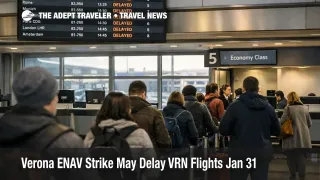
A scheduled four hour labor action involving ENAV personnel is listed for Verona Valerio Catullo Airport (VRN) in Villafranca di Verona, Italy. Air travelers are the most affected group, especially anyone departing in the afternoon, or arriving on an inbound aircraft that must turn and depart again. The practical move is to choose flight times outside the published window when possible, add buffer time if you must fly that day, and be ready to rebook before airport lines and call centers build.
The Verona ENAV strike Jan 31 risk matters because air traffic control, ATC, constraints can slow the pace of arrivals and departures, even when airlines still intend to operate the schedule.
The strike listing for Verona is time boxed from 100 p.m. to 500 p.m. CET on Saturday, January 31, 2026. When tower or approach capacity is reduced, the first order symptom is airborne holding or spacing on arrivals, plus departure metering that lengthens taxi out and creates a queue at the runway. Even a short capacity cut can have outsized effects if it lands on a dense bank of departures, because the backlog takes time to unwind after the window ends.
Italy's minimum service regime also shapes what you see in practice. ENAC notes protected time bands, typically 700 a.m. to 1000 a.m. and 600 p.m. to 900 p.m. local time, when flights should be operated during strike days. That does not guarantee every itinerary, but it does mean airlines often try to protect those bands, which can make mid day timing feel more fragile than the calendar window alone suggests.
Who Is Affected
The first group is travelers with flights scheduled to depart Verona in the 100 p.m. to 500 p.m. CET window. Departures in this band are most exposed to ATC flow limits, because the airport has less room to "work around" constraints when multiple flights want the runway at once.
The second group is anyone arriving into Verona during the same period, including travelers who are not ending their day in Verona. If your inbound arrival is delayed, the ripple is not only a late gate arrival, it can also break onward ground transfers such as prebooked shuttles, timed tours, and hotel check in plans that assume a normal arrival margin.
The third group is travelers flying on aircraft rotations that touch Verona earlier in the day. A flight that departs outside the strike window can still be impacted if the inbound aircraft is late, because the schedule relies on the airplane and crew being in position on time. That is how a local ATC constraint becomes a broader reliability problem, it pushes small delays into later departures, compresses recovery margin, and increases the odds that the last flights of the day run out of slack.
For related Italy disruption context, see Italy Airport Strike Disrupts Flights January 9, 2026 and Landing System Outage at Milan Bergamo Delays BGY Flights.
What Travelers Should Do
If you have flexibility, move your Verona travel away from Saturday, January 31, 2026, or shift to an early morning departure that clears before the 1:00 p.m. CET start. If you must fly that day, treat every downstream commitment as if it starts later than planned, especially ground transfers, tours with hard start times, and same day check ins that charge for late arrival.
Use a clear decision threshold for rebooking versus waiting. If a delay of two to four hours would cause an overnight, strand you after the last practical connection, or break a cruise, tour, or event start, rebook now to a flight outside the afternoon window, or to a different day, rather than betting on day of recovery when seats and phone support tighten.
Over the final 24 to 72 hours, monitor your airline app for schedule retimes and waiver language, and watch for push notifications that your flight is being held for ATC restrictions. Also keep an eye on whether your inbound aircraft is running late earlier in the day, because that is often the earliest warning that your flight will depart behind schedule even if the strike window is short.
How It Works
ENAV is Italy's air navigation service provider, and it manages air traffic services that can directly constrain how many aircraft can safely arrive or depart in a given time slice. When staffing or work rules reduce available capacity, ATC typically protects safety by spacing aircraft farther apart, slowing arrival rates, and metering departures so the system does not overload.
That first order slowdown propagates through at least two other layers of the travel system. The network layer takes the hit when delayed arrivals arrive after their planned turnaround window, causing later departures to leave late, which then pushes delays into the evening. The crew and recovery layer takes the next hit because duty time limits and missed aircraft positioning reduce an airline's ability to "fix the day" with swaps, spare aircraft, or tight retimes, especially on thinner schedules. On the traveler side, the knock on effects show up as missed ground transfers, higher last minute hotel demand near the airport, and fewer same day rebooking options once the evening wave is already full.
For a deeper explainer on how ATC constraints ripple through schedules and recovery, see U.S. Air Traffic Control Privatization: Reality Check.