

Milan Rail Strike Hits Malpensa Express Feb 2, 2026
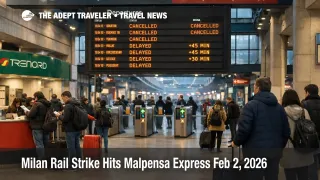
A one day regional rail strike in Lombardy is disrupting service in and around Milan, Italy, including Milan rail strike Malpensa Express airport links used by flyers and Olympics travelers. Commuters, flight passengers, and event visitors using Trenord regional and suburban lines, plus airport trains to Milan Malpensa Airport (MXP), are the most affected. If you have a flight or a fixed event arrival today, plan around the guaranteed service windows, assume last mile road congestion, and keep a paid backup transfer option ready.
The Milan rail strike Malpensa Express disruption matters because it reduces the reliability of the most time sensitive transfer in the region, the airport rail handoff, forcing many travelers to shift to buses, taxis, or earlier departures to protect flights and event start times.
Trenord says the strike window runs from 300 a.m. Monday, February 2, 2026, to 200 a.m. Tuesday, February 3, 2026 (Central European Time), with guaranteed train service during two bands, 600 a.m. to 900 a.m., and 600 p.m. to 900 p.m. Outside those windows, you should treat the published timetable as aspirational until you see the train operating in real time.
For airport travelers, the risk is not only the direct airport train. A canceled feeder line into Milano Centrale or Milano Cadorna can prevent you from reaching any operating Malpensa departure, even if some airport trains still run. That is why the strike tends to create sudden crowding at the few trains that do operate, followed by long gaps that push people toward road transfers at the same time.
A practical change versus advance warning is that Trenord and Malpensa Express guidance now points travelers to specific mitigation, including non stop replacement buses for some airport corridors if trains are suppressed. Trenord's public notice states that if airport trains are canceled, replacement buses can be activated between Milano Cadorna and Malpensa for the RE54 corridor, and between Stabio and Malpensa for the S50 cross border airport link.
For context on the planned setup, and how today's disruption departs from it, see Lombardy Rail Strike Hits Malpensa Express Feb 2.
Who Is Affected
Travelers heading to Milan Malpensa Airport (MXP) are the most time constrained group, especially anyone relying on Malpensa Express style airport trains that connect the city's main rail nodes to Terminal 1 and Terminal 2. Trenord's Olympics period planning highlights how central these links are during February, with more frequent airport connections and extended operating hours intended to move visitors, staff, and media around the region, which increases the downside when a strike pushes demand back onto roads.
Regional commuters across Lombardy are also exposed, including riders coming from nearby cities and suburbs who normally funnel into Milan's stations for onward trains, airport departures, or pre booked shuttles. Reuters reporting on the live strike also flags disruption on commuter and airport services, and notes that Games logistics are already tight because venues are spread across multiple clusters, including mountain areas without direct rail access.
Event week travelers, including Olympics spectators and accredited groups, face a second layer of risk because a rail gap does not just delay arrival, it can break a sequence, airport to city, city to hotel check in, hotel to shuttle pickup, or city to mountain corridor transfer. When one link slips, the remaining options often require same day rebooking onto limited capacity buses or private transfers, where availability and pricing can change fast.
What Travelers Should Do
If you are flying today, build your plan around the guaranteed windows, and then add a road backup. Check Trenord's real time status before you leave lodging, and if you are connecting to the airport by rail, aim to arrive at the airport at least 60 to 90 minutes earlier than your normal pattern for the same flight, because queues, ticketing friction, and platform crowding tend to rise when frequency drops.
Rebook versus wait based on hard penalties. If a missed train could force a flight change fee, an airline no show, a missed event entry slot, or a same day hotel penalty, treat that as the threshold to switch now to an earlier departure or a road transfer, even if it costs more up front. If your schedule can absorb a delay of a few hours and you are traveling on a single flexible ticket chain, you can wait, but only if you have already priced a taxi, a car service, or a coach alternative, and you are willing to trigger it quickly when cancellations cluster.
Over the next 24 to 72 hours, monitor three signals that predict whether the disruption persists into tomorrow morning travel. First, watch whether late evening services resume smoothly as the strike approaches its end time. Second, watch for bunching at Milan hubs, because crowding can carry into early Tuesday even after formal strike hours. Third, if you are traveling for the Games, track organizer shuttle advisories and airport ground transport notices, since organizers have already used shuttle buses as a mitigation lever when rail service is disrupted.
How It Works
Italian regional rail strikes often create a patchwork operating day rather than a complete shutdown. Trenord's notice for this action sets two guaranteed service bands, 600 a.m. to 900 a.m., and 600 p.m. to 900 p.m., which are meant to preserve limited mobility during the busiest commuter periods. In practice, that usually means you get islands of reliability surrounded by long gaps, and those gaps push travelers to converge on fewer departures, increasing dwell times, platform congestion, and the chance that a minor delay becomes a missed connection.
Airport rail is a special case because the traveler penalty for being late is higher, and because the airport train is often only one segment of a longer chain. Trenord and Malpensa Express guidance indicates that when airport trains are canceled, non stop replacement buses may be used to preserve continuity between Milano Cadorna and Malpensa for the RE54 corridor, and between Stabio and Malpensa for the S50 link. That mitigation shifts the problem from rail cancellation to road time uncertainty, and during a strike day that uncertainty grows because more passengers make the same pivot at the same time, competing for taxis, private transfers, and road space.
The Olympics overlay amplifies second order ripples. Trenord has positioned itself as a mobility partner for the Games and has published expanded service concepts for February, including increased connections and longer operating hours, which signals that planners expect the rail network to carry a meaningful share of visitor movement. When a strike interrupts that expectation, travelers and organizers substitute to shuttles and road transfers, which can push delays into hotel check in waves, scheduled venue shuttles, and even flight departure peaks when passengers arrive in larger, later clusters.