

Puerto Vallarta Violence Disrupts Flights Feb 22
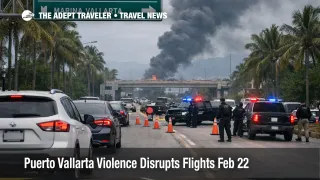
Violence and roadblocks across Jalisco, Mexico disrupted travel in Puerto Vallarta, Mexico on February 22, 2026 after a major federal security operation targeted the leadership of the Jalisco New Generation Cartel. Travelers were affected first by ground movement constraints, including blocked roads and suspended local transport, then by flight cancellations and temporary pauses in airline operations as conditions evolved around the airport corridor. The practical move right now is to treat mobility as the risk, stay inside your hotel or resort if you are in the affected area, and shift any same day travel until official alerts and airline operations stabilize.
The change that matters for trip planning is straightforward. Puerto Vallarta violence flights disruptions are less about the runway and more about whether you can safely and predictably get to Licenciado Gustavo Díaz Ordaz International Airport (PVR) or move between neighborhoods, resorts, and meet points without getting trapped by a sudden road closure.
Who Is Affected
Travelers currently in Puerto Vallarta are the most exposed, especially anyone with a same day departure, an airport transfer booked on a tight timeline, or an itinerary that depends on moving through the main north to south corridors. When roadblocks are built with disabled or burning vehicles, normal detours can collapse fast, because the city has a limited number of high capacity routes that also carry local traffic, supplies, and emergency response.
Arriving passengers are also affected, because a flight that lands does not guarantee a usable onward path to a resort, a rental car pickup, or a prebooked transfer. If taxi and rideshare service is suspended, or if drivers refuse cross town runs, the last mile becomes a bottleneck, and travelers can get stranded at the terminal or in the wrong part of town for their lodging.
Outbound travelers connecting onward, including those returning to the United States or Canada, face a second layer of risk. Airlines may cancel, divert, or delay flights based on their own safety assessments, crew movement constraints, and the availability of ground handling staff. Reuters and other outlets reported temporary pauses and cancellations by carriers serving Puerto Vallarta as the situation unfolded. If you are on separate tickets or have a tight connection later in the day, assume misconnect risk is high until operations normalize.
What Travelers Should Do
If you are in Puerto Vallarta or elsewhere in Jalisco under an active security alert, follow the shelter in place guidance and do not try to outsmart the map. Roadblocks are not a normal traffic jam, they are a security event with unpredictable spillover, and moving at the wrong moment can trap you between closures with no safe exit. Confirm your status with your hotel front desk, monitor official alerts from the U.S. Embassy and the Government of Canada, and keep your phone charged with a backup battery if you have one.
For flights, use a simple decision threshold. If your flight is within the next 12 hours and you cannot confirm that airport access routes are open and transport is operating normally, treat rebooking as the default rather than gambling on a last minute sprint. If your airline offers a waiver, use it early, because the best alternate seats disappear fast once cancellations begin. If your flight is more than 24 hours out, you can usually wait for clearer signals, but only if you can stay put safely and your lodging situation is stable.
Over the next 24 to 72 hours, watch three indicators, not rumors. First, whether shelter guidance is lifted or narrowed. Second, whether taxi, rideshare, and private transfer providers are operating consistently again. Third, whether airlines have resumed normal schedules to PVR without rolling day of cancellations. For ground movement context inside Puerto Vallarta, recent disruption patterns show how quickly a single corridor problem can break airport runs and cruise timing, including Puerto Vallarta Protest Blocks Routes To PVR Airport and Protest Roadblocks Puerto Vallarta Cruise Access Jan 31. For broader destination planning and neighborhood orientation once the situation stabilizes, see Puerto Vallarta, Mexico - Travel News and Guides from The Adept Traveler.
Background
This kind of disruption spreads through the travel system in layers, and the first layer is always mobility. When a security operation triggers retaliatory violence, the immediate effect is that authorities and criminals both contest the same roads, which forces closures, detours, and a rapid collapse in reliable ground transport. That quickly turns airport access into the real constraint, because airports can remain operational while passengers and staff cannot move safely to and from the terminal.
The second layer is airline network recovery. If a carrier cancels a rotation into Puerto Vallarta, the aircraft and crew that were supposed to be there are now out of position, which can ripple into later flights on other routes. Even travelers not headed to Jalisco can feel effects through missed inbound aircraft, crew legality limits, and reaccommodation backlogs that prioritize higher frequency hubs. The third layer hits hotels, tours, and cruise operations, because stranded travelers extend stays, day trips are canceled, and providers lose the ability to guarantee pickups or meet times when roads are unstable. In plain terms, what looks like a local security event becomes a scheduling and capacity problem across flights, rooms, and transfers until movement corridors are predictably open again.
Sources
- Security Alert -Ongoing Security Operations
- Travel advice and advisories for Mexico
- Mexican cartel boss 'El Mencho' killed in military raid
- Air Canada, United Airlines halt flights to Mexico's Puerto Vallarta
- Mexican army kills leader of powerful Jalisco New Generation Cartel during operation to capture him